
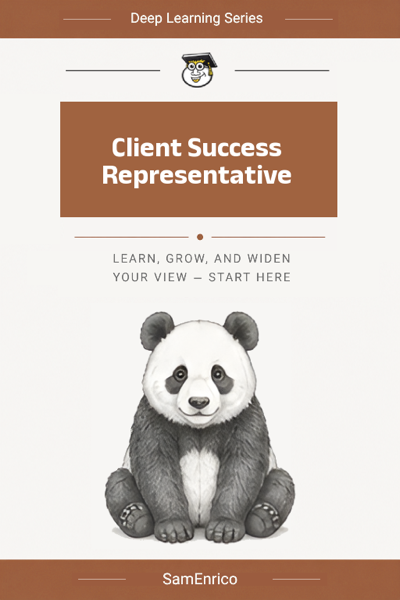
Client Success Representative eBook
A Coursebook on Client Success Representative
by Lujan Aja
A Coursebook on Client Success Representative
Formats
Free sample
Chapter 1: The $1.6 Trillion Blind Spot--The average software company burns 1.6millionannuallyonchurnthatcouldhavebeenpredicted,prevented,oratleastunderstood.Thatisnotatypo.Acrossthe Saa Sindustryalone,thetotalcostofpreventablechurnexceeds1.6 million annually on churn that could have been predicted, prevented, or at least understood. That is not a typo. Across the Saa S industry alone, the total cost of preventable churn exceeds 1.6millionannuallyonchurnthatcouldhavebeenpredicted,prevented,oratleastunderstood.Thatisnotatypo.Acrossthe Saa Sindustryalone,thetotalcostofpreventablechurnexceeds1.6 trillion annually. And yet, most companies continue to treat client retention as an afterthought—something to worry about when a cancellation notice arrives, not something to design for from the very first interaction.This book exists because that $1.6 trillion blind spot represents the single greatest opportunity in modern business. Not artificial intelligence.
Not automation. Not the next growth hack. The greatest opportunity is keeping the clients you already have.If you are reading this, you are likely a Client Success Representative—or you aspire to become one. Perhaps you already have the title on your business card. Perhaps you have been given a portfolio of fifty, a hundred, or even two hundred clients and told to "make them successful." Perhaps you have noticed that your training consisted of a hurried walkthrough of the product and a shared Google Doc titled "CSR Onboarding." You are not alone.
The vast majority of Client Success Representatives enter the field with minimal preparation and are expected to learn through trial by fire.This book is the fire extinguisher.Over the next twelve chapters, you will learn not just the tactics of client success but the systems, mindsets, and frameworks that separate the burned-out ticket-closers from the strategic retention experts. You will learn why the old model of customer service—waiting for problems and then fixing them—is a slow path to bankruptcy. You will learn how to predict churn before your client even knows they are considering leaving. And you will learn how to transform your role from a cost center into the most strategically valuable function in your company.But first, you must understand what you are actually being paid to do.The Great Misunderstanding Most people outside of the Client Success profession—and, alarmingly, many people inside it—believe that a Client Success Representative is just customer support with a fancier title. They imagine someone answering tickets, resetting passwords, and apologizing for bugs.
They imagine a reactive role, a necessary cost of doing business, a position that exists because clients inevitably have problems.This understanding is not merely incomplete. It is dangerously wrong.Client Success and Customer Support are not the same thing. They are not even close. They operate on different time horizons, different metrics, different skill sets, and different economic logics.Customer Support is reactive. A client encounters a problem—the software crashed, they cannot log in, a feature is not working as expected—and they reach out for help.
The support agent responds, solves the problem, and closes the ticket. The cycle repeats. Support is measured by speed: time to first response, time to resolution, number of tickets closed. Support exists to return the client to a neutral state, to fix what is broken so the client can get back to work.Client Success is proactive. The Client Success Representative does not wait for problems to appear.
They anticipate them, prevent them, or mitigate them before the client even knows a risk existed. They monitor usage patterns to identify clients who are drifting toward disengagement. They conduct business reviews to demonstrate value before the client starts wondering if they are getting their money's worth. They build relationships not because relationships are nice, but because a client who trusts their CSR is 63 percent less likely to churn when something goes wrong.Here is the distinction in the simplest possible terms: Customer Support fixes technical problems. Client Success fixes business problems.When a client cannot log in, that is a technical problem.
Support handles it. When a client has not logged in for three weeks and is quietly wondering whether your product is worth the renewal price, that is a business problem. That is your problem.The Subscription Economy Changes Everything To understand why Client Success has become a strategic imperative, you need to understand the fundamental shift in how businesses make money.In the old economy—the transactional economy—companies sold products. You walked into a store, handed over cash, and walked out with a widget. The relationship ended at the cash register.
If the widget broke, you might call customer service. If it worked well, you might buy another widget someday. But the company's revenue did not depend on your ongoing satisfaction. They already had your money.In the new economy—the subscription economy—companies sell access. You do not buy the software; you subscribe to it.
You do not purchase the service; you pay a recurring fee for ongoing value. If you stop paying, your access stops. The company's revenue depends entirely on your continued willingness to write a check every month, every quarter, or every year.This shift changes everything about the economics of client relationships.In a transactional business, the most important metric is customer acquisition cost—how much money you must spend to convince someone to buy your product. In a subscription business, the most important metric is churn—how many clients you lose each period. A transactional business can survive high churn if acquisition is cheap.
A subscription business dies from high churn, regardless of how cheaply it acquires clients.Here is the math that keeps Saa S founders awake at night.Imagine a company that acquires one hundred new clients per month at an average contract value of 1,000peryear.Ifthatcompanyhaszeropercentchurn,aftertwelvemonthstheyhave1,200clientsgenerating1,000 per year. If that company has zero percent churn, after twelve months they have 1,200 clients generating 1,000peryear.Ifthatcompanyhaszeropercentchurn,aftertwelvemonthstheyhave1,200clientsgenerating1.2 million in annual recurring revenue. If that company has five percent monthly churn, after twelve months they have effectively zero net growth. They are acquiring clients as fast as they are losing them. If that company has ten percent monthly churn, they are shrinking despite acquiring one hundred new clients every month.This is the leaky bucket problem.
You can pour new clients into the top of the bucket as fast as you want, but if the bottom has holes, the bucket never fills.Now consider the profitability math. According to research by Frederick Reichheld of Bain & Company, increasing client retention by just five percent increases profits by twenty-five to ninety-five percent. The range is wide because different industries have different margins, but the direction is unambiguous: retention is massively more profitable than acquisition.Why? Because the cost of acquiring a new client is five to twenty-five times higher than the cost of retaining an existing one. New clients require marketing spend, sales commissions, onboarding resources, and often discounted pricing.
Existing clients require ongoing value demonstration—which is far cheaper—and are far more likely to buy additional products or services.A client who stays for three years is not worth three times as much as a client who stays for one year. They are worth exponentially more, because the acquisition cost is amortized over three years instead of one, and because their likelihood of expansion increases with tenure.What You Are Actually Being Paid To Do Let…
This is the end of the free sample. Get the eBook to keep going. Buy now
About this book
Details
- Author
- Lujan Aja
- Publisher
- SamEnrico
- Language
- English
- Genre
- Non-Fiction, Informative, Educational
- Released
- 2026-05-04
- Pages (approx.)
- 139
- Available as
- eBook, Audiobook

Read better in the ZLOADR app
Your eBooks on your phone or tablet. Sign in with your SamEnrico account and start reading.
More by Lujan Aja
 Sales Innovation HandbookLujan Aja$11.99
 Imposter Syndrome Anger GuideLujan Aja$11.99
 Written Commitment InfluenceLujan Aja$11.99
 Neuroplasticity for Addiction HealingLujan Aja$11.99
 The Mexico CV and Resume GuideLujan Aja$11.99
 The Last Whisper of the Nightingale: The Forgotten Song of the Balkan WitchesLujan Aja$11.99
 How to Start a Cigarettes (retail) Business (Beginners Guide)Lujan Aja$11.99
 African Ecommerce YC GuideLujan Aja$12.99
 Franchise Quality Control AbroadLujan Aja$12.99