
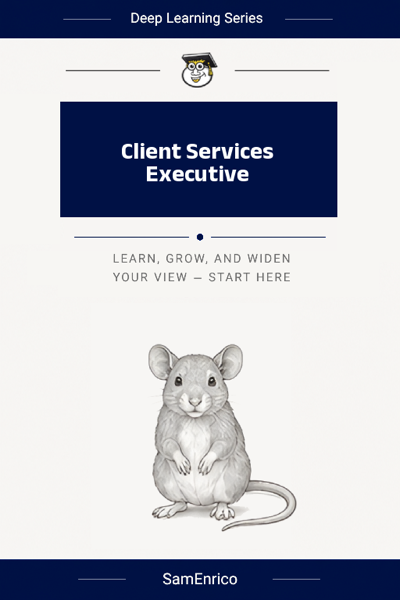
Non-FictionInformativeEducational
Client Services Executive eBook
A Coursebook on Client Services Executive
A Coursebook on Client Services Executive
Formats
Free sample
Chapter 1: The Order-Taker’s Funeral--–- The first time I watched a Client Services Executive get fired, it wasn’t because she was incompetent. It was because she was invisible. She had done everything asked of her. Every email answered within twenty minutes. Every meeting booked.
Every report formatted perfectly. And when the client decided to take their million-dollar contract to a competitor, no one at the agency could explain why. The client’s feedback was brutal but simple: “You gave us exactly what we asked for. That was the problem.”This chapter is called “The Order-Taker’s Funeral” because that is where most account managers, client partners, and service executives are headed if they continue to believe that client service means doing what they are told. The funeral is quiet.
No one speaks badly of you. They simply stop calling. They stop renewing. They stop referring. And one day, you look up and realize that while you were busy being efficient, you were never actually essential.The premise of this entire book rests on a single, uncomfortable truth: Being an order-taker is a fast path to irrelevance.
The market does not reward compliance. It rewards contribution. The Client Services Executive (CSE) who merely transmits requests from the client to the internal team and then transmits answers back is a middleman in an economy that is systematically eliminating middlemen. Artificial intelligence can write conference reports. Project management software can track deadlines.
Chatbots can answer status questions. What AI cannot do is build trust, interpret unspoken needs, or navigate the complex politics of a client’s organization.This chapter redefines the role entirely. It dismantles the reactive, task-based definition of an “Account Manager” and replaces it with a strategic, outcome-obsessed identity: the CSE as the architect of the client’s experience and the guardian of the company’s revenue. By the end of this chapter, you will understand why the 130% Rule (introduced here as a philosophy, with tactical implementation in Chapter 6) is the difference between a vendor and a partner. You will see why service cannot be delegated to a department—it must be embedded in every interaction.
And you will be forced to ask yourself the question that separates the order-takers from the executives: Am I solving problems, or am I just moving information?The Collapse of the Order-Taker Model Let us begin with a diagnosis. The traditional model of client service, still taught in many corporate training programs, is fundamentally reactive. The client has a need. The CSE writes it down. The CSE gives it to operations.
Operations produces something. The CSE gives it back to the client. The client asks for changes. The CSE relays the changes. This cycle repeats until everyone is exhausted or the contract ends.This model is seductive because it feels productive.
Your inbox is full. Your calendar is booked. You are always responding. But responding is not leading. And in a world where clients have more choices than ever, responsiveness without strategic value is a commodity.
Commodities compete on price. Price competition erodes margins. Margin erosion kills careers.Consider the data. According to a study of B2B professional services firms cited in The Art of Client Service, nearly sixty percent of client turnover is not caused by poor output quality. It is caused by perceived indifference.
The client did not feel understood. The client did not feel anticipated. The client felt like one of many. The order-taker, by definition, treats every client the same way: receive input, process input, return output. There is no room for differentiation because there is no room for judgment.The order-taker’s funeral happens slowly.
First, the client stops inviting you to strategy meetings. Then, they start copying your boss on routine emails. Then, they ask for a “cost review.” Then, they are gone. And the post-mortem meeting is excruciating because no one can point to a single catastrophic failure. There was no missed deadline.
No budget blowout. No angry email. There was simply a slow realization that you added no value beyond what a well-designed workflow could provide.This book is written for the CSE who refuses to attend their own funeral. It is written for the person who looks at the order-taker model and recognizes it as a trap. The alternative—the strategic partnership model—requires more courage, more judgment, and more emotional labor.
But it also produces longer contracts, higher margins, and the kind of professional satisfaction that comes from being genuinely indispensable.Redefining the Client Services Executive If the order-taker is dead, what rises in its place? The answer is the Client Services Executive as Strategic Hub. This is not a title change. It is a fundamental reorientation of power, responsibility, and identity.A strategic hub is not a bottleneck. A strategic hub is a center of gravity.
Every piece of information, every client request, every internal capability flows through the CSE, but the CSE does not merely pass things along. The CSE interprets, prioritizes, challenges, and transforms. When the client asks for a feature, the strategic CSE asks why. When the internal team says something is impossible, the strategic CSE asks what would make it possible. When the budget is tight, the strategic CSE asks what success actually looks like and helps the client trade off features against outcomes.This reframing has three concrete implications.First, the CSE owns the relationship, not just the contract.
The contract is a legal document. The relationship is a living system of trust, expectations, and emotional residue. The order-taker manages the contract. The strategic CSE manages the relationship by constantly testing assumptions, surfacing hidden concerns, and building what psychologists call “affective trust”—the kind of trust that comes from believing the other person genuinely cares about your success.Second, the CSE owns the profit margin. This is uncomfortable for many client service professionals who were trained to be “nice.” But the reality is that every concession, every scope creep, every unbilled hour erodes the financial health of the company.
The strategic CSE does not say no reflexively. But they do say no strategically. They protect margins by framing trade-offs clearly: “If we add that feature, we will need to remove this one or extend the timeline. Which do you prefer?” This is not adversarial. It is transparent.
And it preserves the financial viability of the partnership.Third, the CSE owns the outcome. Not the output. Outputs are deliverables—reports, campaigns, software features. Outcomes are business results—revenue growth, cost reduction, market share. The order-taker focuses on outputs: “We delivered the report on time.” The strategic CSE focuses on outcomes: “The report helped you identify three new revenue opportunities worth two million dollars.” This shift changes everything about how you prioritize, how you communicate, and how your client perceives your value.The case study that opens this book’s internal training—and that will be referenced throughout—involves a CSE named Sarah.
Sarah managed a large retail client for a digital agency. The client asked for a new e-commerce feature. The order-taker would have written the request and handed it to engineering. Sarah asked why. It turned out the client was losing sales because of a confusing…
This is the end of the free sample. Get the eBook to keep going. Buy now
About this book
Details
- Author
- Furman Fletcher
- Publisher
- SamEnrico
- Language
- English
- Genre
- Non-Fiction, Informative, Educational
- Released
- 2026-06-02
- Pages (approx.)
- 146
- Available as
- eBook, Audiobook

Read better in the ZLOADR app
Your eBooks on your phone or tablet. Sign in with your SamEnrico account and start reading.
More by Furman Fletcher
 Poverty Survival HandbookFurman Fletcher$11.99
 Assertive Communication for EntrepreneursFurman Fletcher$11.99
 Imposter Syndrome In RetirementFurman Fletcher$11.99
 Static Stretching Cool Down GuideFurman Fletcher$11.99
 The Mindfulness Bingo ChallengeFurman Fletcher$11.99
 MLA Citation Rules DemystifiedFurman Fletcher$12.99
 Block SWOT Library GuideFurman Fletcher$12.99
 How to Start a Musical Box Business (Beginners Guide)Furman Fletcher$11.99
You may also like
 Hong Kong Handover 1997Dunn Johnnie$11.99
 Zumba For Postnatal Recovery CourseNeal Christian$11.99
 Zumba for BeginnersLadner Nikia$11.99
 YouTube Comment Mining GuideHumes Pandora$12.99
 Worry Box MeditationCarlin Rudy$11.99
 Workplace Stress MeditationNguyen Lynn$11.99
 Workplace Stress and Sleep RepairHawley Ivory$11.99
 Workplace Perfectionism CureDelaney Jeffry$11.99
 Workplace Injustice Anger GuideWallen Isabelle$11.99
 Work Addiction and Burnout LinkGreenwood Ester$11.99
 Women in Yoga and WellnessBeattie Galina$11.99
 Women in Stand Up ComedyChun Evangeline$11.99