
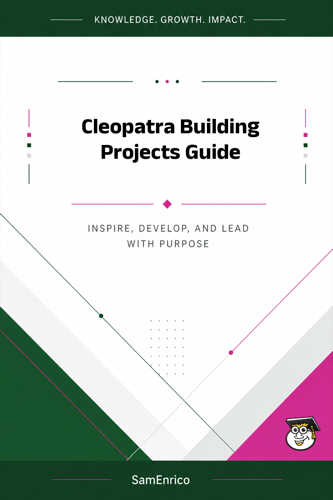
Cleopatra Building Projects Guide
Commission temples and palaces using the pharaoh's
Commission temples and palaces using the pharaoh's architectural propaganda program.
Formats
About this book
Free sample
Chapter 1: The Exiled Builder--–- The year is 48 BCE. Cleopatra Thea Philopator, seventh of her name, twenty-one years old, stands on the shores of the Mediterranean with the salt wind whipping through her hair and the ashes of her throne behind her. Her brother Ptolemy XIII has driven her from Alexandria with an army at his back and the backing of the Roman Senate in his pocket. Her father is dead. Her allies have abandoned her.
The treasury that should fund her army has been seized. By every conventional measure of political power, Cleopatra has nothing.She does not raise an army. She does not sail to Rome to beg for mercy. She does not hide in the desert to wait out the storm.She commissions a building.This single act—this instinct to build rather than fight—reveals something fundamental about Cleopatra that two thousand years of history has largely obscured. Before she was a seductress, before she was a tragic queen, before she was the lover of Caesar and Antony, she was a builder.
And not just any builder. She was perhaps the most sophisticated architectural propagandist the ancient world ever produced, a woman who understood that limestone and granite could accomplish what bronze and iron never could: the conquest of eternity itself.The Architecture of Desperation When a ruler is exiled, conventional wisdom dictates certain responses. Raise mercenaries. Strike alliances. March on the capital.
Ptolemy XIII had anticipated all of these. What he had not anticipated was that his sister would bypass the battlefield entirely and wage war on a different plane altogether—the plane of perception, of legitimacy, of sacred authority.Cleopatra understood something that her brother, for all his military advantages, did not: that in Egypt, power flowed not from the point of a sword but from the walls of a temple. The pharaoh was not merely a political leader. The pharaoh was the living embodiment of divine order, the intermediary between the gods and the people, the one who maintained ma'at—the cosmic balance that kept the Nile flooding, the sun rising, and the world turning. To…
This is the end of the free sample. Get the eBook to keep going. Buy now
Contents
- Chapter 1
- Chapter 2
- Chapter 3
- Chapter 4
- Chapter 5
- Chapter 6
- Chapter 7
- Chapter 8
- Chapter 9
- Chapter 10
- Chapter 11
- Chapter 12
Details
- Author
- Cherry Jacquelynn
- Publisher
- SamEnrico
- Language
- English
- Genre
- Non-Fiction, History, Architecture
- Released
- 2026-06-08
- Pages (approx.)
- 131
- Available as
- eBook, Audiobook

Read better in the ZLOADR app
Your eBooks on your phone or tablet. Sign in with your SamEnrico account and start reading.
More by Cherry Jacquelynn
 Pregnancy Loss ResentmentCherry Jacquelynn$11.99
 Herd Mentality in MarketsCherry Jacquelynn$11.99
 Caregiver Burnout for Hospice CareCherry Jacquelynn$11.99
 The Siege of La Rochelle: A Kingdom DividedCherry Jacquelynn$11.99
 10 Ways to Use Garlic Press (Recipe Book)Cherry Jacquelynn$11.99
 UN Security Clearance ProcessCherry Jacquelynn$12.99
 Managing Quantity SurveyorCherry Jacquelynn$11.99
 How to Produce AvocadosCherry Jacquelynn$11.99
You may also like
 Mali Architecture Mud MosquesWynn Charis$11.99
 Catherine Great Winter Palace GuideMccloud Klara$11.99
 Umayyad Desert Castles GuideMcarthur Reda$11.99
 Slave Trade Forts AfricaGrady Lucie$11.99
 Cleopatra's Fortification ManualJordan Ken$11.99
 Cleopatra Temple Building ProgramRamirez Gerardo$11.99
 Cleopatra Monumental BuildingElmore Valarie$11.99