
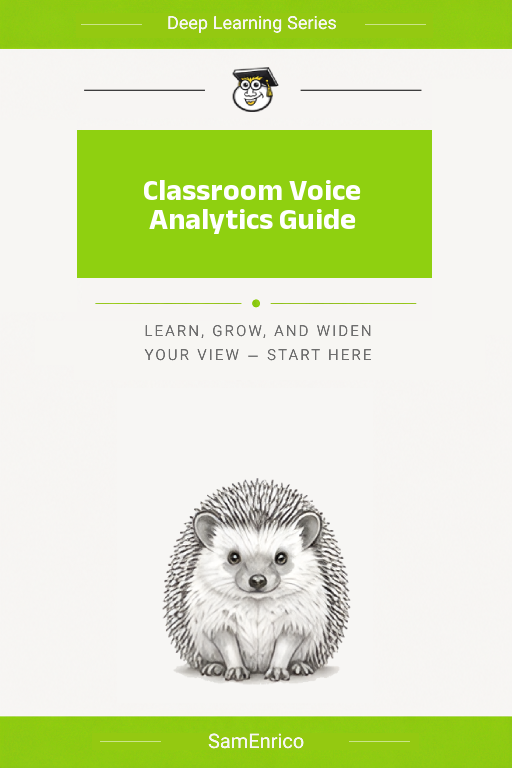
Non-FictionForecast & OutlookClassroom Analytics
Classroom Voice Analytics Guide eBook
Learn tools measuring teacher-student talk ratio,
by Fry Codi
Learn tools measuring teacher-student talk ratio, participation equity, and discussion quality.
Formats
Free sample
Chapter 1: The Memory Trap--Most teachers have never truly heard their own classroom.I don't mean they haven't been present. They've been there, of course—standing at the front, calling on students, scribbling notes on the board, managing the thousand small emergencies that constitute a typical lesson. They've heard the noise. But hearing is not the same as listening. And listening to your classroom with analytical ears—the way a musician listens for a wrong note or a mechanic listens for an engine knock—requires a skill that teacher preparation programs rarely teach.I learned this the hard way.In my fifth year of teaching, I considered myself a competent, even skilled, facilitator of classroom discussion.
I had read the books. I had attended the workshops. I had internalized the mantra that "student voice matters." So when a colleague asked to record my beloved morning discussion seminar—a class of honors seniors who actually did the reading—I agreed without hesitation. I was proud of that class. I was sure the recording would confirm what I already believed: that I was the kind of teacher who listened more than she talked, who distributed participation equitably, who pushed students toward genuine intellectual exchange rather than the simple recitation of right answers.The recording arrived in my inbox on a Tuesday afternoon.
I put in my earbuds and pressed play.For the first three minutes, I felt fine. My voice sounded a little nasal—doesn't everyone hate the sound of their own voice?—but the discussion seemed lively. Students were responding. Ideas were bouncing around.Then I started counting.By minute five, I had stopped listening to the content and started listening only to the pattern. Teacher question.
Student answer. Teacher evaluation ("Good"). Teacher question. Same student answer. Teacher evaluation ("Interesting").
Teacher question. Different student answer. Teacher echo (repeating the student's answer verbatim). Teacher question.By minute ten, I had a sick feeling in my stomach. I grabbed a notebook and started tallying.
Every time I spoke, a mark in the teacher column. Every time a student spoke, a mark in the student column. It was not subtle.Seventy-eight percent.I had talked for seventy-eight percent of the discussion. Not the seventy-eight percent of a lecture—this was supposed to be a seminar. And the student talk?
Three students—all boys, all seated in the front row, all white, all confident in ways that I now recognized as mirrors of my own classroom persona—had taken ninety-two percent of the student talking turns.The other twenty-five students in that room had essentially been audience members.I listened to the rest of the recording in a daze. I heard myself say things I cringed at: "Anyone else?" (when no one had answered the first time), "That's interesting, but let's stay on track" (when a student tried to connect the text to her own life), "What do you mean by that?" (asked in a tone that sounded curious but was actually impatient). I heard a long stretch of silence—my attempt at "wait time"—that lasted exactly 1.7 seconds before I jumped in to rescue the discussion. I heard a student start to speak, hesitate, and then fall silent as I inadvertently talked over her.I turned off the recording and sat in my empty classroom for a long time.Here is what I realized in that silence: I had been lying to myself for five years. Not maliciously.
Not intentionally. But systematically, consistently, and with the full backing of my own faulty memory. I remembered the discussions as vibrant and equitable because I remembered the moments that fit that story—the quiet student who finally spoke, the brilliant insight that emerged from nowhere, the laughter and the nodding heads. I forgot the ninety percent of the time that was just me talking, just the same three students responding, just the steady hum of my own voice filling the room.My memory had edited the footage. And I had believed the edit.The Problem with Memory The cognitive psychology behind this phenomenon is both well-documented and deeply unsettling.
Human memory is not a video recording. It is a reconstructive process—one that prioritizes coherence over accuracy, narrative satisfaction over factual completeness, and emotional resonance over objective detail.When you are teaching, your cognitive load is enormous. You are tracking student understanding, managing behavior, monitoring time, delivering content, making split-second decisions about when to push and when to pause, all while standing on your feet in front of an audience of young people who are watching your every move. In that context, your brain simply does not have the bandwidth to also record an accurate log of who spoke and for how long.Instead, your brain takes shortcuts. It remembers the unusual—the quiet student who surprised you by speaking, the brilliant answer that advanced the discussion, the moment when you said something particularly clever.
It forgets the ordinary—the thirty-seventh time you asked a closed question, the fifteenth time you called on the same student, the twelve seconds of silence that felt like an eternity but was actually less than two seconds.Research confirms this pattern across dozens of studies. When teachers are asked to estimate their own talk time after a lesson, they consistently underestimate it—often by a factor of two. A teacher who actually talked for 80% of a lesson will estimate 40-50%. A teacher who actually called on the same three students for 90% of student turns will remember the one time she called on a quiet student and believe the distribution was fair.This is not a character flaw. It is a feature of how human cognition works under load.
The teacher who overestimates her listening is not arrogant; she is overloaded. The teacher who remembers a discussion as equitable is not willfully blind; she is pattern-seeking. And the teacher who has never recorded her classroom is not avoiding accountability; she has simply never been given a tool that works better than her own unreliable memory.The Voice Analytics Matrix If memory is the problem, data is the solution. But not just any data. The history of classroom observation is littered with checklists that promised objectivity but delivered only the illusion of it.
A principal sitting in the back of a room with a clipboard, marking boxes for "student engagement" and "teacher clarity," is not collecting data in any meaningful sense. She is collecting impressions—and impressions are just memories that haven't happened yet.What we need is a framework that captures the three dimensions of classroom voice that actually matter, each measured with tools that are specific enough to be useful and simple enough to be sustainable. I call this the Voice Analytics Matrix, and it will serve as the organizing structure for everything that follows in this book.The matrix has three independent dimensions:Dimension One: Quantity (Teacher-Student Talk Ratio)This is the most basic measurement: what percentage of class time is the teacher talking versus students? The Teacher-Student Talk Ratio (TSTR) is the entry point for voice analytics because it is the easiest to measure and the most immediately revealing. Most teachers, when they first calculate their TSTR, experience the same sick feeling I did.…
This is the end of the free sample. Get the eBook to keep going. Buy now
About this book
Details
- Author
- Fry Codi
- Publisher
- SamEnrico
- Language
- English
- Genre
- Non-Fiction, Forecast & Outlook, Classroom Analytics
- Released
- 2026-06-01
- Pages (approx.)
- 146
- Available as
- eBook, Audiobook

Read better in the ZLOADR app
Your eBooks on your phone or tablet. Sign in with your SamEnrico account and start reading.
More by Fry Codi
 OKRs for Remote WorkersFry Codi$11.99
 Operation Car Wash Frozen AssetsFry Codi$11.99
 US 179D Energy DeductionFry Codi$11.99
 Family Acceptance Self EsteemFry Codi$11.99
 Alcohol Withdrawal Safety and Self CareFry Codi$11.99
 The Silent Revolution: How a 19th-Century Inventor Outsmarted the WorldFry Codi$11.99
 US AI Executive Order WorkbookFry Codi$12.99
 Ultimate Handbook Guide to Tokyo : (Japan) Travel GuideFry Codi$11.99
 Playing Team SportsFry Codi$11.99
 Understanding Idaho SyndromeFry Codi$17.99
You may also like
 Hong Kong Handover 1997Dunn Johnnie$11.99
 Zumba For Postnatal Recovery CourseNeal Christian$11.99
 Zumba for BeginnersLadner Nikia$11.99
 YouTube Comment Mining GuideHumes Pandora$12.99
 Worry Box MeditationCarlin Rudy$11.99
 Workplace Stress MeditationNguyen Lynn$11.99
 Workplace Stress and Sleep RepairHawley Ivory$11.99
 Workplace Perfectionism CureDelaney Jeffry$11.99
 Workplace Injustice Anger GuideWallen Isabelle$11.99
 Work Addiction and Burnout LinkGreenwood Ester$11.99
 Women in Yoga and WellnessBeattie Galina$11.99
 Women in Stand Up ComedyChun Evangeline$11.99