
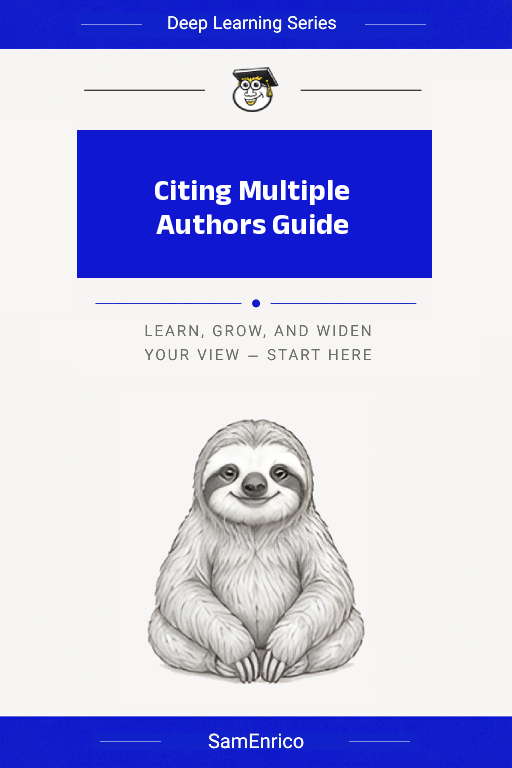
Non-FictionStudent's ShortcutAuthors
Citing Multiple Authors Guide eBook
Handle two, three, or twenty authors with et al. r
Handle two, three, or twenty authors with et al. rules across citation styles.
Formats
Free sample
Chapter 1: The Three-Question Method...--What if I told you that every single multi-author citation problem you will ever face can be solved by asking just three questions in the right order? Not a hundred pages of memorization. Not a color-coded spreadsheet taped to your wall (though we provide one anyway). Just three questions that take about eight seconds to run through your head.Most students and researchers approach citations like they are memorizing a foreign language vocabulary list – each style a different word for the same concept, each threshold a new exception to cram. But that is exactly backwards.
Citation styles are not arbitrary. They are logical systems that evolved to solve specific communication problems in specific disciplines. And once you understand the logic – once you internalize the three questions that every style guide is secretly asking – the rules stop feeling like random hurdles and start feeling like what they actually are: predictable, consistent answers to the same few puzzles.This chapter is the foundation of everything that follows. Get these three questions into your bones, and the rest of this book becomes reference material – something you flip to for the specific numbers, not something you have to relearn every time you switch from APA to Chicago or from a two-author paper to a twenty-author nightmare.The Three Questions Here they are. Write them down.
Put them on a sticky note next to your monitor.Question One: How many authors does this source have?Question Two: Am I citing this source in the body of my paper (in-text) or in the reference list at the end?Question Three: Which style guide am I following?That is it. Every multi-author citation decision in every style guide you will ever encounter reduces to these three questions. The rest is just looking up the specific number thresholds – and those are all in Chapter Two, on a single page, ready for you to steal.Why three questions? Because every citation style has to balance two competing priorities: giving credit where credit is due, and keeping the text readable. You cannot list fourteen names in a parenthetical citation without making your sentence unreadable.
But you also cannot chop those fourteen names to "et al." in the reference list without making it impossible for readers to find specific authors. So styles split the difference – and that split is exactly what the three questions navigate.Question One tells you how much pressure the system is under. The more authors, the more the style wants to abbreviate.Question Two tells you which side of the split you are on. In-text citations favor readability and brevity. Reference lists favor completeness and credit.Question Three tells you where your discipline falls on the spectrum between humanities (more names, more credit) and sciences (fewer names, more brevity).Let us walk through each question in depth.Question One: How Many Authors?This seems obvious.
But it is the most frequently misapplied part of the entire citation process – not because people cannot count, but because they do not know the thresholds. Is three authors "many" or "few"? Is six? Is twenty?The answer depends entirely on the style guide, which brings us to Question Three. But here is what you need to understand at a conceptual level: every style guide has a number – a threshold – at which it stops listing all the authors and starts using "et al." That threshold can be as low as two authors (meaning any source with three or more authors gets "et al.") or as high as ten authors (meaning you list every name unless there are eleven or more).
And different styles use different thresholds for in-text citations versus reference lists.Here is the key insight that most citation guides never tell you: the threshold is not arbitrary. It reflects how frequently papers in that discipline have multiple authors. In the humanities, where single-author books and two-author articles are the norm, a three-author paper is genuinely unusual – so the style lists all three names to signal that rarity. In the hard sciences, where twenty-author papers are routine, listing all twenty would be absurd – so the style starts abbreviating much earlier. The threshold is a signal about the expected norms of the field.This is also why you cannot just memorize "et al.
starts at three authors" and call it done. You have to know whether you are in-text or in the reference list, and you have to know your style guide. Which brings us to Question Two.Question Two: In-Text or Reference List?This is where even experienced writers stumble. A source with five authors might appear as "Smith et al." in the body of your paper but then have all five names listed in the reference list. Or, in some styles, the reference list also abbreviates after a certain point.
Or, in Harvard, the reference list never abbreviates – ever – even for a paper with forty authors.Why the difference? Because in-text citations and reference lists serve different purposes.In-text citations exist to identify which source you are drawing from, right now, in this sentence, without interrupting the flow of your argument. They are like license plates: short identifiers that let a reader match a passing glimpse to a specific entry in the reference list. The goal is brevity and speed. If you have ever tried to read a sentence with "(Smith, Jones, Taylor, Williams, Brown, Davis, Miller, Wilson, Moore, Taylor, Anderson, Thomas, Jackson, White, Harris, Martin, Thompson, Garcia, Martinez, Robinson, Clark, Rodriguez, Lewis, Lee, Walker, Hall, Allen, Young, King, Wright, Lopez, Hill, Scott, Green, Adams, Baker, Gonzalez, Nelson, Carter, Mitchell, Perez, Roberts, Turner, Phillips, Campbell, Parker, Evans, Edwards, Collins, Stewart, Sanchez, Morris, Rogers, Reed, Cook, Morgan, Bell, Murphy, Bailey, Rivera, Cooper, Richardson, Cox, Howard, Ward, Torres, Peterson, Gray, Ramirez, James, Watson, Brooks, Kelly, Sanders, Price, Bennett, Wood, Barnes, Ross, Henderson, Coleman, Jenkins, Perry, Powell, Long, Patterson, Hughes, Flores, Washington, Butler, Simmons, Foster, Gonzales, Bryant, Alexander, Russell, Griffin, Diaz, Hayes, 2020)" – you know why styles abbreviate.
In-text citations are not the place for completeness.Reference lists exist to provide complete, unambiguous bibliographic information so that a reader can find the exact source you used. The goal is completeness and precision. If a reference list said "Smith et al., 2020" and there are twelve Smiths who published in 2020, the reader cannot find your source. So reference lists resist abbreviation, listing full names as long as is practically possible.The tension between these two purposes creates the split that frustrates so many writers. But once you understand that it is an intentional, logical trade-off – readability in the text, completeness in the reference list – the frustration often dissolves.
You are not being asked to memorize random rules. You are being asked to respect a discipline's decision about where to draw the line between brevity and completeness.Question Three: Which Style Guide?This is the question that terrifies most people, because they think it means memorizing nine different sets of rules. But here is the secret: you do not need to memorize all nine. You need to know your style guide. Just one.
The one your professor, journal, or employer requires. The rest of this book exists so that when you switch from…
This is the end of the free sample. Get the eBook to keep going. Buy now
About this book
Details
- Author
- Combs Karleen
- Publisher
- SamEnrico
- Language
- English
- Genre
- Non-Fiction, Student's Shortcut, Authors
- Released
- 2026-05-30
- Pages (approx.)
- 159
- Available as
- eBook, Audiobook

Read better in the ZLOADR app
Your eBooks on your phone or tablet. Sign in with your SamEnrico account and start reading.
More by Combs Karleen
 Antwerp Heist Loot DisposalCombs Karleen$11.99
 Vaginal Weight Training GuideCombs Karleen$11.99
 ABC Please Skill HandbookCombs Karleen$11.99
 Emotion Regulation For RetirementCombs Karleen$11.99
 Gladdening Mental ObjectsCombs Karleen$11.99
 Landlord Insurance GuideCombs Karleen$11.99
 DASH Diet GuideCombs Karleen$11.99
 Bruce Lipton BiologyCombs Karleen$11.99
 The Djinn’s Gambit: A Spy Among the Smokeless OnesCombs Karleen$11.99
 The Djinn’s Last Lesson: Wisdom from the WhirlwindCombs Karleen$11.99
 A Collector's Handbook to the Dutton B-plusCombs Karleen$11.99
 10 Ways to Use Tabasco (Recipe Book)Combs Karleen$11.99
You may also like
 Hong Kong Handover 1997Dunn Johnnie$11.99
 Zumba For Postnatal Recovery CourseNeal Christian$11.99
 Zumba for BeginnersLadner Nikia$11.99
 YouTube Comment Mining GuideHumes Pandora$12.99
 Worry Box MeditationCarlin Rudy$11.99
 Workplace Stress MeditationNguyen Lynn$11.99
 Workplace Stress and Sleep RepairHawley Ivory$11.99
 Workplace Perfectionism CureDelaney Jeffry$11.99
 Workplace Injustice Anger GuideWallen Isabelle$11.99
 Work Addiction and Burnout LinkGreenwood Ester$11.99
 Women in Yoga and WellnessBeattie Galina$11.99
 Women in Stand Up ComedyChun Evangeline$11.99