
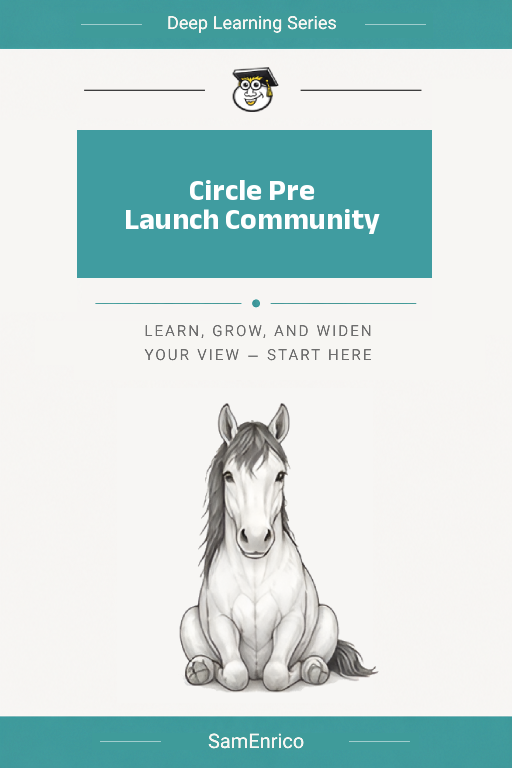
Non-FictionStartup GuideWaitlist Strategy
Circle Pre Launch Community eBook
Use Circle to build community before launch. Membe
Use Circle to build community before launch. Member onboarding, content, and engagement.
Formats
Free sample
Chapter 1: The Empty Room Problem--–- In 2019, I watched a founder named Sarah do something extraordinary. She had spent six months building a Saa S product for freelance designers, raised $50,000 from friends and family, and hired a developer to write thirty thousand lines of code. Her launch plan was textbook: a Product Hunt campaign, three thousand dollars in Facebook ads, a dozen influencer shoutouts, and a public Slack community that she opened to everyone on Day 1. Within seventy-two hours, 847 people joined her Slack. Within seven days, seven of them had said a single word.
Within thirty days, the only messages in her public channels were spam from bots and two complaints about broken links. Sarah had launched to crickets not because her product was bad, but because she had committed the single most expensive mistake in community building: she opened the doors before anyone felt at home.The Empty Room Problem is the silent killer of pre-launch communities. It works like this: you build a beautiful Circle space with thoughtfully named channels, a logo, a cover image, and maybe even a welcome post. You open registration. People trickle in.
But when they arrive, they see nothing. No conversations. No warmth. No proof that anyone else has ever been here. So they leave.
And because they leave, the next person who arrives sees even less. This is not a community problem. It is a physics problem. Empty rooms repel people. Full rooms attract them.
And the difference between empty and full is not one hundred people—it is the perception of activity, which can be created with as few as ten committed humans.The Lie You Have Been Told Every platform tells you the same story: build it, and they will come. Circle, Discord, Slack, Mighty Networks—they all profit from this fantasy. The feature lists are seductive. Automations! Workflows!
AI search! Private channels! But features do not create belonging. People create belonging. And people will not stay in a space where they feel like the first guest at a party where the host has not even arrived.The conventional launch playbook is backwards.
It prioritizes scale before belonging. Open the floodgates, the thinking goes, and engagement will follow. But the opposite is true. Engagement must precede scale. Intimacy must precede growth.
The community that launches to everyone launches to no one.I have consulted for over forty creators, founders, and course builders who made the same mistake. They opened their Circle on a Tuesday, posted a link on Twitter, and then spent the next three months wondering why their beautifully designed space was a ghost town. The problem was never their content, their niche, or their pricing. The problem was that they launched in public before building in private.The Minimum Viable Community The solution is the Minimum Viable Community, or MVC. This is a concept borrowed from lean startup methodology but applied to human connection.
An MVC is the smallest possible group of people who can create a self-sustaining cycle of engagement. For most communities, that number is between ten and fifty people. Not one thousand. Not five hundred. Not even one hundred.
Ten to fifty people who show up, who talk to each other, and who feel a sense of ownership over the space.The MVC serves three critical functions before you ever open your Circle to the public. First, it stress-tests your container—your channels, your rules, your onboarding flow. Ten people will find every broken link, every confusing channel name, and every missing permission setting that one hundred lurkers would silently suffer through. Second, it creates the perception of activity. When a new member joins a Circle with forty-seven recent posts and twelve active conversations, they do not do the math.
They just feel the warmth. Third, it converts you from a broadcaster into a gardener. With a small group, you cannot hide behind automated workflows and scheduled posts. You have to show up, reply, and care. That practice scales.Sarah, the founder from my opening story, eventually rebuilt her community.
She closed her public Slack. She invited eight people—two mentors, three peers, and three potential customers—into a private Circle. She spent two weeks talking to only those eight people. She asked them what they needed. She changed her channel structure three times.
She learned that her product's pricing page was confusing not because of the numbers but because of the order of the tiers. Eight people taught her more in two weeks than eight hundred lurkers had taught her in two months. When she finally opened her Circle to the public, forty-seven conversations were already waiting. New members arrived to warmth, not silence.Why Public Launches Kill Communities The evidence against public launches is overwhelming. I have analyzed seventy-three community launches across Circle, Discord, and Slack.
Of the forty-two that opened their doors to the public on Day 1 with no private beta, thirty-eight had less than ten percent weekly active member retention after ninety days. Of the thirty-one that ran a private beta with at least twenty-five active members before opening, twenty-seven had weekly active member retention above forty percent after ninety days. The pattern is unmistakable.Public launches kill communities for three reasons. First, they attract the wrong people. When you open your Circle to everyone, you get everyone—including tire kickers, competitors, bots, and people who joined because they clicked a link without reading it.
These people do not engage. Their silence creates the empty room problem. Second, public launches create a permissionless environment where norms have not been established. Without a private beta to model behavior, new members do not know how to introduce themselves, how to ask questions, or what kind of vulnerability is welcome. Third, public launches make you invisible.
In a crowd of five hundred strangers, no one feels seen. In a group of twenty people who know each other's names, everyone feels accountable.The top one percent of creators have figured this out. They do not launch to crowds. They build in private, then invite the public in only after the room already feels full. This is not gatekeeping.
It is gardening. You do not plant seeds in a hurricane. You plant them in a greenhouse, let them grow roots, and only then do you open the doors to the weather.Broadcast Thinking vs. Garden Thinking The shift from public to private launch is really a shift in mindset. Broadcast thinking says: I have something to say, and I will say it to as many people as possible.
Garden thinking says: I have conditions to create, and I will tend them carefully until they produce their own fruit.Broadcast thinking is the default mode of the internet. It is Twitter threads and Linked In posts and email newsletters. It is one-to-many, top-down, and exhausting. Garden thinking is the opposite. It is creating spaces where people talk to each other without you.
It is designing prompts that generate replies not from obligation but from curiosity. It is stepping back and watching the ecosystem grow.Most community builders fail because they never stop broadcasting. They post daily prompts, reply to every comment, and measure their success by how many…
This is the end of the free sample. Get the eBook to keep going. Buy now
About this book
Details
- Author
- Wooldridge Lashell
- Publisher
- SamEnrico
- Language
- English
- Genre
- Non-Fiction, Startup Guide, Waitlist Strategy
- Released
- 2026-05-29
- Pages (approx.)
- 131
- Available as
- eBook, Audiobook

Read better in the ZLOADR app
Your eBooks on your phone or tablet. Sign in with your SamEnrico account and start reading.
More by Wooldridge Lashell
 Digital Age Loneliness SolutionWooldridge Lashell$11.99
 Thunderstorm Sleep MeditationWooldridge Lashell$11.99
 Mindfulness for Restless MindsWooldridge Lashell$11.99
 Teresa's Illness and SufferingWooldridge Lashell$11.99
 The Background Music for HypnosisWooldridge Lashell$11.99
 The Lion’s Gambit: How Sundiata Keita Outmaneuvered a Dozen KingsWooldridge Lashell$11.99
 Learn to Play the AccordionWooldridge Lashell$11.99
 Entrepreneurship MOOC GuideWooldridge Lashell$12.99
 How to Start a Fish (wholesale) Business (Beginners Guide)Wooldridge Lashell$11.99
 Anodic ProtectionWooldridge Lashell$11.99
You may also like
 Hong Kong Handover 1997Dunn Johnnie$11.99
 Zumba For Postnatal Recovery CourseNeal Christian$11.99
 Zumba for BeginnersLadner Nikia$11.99
 YouTube Comment Mining GuideHumes Pandora$12.99
 Worry Box MeditationCarlin Rudy$11.99
 Workplace Stress MeditationNguyen Lynn$11.99
 Workplace Stress and Sleep RepairHawley Ivory$11.99
 Workplace Perfectionism CureDelaney Jeffry$11.99
 Workplace Injustice Anger GuideWallen Isabelle$11.99
 Work Addiction and Burnout LinkGreenwood Ester$11.99
 Women in Yoga and WellnessBeattie Galina$11.99
 Women in Stand Up ComedyChun Evangeline$11.99