
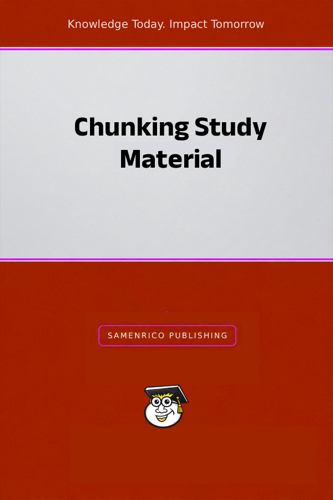
Chunking Study Material eBook
Break large topics into smaller manageable groups
Break large topics into smaller manageable groups for easier learning.
Formats
Free sample
Chapter 1: The Backpack That Leaks--–- The first time Maya cried in a library, she was surrounded by 847 pages of organic chemistry, three highlighters, and the absolute certainty that she was stupid.She had studied for six hours. Six hours of re-reading, underlining, and whispering mechanisms to herself like a desperate prayer. When she closed the textbook and tried to recall the first reaction—just the first one—her mind offered nothing but a faint, buzzing static. The information had gone in. She had felt it going in.
And then, like water through a sieve, it had simply… left.Maya is not real. But you have been Maya. Or you will be.This book exists because of that feeling. The feeling of sitting in front of an open textbook, a stack of notes, a lecture recording, and realizing that your brain has become a brick wall instead of a sponge. The feeling of studying harder than everyone you know and still scoring lower.
The feeling of reading the same paragraph four times and still not knowing what it said.Here is the truth that no one told you: your brain is not broken. Your work ethic is not the problem. The problem is that you have been trying to carry a swimming pool in a backpack.The Myth of the Infinite Mind We live in an age of astonishing misinformation about learning. Schools, universities, and online courses operate on a single, unspoken assumption: that the human brain can absorb an unlimited amount of information at once, provided the student tries hard enough. This assumption is not just wrong.
It is catastrophically wrong.Consider what we ask of students. A single chapter of a biology textbook might contain fifty new vocabulary words, twenty chemical reactions, fifteen cellular structures, and ten historical discoveries. A law student might be assigned three hundred pages of case law in a week. A medical student might need to memorize the symptoms, treatments, and contraindications for dozens of diseases before an exam. And the instruction is always the same: read, highlight, re-read, cram.This approach treats the brain like an empty hard drive.
But the brain is not a hard drive. It is a biological organ with strict physical limits. And the most important of those limits—the one that will change everything you understand about studying—is called working memory.The 4 ± 1 Bottleneck Working memory is the space in your mind where thinking actually happens. It is not where you store memories permanently. It is where you hold information right now while you manipulate it, compare it, combine it, or apply it.Imagine a small desk.
On that desk, you can place the materials you are actively working with. Your long-term memory is a vast warehouse behind you, filled with everything you have ever learned. But the desk—the working surface—is tiny.How tiny? In 1956, cognitive psychologist George Miller published a landmark paper titled "The Magical Number Seven, Plus or Minus Two." Miller argued that the average human working memory could hold about seven items at once. For decades, this was the accepted number.
But more recent research has refined Miller's finding. Under real-world conditions—with distractions, fatigue, and complex information—the true limit is closer to 4 ± 1 items.That is right. Your conscious mind can actively work with only three to five pieces of information at any given moment.Let that sink in.You have a brain capable of extraordinary feats. It can recognize faces from decades ago, navigate complex social situations, compose music, solve differential equations. And yet, at any single moment, you can only hold three to five thoughts in your hand.
Everything else must be stored elsewhere or it will fall.This is not a design flaw. It is a feature. The brain's working memory limit forces you to focus, to prioritize, to select what matters. Without this bottleneck, you would be overwhelmed by every sensation, every memory, every possibility. The limit is what makes concentrated thought possible.But here is the problem: traditional studying ignores the bottleneck entirely.Why Traditional Studying Fails (The Science of Illusion)Let me describe a common study session.
You open your textbook to Chapter 7. You read the first paragraph. You highlight a sentence. You read the second paragraph. You highlight two more sentences.
By the time you reach the bottom of the page, you have highlighted perhaps ten separate facts. Then you turn the page and continue.What have you actually done? You have asked your working memory to hold ten unrelated items simultaneously while also processing new information. But your working memory can only hold three to five items. So the vast majority of those highlighted facts never enter working memory at all.
They pass through your eyes, trigger a flicker of recognition, and vanish.You feel like you are studying because you are moving your eyes across words and wielding a highlighter. But feeling like you are studying and actually learning are two different things. This is what cognitive scientists call the illusion of fluency: the mistaken belief that because information feels familiar (you just saw it), it has been learned.The illusion is seductive. When you re-read a paragraph immediately after reading it, the words feel easy. They feel obvious.
Your brain confuses that ease with mastery. But wait a week, or even a day, and the ease vanishes. The information was never encoded in the first place.Cramming is the most extreme version of this illusion. Staying up all night before an exam feels heroic. It feels like sacrifice.
But from the perspective of your brain, cramming is a disaster. Sleep is when memories are consolidated, when chunks are welded into long-term storage. When you cram, you are building a house on a foundation of exhaustion and then never letting the concrete dry.The research is unequivocal: students who cram forget approximately 50% of what they studied within 24 hours, and up to 80% within a week. The information was never learned. It was merely rented.The Paradox of More There is a cruel irony in modern education.
Never before in human history has so much information been so accessible. The entirety of human knowledge sits in your pocket. You can access lectures from Nobel laureates for free. You can find explanations for any concept in dozens of formats.And yet, students are more overwhelmed than ever.This is the paradox of information abundance: more available data does not equal more learning. In fact, beyond a certain point, more information actively harms learning by overwhelming the bottleneck.
Without a structure to sort, prioritize, and group information, the brain simply shuts down.Imagine being handed a thousand loose screws, bolts, and wires and being told to build an engine. You would be paralyzed by choice, by the sheer chaos of the components. Now imagine being handed the same components already organized into ten subassemblies: the fuel system, the cooling system, the electrical system, and so on. Suddenly the task becomes possible.The difference between the two scenarios is not the amount of information. It is the structure of the information.
And structure is exactly what chunking provides.The Solution: Chunking Chunking is the process of breaking large topics into smaller, meaningful…
This is the end of the free sample. Get the eBook to keep going. Buy now
About this book
Details
- Author
- Thomson Lucina
- Publisher
- SamEnrico
- Language
- English
- Genre
- Non-Fiction, Self-Help, Learning Strategies
- Released
- 2026-06-11
- Pages (approx.)
- 142
- Available as
- eBook, Audiobook

Read better in the ZLOADR app
Your eBooks on your phone or tablet. Sign in with your SamEnrico account and start reading.
More by Thomson Lucina
 ESL Teacher Abroad Stress GuideThomson Lucina$11.99
 Anger Management Apps GuideThomson Lucina$11.99
 Martial Artist HypnosisThomson Lucina$11.99
 Action Planning for LawyersThomson Lucina$11.99
 The Grandfather's War CrimesThomson Lucina$11.99
 Senior Self ForgivenessThomson Lucina$11.99
 CPR for Asthma AttackThomson Lucina$11.99
 The Tide of Empire: How Elizabeth I Charted the British SeasThomson Lucina$11.99
 Gwythaint: The Shadow That Feeds on KingsThomson Lucina$11.99
 How to Produce Educational Flash CardsThomson Lucina$11.99
 How to Produce Pre-wash and Stain RemoverThomson Lucina$11.99
 Freemium Upgrade Personalization EngineThomson Lucina$12.99
You may also like
 Interleaved Studying PracticeLarue Lera$11.99
 Interleaving Practice for Problem SolvingMcgrath Rueben$11.99
 Chunking Abstract ConceptsMarx Lane$11.99
 Memory Retention Study GuideReiter Bonny$11.99
 Interleaving Study MethodKroll Ermelinda$11.99
 Pattern Recognition for LearningBenitez Horacio$11.99
 Loci Palace Construction HandbookStover Tenisha$11.99
 The Sleep Dependent Learning GuideHammonds Warner$11.99