
Non-FictionSelf-HelpLanguage Learning
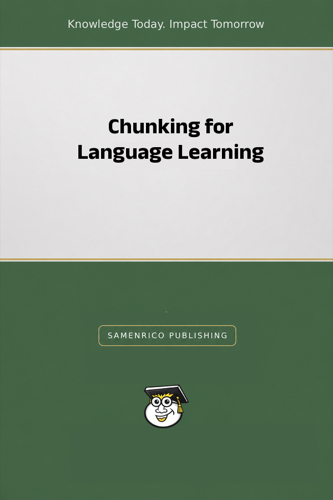
Chunking for Language Learning eBook
Group vocabulary and grammar patterns to accelerat
by Helton Bess
Group vocabulary and grammar patterns to accelerate fluency using this guide.
Formats
Free sample
Chapter 1: The Fluency Gap--–- Maria had passed the highest-level Spanish exam. She could conjugate irregular verbs in the subjunctive mood. She knew over five thousand words. But when a waiter in Madrid asked, "¿Algo más?" – "Anything else?" – she froze. Her brain began its slow, painful assembly: "I...
would... like... to... obtain... the...
check." By the time she said "La cuenta, por favor," the waiter had already walked away twice. Maria knew the word cuenta. She knew por favor. But she didn't have the chunk.This is not a story about vocabulary size. It is not a story about laziness or low aptitude.
It is a story about a flaw in nearly every language learning method taught today – and the single most powerful fix that polyglots, linguists, and neuroscientists agree upon but almost never explain clearly.You are about to learn why you know thousands of words yet cannot speak. You are about to learn why children speak fluently with smaller vocabularies than yours. And you are about to discover a mental switch that, once flipped, will change how you acquire every language for the rest of your life.Welcome to the Fluency Gap.The Dictionary in Your Head Imagine two language learners. The first learner – let us call her the Architect – has been taught that language works like Lego bricks. Words are bricks.
Grammar rules are the instruction manual. To speak, you select the right bricks and snap them together following the rules. The Architect is careful. Precise. She learned that "I" comes before "go," that "to" connects verbs, that adjectives go before nouns in English but after nouns in French.
She has spent years studying. She can diagram sentences perfectly.The second learner – call her the Chunk User – has never diagrammed a sentence in her life. She cannot explain the difference between a gerund and a present participle. But when she needs to say "I'm going to grab a bite," it comes out as one seamless unit. She does not assemble.
She retrieves.Here is the shocking truth: the Architect has studied more. She knows more grammar rules. She has a larger vocabulary. But the Chunk User speaks faster, makes fewer errors, and sounds more natural. In real-time conversation, the Architect hesitates, backtracks, and produces sentences that are grammatically correct but strangely foreign.
The Chunk User just... talks.Why?Because the Architect is using the wrong mental processor.Neuroscience and second language acquisition research have converged on a finding that most classrooms ignore: native speakers do not think in words. They do not construct sentences from scratch. Instead, they store and retrieve lexical chunks – multi-word units that function as single pieces of language. When a native English speaker says "nice to meet you," they are not assembling "nice" + "to" + "meet" + "you." They are pulling a single预制块 from memory.
The same is true for "I don't know," "what's up," "come to think of it," "as a matter of fact," and thousands of other common expressions.Your brain has two processors. The word-by-word processor (what we will call the Dictionary) is slow, effortful, and error-prone. It is useful for novel sentences you have never heard before. But it is not how fluent conversation happens. The chunk processor (the Library) is fast, automatic, and context-appropriate.
It retrieves ready-made language in the same way you recall your own phone number – as a single unit, without calculation.The Fluency Gap is the distance between what you can say using your Dictionary and what you can say using your Library. For most classroom-trained learners, that gap is enormous. They have built an impressive Dictionary. Their Library is nearly empty.This book exists to fill your Library.What Exactly Is a Chunk?Before we go further, we need precise definitions. Not every group of words is a chunk.
A chunk must meet specific criteria that researchers have identified across dozens of languages.The Chunk Definition Box (keep this nearby – we will reference it throughout the book)A chunk is a multi-word unit that native speakers store and retrieve as a single piece. There are two main types:Fixed chunks: The same words in the same order every time. Examples include:Nice to meet you (four words, one chunk)How are you? (three words, one chunk)I don't know (three words, one chunk)Come to think of it (five words, one chunk)As a matter of fact (five words, one chunk)Slot-and-frame chunks: A fixed frame with one or two variable slots. These are especially powerful because learning one frame gives you dozens of sentences.
Examples include:It's worth [verb]ing → It's worth trying, It's worth mentioning, It's worth noting The more [X], the more [Y] → The more you practice, the faster you improve I was wondering if [sentence] → I was wondering if you could help me Could you please [verb]? → Could you please repeat that?What is not a chunk:Entire scripts or long sequences ("Could we have a table? What do you recommend? We're ready to order" is three separate chunks, not one)Single words (except high-frequency social words like thanks, sorry, hello – these function as chunks in context)Random word combinations that do not appear frequently in natural speech Why does this definition matter? Because once you know what a chunk is, you can start seeing them everywhere.
They are hiding in plain sight in every conversation, every movie, every podcast. And your brain is already wired to find them – you just need to know where to look.The Cost of Word-by-Word Translation Let us return to Maria in Madrid. Her problem was not lack of knowledge. It was the wrong retrieval pathway. Let us examine what happened inside her brain during those three seconds of silence.When the waiter said "¿Algo más?" Maria's brain began a multi-step process:Hear the sounds – "¿Algo más?"Translate – "Something else?"Formulate a response – She needs the check.Search for individual words – "Check" is cuenta.
"Please" is por favor. "I would like" is quisiera (subjunctive – she knows this!).Apply grammar rules – Does quisiera need a following verb? Is la cuenta feminine? Does por favor go before or after?Assemble – "Quisiera + la cuenta + por favor."Output – "La cuenta, por favor."This process takes three to five seconds in real time. By step four, the waiter has already started serving another table.Now watch a native speaker – or a chunk-using learner – handle the same situation:Hear the sounds – "¿Algo más?"Retrieve chunk – "La cuenta, por favor" (stored as one unit)Output – "La cuenta, por favor."Total time: less than one second.The native speaker did not translate.
Did not search for individual words. Did not apply grammar rules. They simply retrieved a stored chunk. This is the difference between having a Dictionary and having a Library.Most learners spend years building a beautiful, detailed Dictionary. They know that cuenta means check, that por favor means please, that quisiera is the first-person subjunctive of querer.
But when the waiter asks "¿Algo más?" their Dictionary is useless. The waiter is not asking for a definition. The waiter is asking for a chunk.The Self-Assessment: Where Is Your Chunk Library Empty?Before we go further, take two minutes to complete…
This is the end of the free sample. Get the eBook to keep going. Buy now
About this book
Details
- Author
- Helton Bess
- Publisher
- SamEnrico
- Language
- English
- Genre
- Non-Fiction, Self-Help, Language Learning
- Released
- 2026-06-06
- Pages (approx.)
- 132
- Available as
- eBook, Audiobook

Read better in the ZLOADR app
Your eBooks on your phone or tablet. Sign in with your SamEnrico account and start reading.
More by Helton Bess
 Improv for ConsultantsHelton Bess$11.99
 Education Market PositioningHelton Bess$11.99
 The Macro Tracking GuideHelton Bess$11.99
 Ketamine Bipolar Depression GuideHelton Bess$11.99
 Transportation Capacity AIHelton Bess$11.99
 Property Damage Parent AngerHelton Bess$11.99
 Assertiveness for CodependentsHelton Bess$11.99
 The Architect of the Roar: How Bob McArthur Built the Soul of Australian FootballHelton Bess$11.99
 The Poisoner of Ealing: The First Forensic Toxicology BreakthroughHelton Bess$11.99
 Bulldogs: English BulldogHelton Bess$11.99
 EU VAT Record Keeping RequirementsHelton Bess$12.99
 Employee Reference Liability RisksHelton Bess$12.99
You may also like
 Hong Kong Handover 1997Dunn Johnnie$11.99
 Zumba For Postnatal Recovery CourseNeal Christian$11.99
 Zumba for BeginnersLadner Nikia$11.99
 YouTube Comment Mining GuideHumes Pandora$12.99
 Worry Box MeditationCarlin Rudy$11.99
 Workplace Stress MeditationNguyen Lynn$11.99
 Workplace Stress and Sleep RepairHawley Ivory$11.99
 Workplace Perfectionism CureDelaney Jeffry$11.99
 Workplace Injustice Anger GuideWallen Isabelle$11.99
 Work Addiction and Burnout LinkGreenwood Ester$11.99
 Women in Yoga and WellnessBeattie Galina$11.99
 Women in Stand Up ComedyChun Evangeline$11.99