
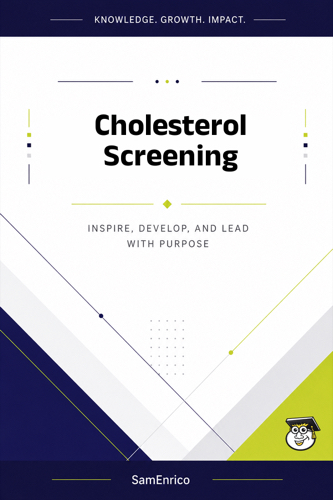
Non-FictionHealth & WellnessLipids
Cholesterol Screening eBook
Teaches lipid panel interpretation for heart disea
by Stanton Mee
Teaches lipid panel interpretation for heart disease risk.
Formats
Free sample
Chapter 1: The Cholesterol Conspiracy--–- The heart attack that changed everything came with no warning, no chest pain, no shortness of breath. Forty-seven-year-old Marcus Chen was six miles into his morning run when his aorta tore from the inside out. He was a marathoner, a vegetarian, and a non-smoker. His total cholesterol six months earlier had been 189 mg/d L—well within the laboratory's "normal" reference range. His doctor had congratulated him.
"Keep doing what you're doing," the physician wrote in an after-visit summary that Marcus still has, folded and creased, in his nightstand drawer. What Marcus and his doctor did not know was that his LDL particle number was in the 99th percentile. His lipoproteins were small, dense, and highly atherogenic. And his Lp(a)—a genetic time bomb that no one had bothered to measure—was three times the safe upper limit. The "normal" cholesterol number was a lie.
Not a malicious lie, but a dangerous half-truth that cost Marcus his ascending aorta and, for six minutes on a running path in Boulder, Colorado, his life. He survived because a trauma surgeon happened to be running behind him. Most people are not so lucky.The Cholesterol Lie That Killed Your Grandfather You have been told a story about cholesterol. It is a simple story, clean and easy to remember, the kind of story that fits neatly into a five-minute doctor's appointment or a government dietary guideline or a late-night television commercial for a statin. The story goes like this: There is bad cholesterol (LDL) and good cholesterol (HDL).
You want less of the bad and more of the good. Eat less saturated fat, take your medication if your numbers are high, and you will reduce your risk of heart disease. This story is not merely incomplete. It is dangerously wrong in ways that have cost millions of lives.The truth is that cholesterol is not your enemy. It is a molecule so essential to human life that every single one of your roughly thirty-seven trillion cells depends on it.
Cholesterol provides the structural integrity that keeps your cell membranes flexible yet sturdy. It is the raw material from which your body manufactures vitamin D when sunlight hits your skin. It is the precursor to every sex hormone you produce—testosterone, estrogen, progesterone—as well as cortisol, the stress hormone that keeps you alive in an emergency. Your brain, which represents only two percent of your body weight, contains twenty-five percent of your body's entire cholesterol supply. Without cholesterol, you would not remember your first kiss, feel hunger, or fall in love.The real enemy was never cholesterol itself.
The real enemy is dysregulation—the breakdown of the elegant transport system that moves cholesterol and other fats through your bloodstream. And the real tragedy is that the medical establishment has spent fifty years aiming at the wrong target, using the wrong tools, and telling patients they were "fine" when they were anything but.The Seven Countries Study: How a Flawed Study Changed the World To understand how we arrived at this moment of mass confusion, we must travel back to 1953, to a conference in Rome where a physiologist named Ancel Keys presented data that would reshape global nutrition policy for decades. Keys had analyzed dietary and mortality data from seven countries—the United States, Japan, Italy, England, Wales, Australia, and Canada—and found a striking correlation: populations that consumed more saturated fat had higher rates of heart disease. The "lipid hypothesis"—the idea that dietary fat and cholesterol cause heart attacks—was born.What Keys did not tell the conference, and what the medical establishment chose not to investigate too closely for the next thirty years, was that he had data from twenty-two countries. He had cherry-picked the seven that supported his hypothesis.
When you include all twenty-two countries, the correlation between saturated fat consumption and heart disease disappears entirely. France, for example, has high saturated fat intake and low heart disease rates—the so-called French Paradox. Georgia, at the time, had low saturated fat intake and high heart disease rates. The data did not fit the story, so the story ignored the data.This is not merely an academic footnote. The Seven Countries Study became the foundation of the dietary guidelines that told generations of Americans to replace butter with margarine, eggs with cereal, and red meat with processed carbohydrates.
The result was not a reduction in heart disease. The result was an epidemic of obesity, metabolic syndrome, and type 2 diabetes—all of which are powerful risk factors for the very heart disease we were trying to prevent.The Sugar Industry's Masterstroke The cholesterol story becomes even darker when we follow the money. In 2016, a team of researchers at the University of California, San Francisco, unearthed a cache of internal documents from the Sugar Research Foundation. The documents revealed that the sugar industry had paid Harvard scientists the equivalent of nearly fifty thousand dollars in today's money to publish a 1967 review that downplayed the link between sugar and heart disease while pinning the blame on saturated fat and cholesterol. The lead author of that review, Dr.
D. Mark Hegsted, went on to become the head of nutrition at the United States Department of Agriculture, where he helped draft the very dietary guidelines that told Americans to avoid fat and eat more carbohydrates—including, of course, sugar.This was not a conspiracy in the Hollywood sense, with villains twirling mustaches. It was something more insidious: a systematic distortion of science by an industry whose profits depended on keeping Americans afraid of eggs and bacon while pouring sugar into every processed food on the supermarket shelf. And it worked brilliantly. Per capita sugar consumption in the United States rose from about 110 pounds per year in 1960 to more than 150 pounds per year by the turn of the century.
Over the same period, rates of obesity tripled, diabetes increased sevenfold, and heart disease—despite dramatic advances in emergency medicine—remained the number one killer of men and women.Your Doctor Is Using a 1972 Formula Here is a fact that should shock you: the way your doctor calculates your LDL cholesterol has not fundamentally changed since 1972. The Friedewald equation—named after the American pathologist who devised it—uses a simple formula: LDL cholesterol equals total cholesterol minus HDL cholesterol minus triglycerides divided by five. This equation was never intended for routine clinical use. Friedewald himself described it as a convenience for researchers, not a diagnostic tool for patients. But it was simple, it required no expensive equipment, and it gave doctors a number they could write on a prescription pad.The Friedewald equation has two catastrophic flaws.
First, it becomes wildly inaccurate when triglycerides exceed 400 mg/d L—a common scenario in patients with metabolic syndrome and diabetes. Second, and more importantly, it measures the concentration of cholesterol inside LDL particles, not the number of particles themselves. This distinction is not a technical nuance. It is the single most important concept in modern lipidology, and your doctor probably never learned it.Consider two patients, both with LDL cholesterol of 130 mg/d L. Patient A has large, fluffy LDL particles—Pattern A in the scientific literature.…
This is the end of the free sample. Get the eBook to keep going. Buy now
About this book
Details
- Author
- Stanton Mee
- Publisher
- SamEnrico
- Language
- English
- Genre
- Non-Fiction, Health & Wellness, Lipids
- Released
- 2026-06-06
- Pages (approx.)
- 149
- Available as
- eBook, Audiobook

Read better in the ZLOADR app
Your eBooks on your phone or tablet. Sign in with your SamEnrico account and start reading.
More by Stanton Mee
 Single Parent Anger SurvivalStanton Mee$11.99
 Whitewashed AccusationsStanton Mee$11.99
 Batching Remote Tasks GuideStanton Mee$11.99
 UAE Gender Interaction NormsStanton Mee$11.99
 Idea Selection MethodsStanton Mee$11.99
 Conversation Starters for TeachersStanton Mee$11.99
 Dream Mirror JournalStanton Mee$11.99
 The Fall of the Tennis Titan: Suzanne Lenglen's Last Stand at WimbledonStanton Mee$11.99
 The Alchemists of Prague: Kepler's Celestial RevolutionStanton Mee$11.99
 Reconciliation with ERP SystemsStanton Mee$12.99
 Plagiarism and Citation Ethics HandbookStanton Mee$12.99
 How to Produce OilStanton Mee$11.99
You may also like
 Hong Kong Handover 1997Dunn Johnnie$11.99
 Zumba For Postnatal Recovery CourseNeal Christian$11.99
 Zumba for BeginnersLadner Nikia$11.99
 YouTube Comment Mining GuideHumes Pandora$12.99
 Worry Box MeditationCarlin Rudy$11.99
 Workplace Stress MeditationNguyen Lynn$11.99
 Workplace Stress and Sleep RepairHawley Ivory$11.99
 Workplace Perfectionism CureDelaney Jeffry$11.99
 Workplace Injustice Anger GuideWallen Isabelle$11.99
 Work Addiction and Burnout LinkGreenwood Ester$11.99
 Women in Yoga and WellnessBeattie Galina$11.99
 Women in Stand Up ComedyChun Evangeline$11.99