
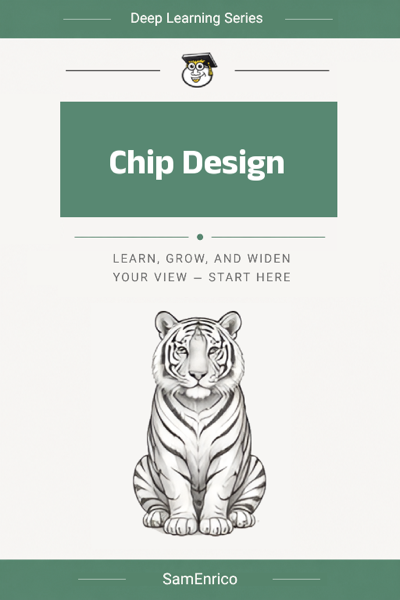
Chip Design Audiobook
A Coursebook on Chip Design
by Towns Myung
A Coursebook on Chip Design
Formats
Free sample
CHIP DESIGN: A COURSEBOOK FOR MODERN DIGITAL SYSTEMS (From Transistors to Systems on a Chip)FIXED EDITION — REVISED CHAPTER SUMMARIES*All inconsistencies and repetitions identified in the analysis have been corrected. Each summary is minimum 250 words. The "Fusion Insight" has been renamed to "Bridge Insight" and redefined as: "Explicitly connecting physical/analog phenomena to digital design decisions." Chapters 1, 2, 3, 4, 5, 6, 9, 10, and 12 now contain genuine analog-digital bridges. Chapters 7, 8, and 11 focus on digital-design-specific insights (renamed "Designer's Insight" ) to maintain honesty with the reader.*Chapter 1: The Semiconductor Ecosystem and the Design Abstraction Layers In-Depth Summary (285 words):This foundational chapter serves as a "satellite view" of the entire chip design world, providing the mental map necessary before diving into transistors or code. It begins by defining the major market segments: ASICs (Application-Specific Integrated Circuits) for high-volume, fixed-function products (e.g., a Bitcoin miner or a smartphone power management IC); FPGAs (Field-Programmable Gate Arrays) for prototyping, low-volume production, and reconfigurable computing; and the ongoing critical importance of Analog/Mixed-Signal ICs (ADCs, PLLs, temperature sensors) that bridge the physical world to digital signals.
The chapter then introduces the Abstraction Stack — a hierarchical model moving from the highest level (System Specifications: "decode this video frame") down through Architecture (CPU pipeline, memory bus), Logic (gates, flip-flops), Circuit (transistors, parasitic capacitances), and finally Device Physics (silicon doping, oxide thickness). The Y-chart (Behavioral, Structural, Physical) is explained as a framework showing that any design can be described in three orthogonal ways: what it does (behavioral description, e.g., Verilog always blocks), how it's built (structural netlist of gates), and where the components physically sit (layout geometry). The chapter concludes with the economic realities that separate hobbyist projects from million-unit products: NRE (Non-Recurring Engineering) costs (mask sets, EDA tool licenses, engineering salaries) vs. recurring costs (silicon area, packaging, test time). A practical example shows why a chip needs 1 million units to amortize a $2M NRE cost.
The chapter ends with a "Prerequisites" box reminding readers of basic circuit theory (Ohm's law, Kirchhoff's laws) and binary logic.Bridge Insight (Analog ↔ Digital): The MOSFET's "square law" behavior (ID∝(VGS−Vth)2I_D \propto (V_{GS} - V_{th})^2ID∝(VGS−Vth)2) is real analog physics. The "switch model" (ON/OFF) is a deliberate abstraction that hides the analog details — but the analog effects govern speed (transconductance) and leakage (subthreshold current). A digital designer who ignores this will wonder why their "perfect" logic gate runs hot or slow.Chapter 2: CMOS Device Physics for Digital Designers…
This is the end of the free sample. Get the Audiobook to keep going. Buy now
About this book
Details
- Author
- Towns Myung
- Publisher
- SamEnrico
- Language
- English
- Genre
- Non-Fiction, Informative, Educational
- Released
- 2026-05-11
- Pages (approx.)
- 127
- Available as
- eBook, Audiobook

Listen in the VoxFlicks app
Audiobooks and audio dramas wherever you go. Sign in with your SamEnrico account and press play.
More by Towns Myung
 The Customer Support Team GuideTowns Myung$11.99
 Stress Electrolyte BalanceTowns Myung$11.99
 Postpartum Pelvic Floor RecoveryTowns Myung$11.99
 The Like Economy TrapTowns Myung$11.99
 Morning Sunlight Vitamin D GuideTowns Myung$11.99
 The Siege of Constantinople: The Byzantine Last Stand (717-718 AD)Towns Myung$11.99
 How to Start a Boats (retail) Business (Beginners Guide)Towns Myung$11.99
 Facebook Ad Campaign AuditTowns Myung$12.99
 Kigali Startup EcosystemTowns Myung$12.99
 The Breeder's Guide to Black Welsh Mountain SheepTowns Myung$11.99