
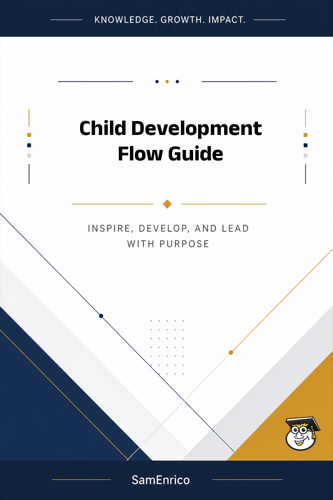
Child Development Flow Guide eBook
Helps children experience flow through play.
Helps children experience flow through play.
Formats
Free sample
Chapter 1: Playful Effort–- The first time Leo built a tower that reached his chin, he did not smile. He frowned, chewed his lower lip, and held his breath until the seventh block wobbled. When it fell, he did not cry. He picked up the same block and started again. His mother, watching from the kitchen doorway, felt her own shoulders relax.
She had not interrupted. She had not said “Good job!” or “Be careful!” She had simply stood still, coffee growing cold in her hand, and watched her four-year-old son experience something that no flashcard, no app, no structured activity could teach. Leo was in flow.That word—“flow”—sounds gentle, even passive, like a stream meandering through a meadow. But anyone who has watched a child in deep play knows the truth. Flow is not lazy.
It is not calm in the way that naptime is calm. Flow is the kind of focused effort that makes a child forget to eat, forget to ask for help, forget to complain. It is the opposite of passive entertainment. It is, as one researcher put it, “the psychology of optimal experience,” and it may be the single most underutilized tool in modern parenting.This chapter is the foundation of everything that follows. Here, you will learn what flow actually is—not the pop-psychology version, but the rigorous, research-backed framework developed by Mihaly Csikszentmihalyi and refined by decades of neuroscience.
You will learn why your child’s brain literally changes shape during deep play, why boredom is not the enemy you think it is, and why the most common parenting instinct (“Let me help you!”) is often the fastest way to destroy concentration. Most importantly, you will learn the single sentence that will guide you through the rest of this book: Flow is playful effort—the kind of hard work that feels like play because you chose it.The Eight Doors to the Zone Before we can cultivate flow, we must recognize it. Csikszentmihalyi, after interviewing thousands of people—from rock climbers to chess grandmasters to assembly line workers—identified eight characteristics that appear whenever a person is in flow. These are not theoretical abstractions. They are observable, measurable, and surprisingly easy to spot in children once you know what to look for.1.
Clear goals, moment to moment. The child knows what they are trying to do. Not in a verbal, planned way—Leo did not say, “My goal is to stack seven blocks without toppling”—but in a felt, immediate way. The goal is built into the activity itself. Stacking blocks: the tower stands or falls.
Drawing: the line goes where the hand guides it. A game of tag: you touch or you are touched. This is why open-ended toys (blocks, balls, clay) produce more flow than complicated electronic toys with shifting objectives. A clear goal is not the same as an adult-imposed goal (“Finish this worksheet”). It is a goal that emerges from the child’s own intention.2.
Immediate feedback. The child knows, in every moment, how they are doing. The block wobbles. The ball goes in the hoop or bounces off the rim. The tower falls or stands.
This feedback loop is why flow is so satisfying and why external rewards (stickers, praise, candy) are not only unnecessary but actively harmful to flow. When a child is in flow, the activity itself provides all the feedback they need. Your “Good job!” is not help; it is noise.3. A balance between challenge and skill. This is the most important characteristic for parents to understand, because it is the one you can most directly influence.
If a task is too easy, the child experiences boredom—not the productive kind we will discuss later, but the hollow, restless kind that leads to whining and disruption. If a task is too hard, the child experiences anxiety—frustration, tears, avoidance. Flow lives in the narrow channel between boredom and anxiety, where the challenge is just slightly above the child’s current skill level. This is what Lev Vygotsky called the Zone of Proximal Development, and it is where all real learning happens.4. Concentration on the task at hand.
In flow, attention is completely absorbed. There is no mental bandwidth left for self-consciousness, for worrying about what the parent is thinking, for rehearsing what to say at dinner. This is why children in flow do not hear you call their name. They are not ignoring you. They are using every ounce of their cognitive capacity on the task they have chosen.
Interrupting flow for a snack, a photo, or a “check-in” is not neutral. It is destructive, requiring up to fifteen minutes to rebuild.5. The loss of self-consciousness. Normally, children (and adults) are at least somewhat aware of themselves as social beings: Am I doing this right? Is someone watching?
Do I look silly? In flow, that voice goes quiet. The child is not thinking about themselves at all. They are simply doing. This is why flow is so restorative for children who struggle with anxiety or social self-consciousness.
The inner critic takes a vacation.6. Altered time perception. Hours can feel like minutes; minutes can feel like hours. A child who plays with water for what feels like five minutes may look up to find that forty-five minutes have passed. Conversely, a child who is forced to sit through a worksheet that is too easy will feel every second stretch into an eternity.
Parents can use this as a diagnostic: if your child keeps asking “How much longer?”, they are not in flow.7. Intrinsic reward. The activity is its own reward. The child does not play to earn a sticker, to get a treat, or to win your approval. They play because the playing itself feels good.
This is the deepest reason why flow builds resilience. Children who regularly experience intrinsic reward learn that effort can be its own pleasure. They do not need external motivation to persist through difficulty.8. A sense of control over the task. The child feels, at least in principle, that they can influence the outcome.
This does not mean they never fail—the tower falls, the tagger catches them. But they feel that their actions matter, that they are not merely passive recipients of fate. This is why choice is so critical. A child who is told “You must build a tower” is already partially out of flow. A child who chooses to build a tower owns the task from the first block.These eight characteristics are not an all-or-nothing checklist.
A child can be in flow without experiencing all eight simultaneously. But the more of these characteristics that are present, the deeper the flow. And the deeper the flow, the greater the developmental benefits—benefits that go far beyond mere happiness.What Happens Inside the Flowing Brain For most of human history, we could only guess what happened inside a child’s head during deep play. Now, thanks to functional magnetic resonance imaging (f MRI) and electroencephalography (EEG), we can watch it happen in real time. The picture is striking.When a child enters flow, several neurological events occur simultaneously.
First, the brain releases a cascade of dopamine—the same neurotransmitter involved in pleasure, motivation, and reward. But unlike the dopamine…
This is the end of the free sample. Get the eBook to keep going. Buy now
About this book
Details
- Author
- Dewitt Felton
- Publisher
- SamEnrico
- Language
- English
- Genre
- Non-Fiction, Self-Help, Child Psychology
- Released
- 2026-06-09
- Pages (approx.)
- 146
- Available as
- eBook, Audiobook

Read better in the ZLOADR app
Your eBooks on your phone or tablet. Sign in with your SamEnrico account and start reading.
More by Dewitt Felton
 The Pomodoro MasteryDewitt Felton$11.99
 Cathedral Silence GuideDewitt Felton$11.99
 Stress Pregnancy ComplicationsDewitt Felton$11.99
 Self Talk for StudentsDewitt Felton$11.99
 Cabin Porch Swing GuideDewitt Felton$11.99
 Archer's Self HypnosisDewitt Felton$11.99
 ABCDE for FreelancersDewitt Felton$11.99
 The Vanishing of the Shanghai Princess: A Prohibition-Era MysteryDewitt Felton$11.99
 Crowfoot’s Shadow: A Blackfoot Spy’s GambitDewitt Felton$11.99
 How to Produce Digital CamerasDewitt Felton$11.99
 White Rhinoceroses: Second LargestDewitt Felton$11.99
 How to Produce a Plant ProtectorDewitt Felton$11.99
You may also like
 Middle School Academic AnxietyRedding Elvera$11.99
 Children's Recurring DreamsCovert Yi$11.99
 Child Emotion RegulationAkin Loise$11.99
 Recurring Dreams in Children GuideAmato Lupe$11.99
 Recurring Dream Children GuideLindsey Brad$11.99
 Divorce and Child Therapy GuideLim Tanner$11.99
 Childhood Nightmare Resolution HandbookRector Edda$11.99
 Nightmare Processing For KidsMuniz Katerine$11.99
 Children's Dream Journal GuideGentry Latarsha$11.99
 Childhood Nightmare RescriptingWyman Zulma$11.99
 Angry Parent Peaceful Child RepairWithrow Estrella$11.99
 The Children Emotion Labeling GuideCouch Madalene$11.99