
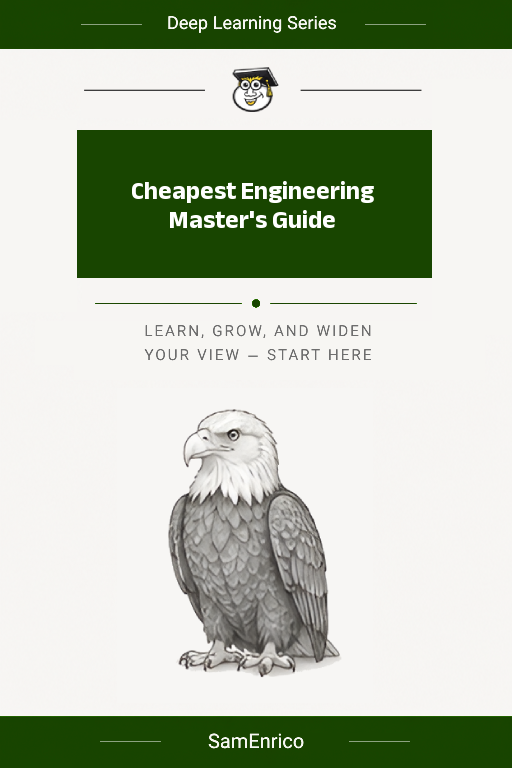
Non-FictionStudent's ShortcutEngineering
Cheapest Engineering Master's Guide eBook
Find low-cost mechanical, electrical, and civil en
Find low-cost mechanical, electrical, and civil engineering master's programs across Europe.
Formats
Free sample
Chapter 1: The Tuition Mirage--The first lie you will be told about master's degrees is that they cost what the price tag says.The second lie is that cheap means low quality.The third lie—the one that keeps thousands of engineers trapped in debt for decades—is that you have no other choice.Let me show you something that admissions officers in the United States, the United Kingdom, and Australia desperately hope you never discover. A two-year master's degree in mechanical engineering at a top German public university costs exactly zero euros for tuition. At a top Italian university, you will pay around twelve hundred euros per year. At a French grande école, with an income-based fee reduction, you might pay three hundred seventy-seven euros for the entire degree.The same degree at Stanford University costs approximately one hundred eighteen thousand dollars in tuition alone. At Imperial College London, you will pay around forty thousand pounds.
At the University of Melbourne, you are looking at roughly seventy thousand Australian dollars.These are not misprints. These are not special discounts for local students. These are the published tuition rates for international students from anywhere in the world.And before your brain starts searching for the catch, let me stop you. The catch is that no one has told you about this. The catch is that your university's study abroad office has never mentioned Germany's tuition-free system because they want you to stay and pay.
The catch is that scholarship search engines are optimized for expensive programs because those programs have marketing budgets. The catch is that the entire Anglo-American higher education industry depends on your belief that a master's degree must cost a life-altering amount of money.This chapter will dismantle that belief completely. By the time you finish reading, you will understand not just which countries offer near-zero tuition, but why they offer it, how to qualify for it, and why the word "free" is actually a dangerous distraction that has sent thousands of students home in financial failure.The Three Near-Zero Tuition Countries Let me be precise about what "near-zero tuition" actually means. In Germany, Austria, and Norway, public universities charge zero euros for tuition to international students. Zero.
Not discounted. Not subsidized. Zero.But you will pay something. Every semester, you will pay a semester contribution called the Semesterbeitrag in Germany, the ÖH Beitrag in Austria, or the semesteravgift in Norway. This fee ranges from three hundred to five hundred euros in Germany, approximately twenty euros in Austria, and about one hundred euros in Norway.
This money covers student services, administrative costs, and—most importantly—an unlimited public transit pass for your entire region.Here is what that transit pass is worth. In the German state of Schleswig-Holstein, where Kiel University is located, a yearly regional train pass for the entire state costs approximately one thousand three hundred euros. Your semester fee of three hundred euros includes this pass for six months. The university is essentially paying you seven hundred euros per semester to ride trains for free.So when someone tells you German tuition is "free," they are technically wrong. But practically speaking, your out-of-pocket tuition cost is between zero and five hundred euros per semester, and you receive a transit pass worth two to three times that amount.
Call it what you want. I call it the best deal in higher education.Germany is the gold standard for a reason. The country has sixteen public universities ranked in the QS World University Rankings top five hundred for engineering. All of them charge zero tuition. All of them teach master's programs in English.
All of them are desperate for international students because Germany has a shortage of three hundred thousand engineers.But—and this is the most important "but" in this entire chapter—Germany is also the most difficult country to survive financially in your first year. The visa requires you to lock away almost twelve thousand euros in a blocked account before you arrive. The housing waitlists in major cities are measured in semesters, not weeks. The bureaucracy is legendary and unforgiving. Zero tuition does not mean zero stress.
It means the financial challenge shifts from paying the university to surviving until you can work.This is the great unspoken truth about near-zero tuition countries. They are not easier than expensive countries. They are harder in different ways. The difficulty moves from your bank account to your planning, your patience, and your ability to navigate foreign systems.Germany: The Industrial Powerhouse Let me walk you through three specific German programs that exemplify everything this book teaches. Each represents a different strategy for minimizing cost while maximizing career outcome.Kiel University sits at the northern tip of Germany, far from the expensive cities of Munich and Frankfurt.
The city of Kiel has two hundred fifty thousand people, a shipbuilding industry, and a university that specializes in marine engineering and microelectronics. The M.Sc. in Electrical and Information Engineering costs zero euros in tuition. The semester fee is approximately three hundred euros. The city is small enough that dorm waitlists are only one or two months, not the two or three semesters you would face in Berlin.But here is the catch that filters out unprepared applicants.
Kiel requires the GRE General Test with a quantitative score above one hundred sixty for non-European applicants. This is not a suggestion. The admissions office will reject your application automatically if your GRE Quant falls below one hundred sixty. They also require proof of German language at the A2 level for some tracks, though the program is officially taught in English.Why does Kiel impose these requirements when they need international engineers? Because too many students arrived in the past without sufficient preparation, failed their courses, lost their visas, and blamed the university.
The GRE and German language requirements are not barriers to exclude you. They are filters to protect you from yourself. If you cannot score above the fiftieth percentile on the GRE Quant section, you will likely struggle with Kiel's rigorous mathematics courses. If you cannot hold a basic conversation in German, you will struggle to find housing, open a bank account, and navigate the visa office.This is not cruelty. This is honesty.
And this book will give you the tools to meet these requirements.THWS Würzburg-Schweinfurt offers something completely different. The M.Eng. in Business and Engineering is a ninety-ECTS program—meaning three semesters or eighteen months, shorter than the standard two-year German master's. Tuition is zero euros. The semester fee is approximately three hundred fifty euros.
But the real story is location.Schweinfurt is not a city anyone visits for tourism. It has fifty thousand people and a skyline dominated by industrial smokestacks. It is the ball bearing capital of Germany, home to SKF, FAG, and ZF Friedrichshafen. The rent for a studio apartment is three hundred fifty to five hundred euros per month, half what you would pay in Munich or Hamburg. The local companies sponsor work visas for THWS graduates before they even finish their thesis.The tradeoff is obvious.
You will live in an ugly industrial town with limited nightlife and few other international students. But you will graduate…
This is the end of the free sample. Get the eBook to keep going. Buy now
About this book
Details
- Author
- Diamond Tristan
- Publisher
- SamEnrico
- Language
- English
- Genre
- Non-Fiction, Student's Shortcut, Engineering
- Released
- 2026-05-28
- Pages (approx.)
- 152
- Available as
- eBook, Audiobook

Read better in the ZLOADR app
Your eBooks on your phone or tablet. Sign in with your SamEnrico account and start reading.
More by Diamond Tristan
 Understanding Compulsive Overeating PatternsDiamond Tristan$11.99
 Titanic Stern Section AnalysisDiamond Tristan$11.99
 Small Talk for Professional ConferencesDiamond Tristan$11.99
 Alzheimer's Early Onset CrisisDiamond Tristan$11.99
 Workaholic Sabbatical GuideDiamond Tristan$11.99
 The Anger and Resentment GuideDiamond Tristan$11.99
 Attention TrainingDiamond Tristan$11.99
 Asking For Help GuideDiamond Tristan$11.99
 Anansi the Weaver and the Round TableDiamond Tristan$11.99
 The Alchemist and the Astronomer: A Love Written in the StarsDiamond Tristan$11.99
 How to Produce Hockey GoalsDiamond Tristan$11.99
 How to Produce Tanning ProductsDiamond Tristan$11.99
You may also like
 Hong Kong Handover 1997Dunn Johnnie$11.99
 Zumba For Postnatal Recovery CourseNeal Christian$11.99
 Zumba for BeginnersLadner Nikia$11.99
 YouTube Comment Mining GuideHumes Pandora$12.99
 Worry Box MeditationCarlin Rudy$11.99
 Workplace Stress MeditationNguyen Lynn$11.99
 Workplace Stress and Sleep RepairHawley Ivory$11.99
 Workplace Perfectionism CureDelaney Jeffry$11.99
 Workplace Injustice Anger GuideWallen Isabelle$11.99
 Work Addiction and Burnout LinkGreenwood Ester$11.99
 Women in Yoga and WellnessBeattie Galina$11.99
 Women in Stand Up ComedyChun Evangeline$11.99