
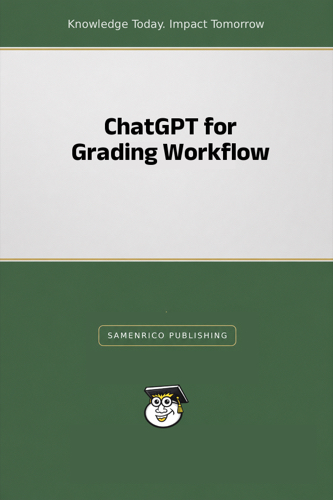
Non-FictionAI OperatorAssessment
ChatGPT for Grading Workflow eBook
Automate rubric-based grading of essays and short
Automate rubric-based grading of essays and short answers while maintaining quality.
Formats
Free sample
Chapter 1: The Sunday Night Dread...--Between September and May of any given school year, an estimated 67% of K-12 and university teachers report that grading is the single largest contributor to their workplace stress. Not lesson planning. Not classroom management. Not parent emails. Grading.
The stack of papers, the blinking cursor on a rubric spreadsheet, the repetitive comments written for the thirtieth time about comma splices or missing topic sentences. For the average secondary English or history teacher with 150 students, grading a single five-paragraph essay takes five to seven minutes per paper when done conscientiously. Multiply that by 150. That's 750 minutes—12.5 hours—per assignment. Now multiply that by six major assignments per year.
Seventy-five hours. Two full work weeks. And that is just essays. Short answers, lab reports, discussion post feedback, and daily check-ins add dozens more hours.This chapter is not an introduction. It is an intervention.
Before we talk about prompts, rubrics, or AI workflows, we must name the enemy clearly. The enemy is not lazy students, unreasonable administrators, or flawed curriculum. The enemy is the false belief that grading must be slow, lonely, and exhausting to be rigorous. That belief has cost teachers their evenings, their weekends, their relationships, and, in too many cases, their careers. In this chapter, we will quantify the true cost of grading, dismantle the myths that keep teachers trapped in inefficient workflows, introduce a new mental model for what an AI assistant can and cannot do, and end with a self-assessment that will show you exactly where you can save hours starting tomorrow.
If you have ever felt a knot in your stomach when you look at the ungraded pile, you are not broken. You are just grading like it is 1995. Let us change that.The Hidden Math of Grading Burnout Let us be precise. Grading burnout is not a feeling. It is a mathematical inevitability built into the current structure of teaching.
Consider a realistic scenario. You are a high school social studies teacher with five sections of 30 students each. That is 150 students. You assign a one-page written response requiring source citation and argumentation. A good-faith grading approach includes: reading for understanding, checking against a rubric, noting specific evidence, writing a short comment, and entering the score.
Research on teacher grading speed suggests that even experienced teachers average three to four minutes per page for thoughtful, rubric-aligned grading. That yields 450 to 600 minutes—seven and a half to ten hours—for one assignment. Now add the cognitive load. Grading is not passive reading; it requires constant decision-making. Does this thesis meet the standard?
Is this evidence sufficient? Is this a pattern error or a one-time mistake? Each decision consumes mental energy. After the thirtieth paper, decision fatigue sets in. After the sixtieth, consistency drifts.
After the ninetieth, many teachers begin skimming or using shorthand comments that help no one.The math gets worse when we factor in the emotional labor of grading. Writing constructive criticism for a student who clearly did not try takes emotional regulation. Reading the same misconception across forty papers takes patience. Facing a stack of submissions the night before grades are due takes willpower. Teachers report that grading is not merely time-consuming; it is emotionally depleting in ways that lesson planning and direct instruction are not.
One teacher interviewed for the research behind this book described grading as "death by a thousand paper cuts." Another said, "I love teaching. I hate grading. And I hate that I hate it because I know my students deserve feedback."The most insidious cost, however, is not time or emotion. It is the opportunity cost of what teachers cannot do because they are grading. Teachers who spend weekends grading are not planning creative lessons, not calling parents with good news, not collaborating with colleagues, not resting.
A 2022 survey by the Teacher Wellbeing Index found that teachers who reported grading as their primary stressor were 3.2 times more likely to consider leaving the profession within two years. Grading does not just exhaust teachers. It drives them out of teaching.The Myths That Keep Teachers Stuck Before we can build a better workflow, we must dismantle the mental traps that make teachers resistant to change. These myths are not malicious. They are often taught explicitly in teacher preparation programs or absorbed through the hidden curriculum of school culture.
But they are myths nonetheless, and they are keeping you chained to the grading pile.Myth 1: "Every piece of writing deserves my full, undivided attention." This sounds noble. It is also impossible to sustain. The reality is that students receive diminishing returns from hyper-detailed feedback after the first few comments. John Hattie's meta-analysis of educational interventions found that while feedback is among the most powerful tools for learning, its power comes from timeliness and specificity, not volume. A student who receives a ten-minute, heavily annotated paper two weeks after submission learns less than a student who receives a two-minute, targeted comment the next day.
Speed and focus often beat exhaustive depth.Myth 2: "If I automate anything, I am cheating my students." This myth confuses the tool with the pedagogue. Using a calculator does not make a math teacher lazy. Using a spelling checker does not make a writing teacher fraudulent. Automation is not abdication. It is delegation of the repetitive, pattern-based aspects of grading to a machine that is literally built for that purpose, freeing the teacher to do what only humans can do: interpret nuance, address affective needs, build relationships, and design better instruction.
The fear of automation is often a fear of being replaced. But as you will see throughout this book, the workflow we are building puts the teacher at the center, not the periphery.Myth 3: "Good grading is slow grading." Speed is not the enemy of quality. In fact, research on expertise suggests that experts in any field—from chess to medicine to teaching—make faster decisions because they have developed pattern recognition. A novice grader reads each sentence. An expert grader sees structures, anticipates common errors, and allocates attention efficiently.
The goal of this book is not to make you a faster human grader. It is to give you an AI assistant that has already read thousands of essays and can handle the pattern recognition, leaving you to focus on the judgments that require your expertise.Myth 4: "My students will not accept AI grading." This is a projection of adult anxiety onto digital natives. Students care about two things: getting feedback quickly enough to use it on the next assignment, and feeling that the feedback is fair. Multiple studies on AI feedback tools have found that students often prefer AI-generated comments because they are more specific, less emotionally charged, and arrive sooner. The resistance, when it occurs, is almost always about transparency.
Students do not like feeling that a secret algorithm judged them. But when teachers are transparent—"I use an AI first pass to give you faster feedback, and then I review every score before it counts"—students are overwhelmingly accepting. You will learn exactly how to handle this transparency conversation in Chapter 2.The AI Partnership Model: From Replacement to Assistant The most important sentence in this book appears here. Read it twice. You are…
This is the end of the free sample. Get the eBook to keep going. Buy now
About this book
Details
- Author
- Falcon Antionette
- Publisher
- SamEnrico
- Language
- English
- Genre
- Non-Fiction, AI Operator, Assessment
- Released
- 2026-06-07
- Pages (approx.)
- 145
- Available as
- eBook, Audiobook

Read better in the ZLOADR app
Your eBooks on your phone or tablet. Sign in with your SamEnrico account and start reading.
More by Falcon Antionette
 Fear of Happiness Cherophobia GuideFalcon Antionette$11.99
 Polish Human Chain PartisansFalcon Antionette$11.99
 Breath Awareness For RetirementFalcon Antionette$11.99
 Stress Related Skin Disorders HandbookFalcon Antionette$11.99
 Windigo's Lament: The Hunger of Winter's ShadowFalcon Antionette$11.99
 Understanding Marek DiseaseFalcon Antionette$17.99
 Croatia Tourism Real Estate GuideFalcon Antionette$12.99
 Strategy Meeting Glossary TermsFalcon Antionette$12.99
 How to Become a Seed PelleterFalcon Antionette$11.99
 Metric Dashboard DesignerFalcon Antionette$11.99
You may also like
 Hong Kong Handover 1997Dunn Johnnie$11.99
 Zumba For Postnatal Recovery CourseNeal Christian$11.99
 Zumba for BeginnersLadner Nikia$11.99
 YouTube Comment Mining GuideHumes Pandora$12.99
 Worry Box MeditationCarlin Rudy$11.99
 Workplace Stress MeditationNguyen Lynn$11.99
 Workplace Stress and Sleep RepairHawley Ivory$11.99
 Workplace Perfectionism CureDelaney Jeffry$11.99
 Workplace Injustice Anger GuideWallen Isabelle$11.99
 Work Addiction and Burnout LinkGreenwood Ester$11.99
 Women in Yoga and WellnessBeattie Galina$11.99
 Women in Stand Up ComedyChun Evangeline$11.99