
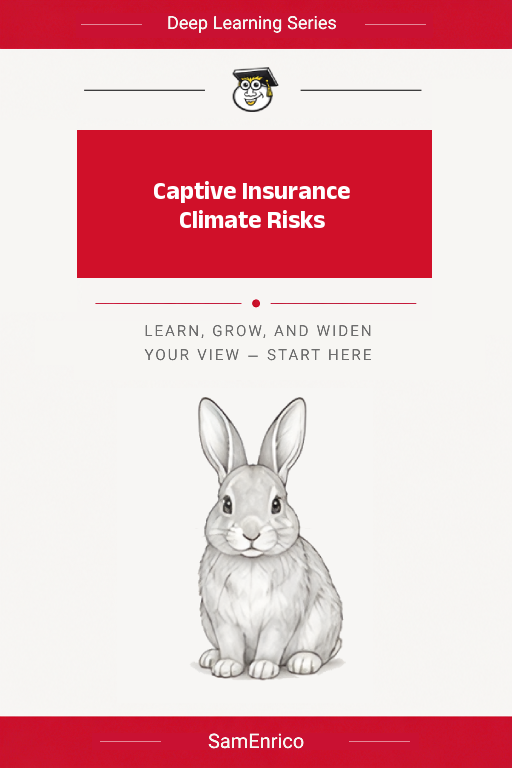
Captive Insurance Climate Risks eBook
Form a captive insurer to self-insure climate risk
Form a captive insurer to self-insure climate risks when commercial markets retreat.
Formats
Free sample
Chapter 1: The Cancellation Notice--–- The envelope arrived on a Tuesday. Certified mail, return receipt requested. The risk manager, a thirty-year veteran of the property-casualty industry, knew what it was before she opened it. She had seen the same envelope land on a dozen other desks over the past eighteen months. Hers was simply the latest.Inside, a single page from a carrier she had done business with for two decades.
The letter was polite, professional, and utterly devastating: "After careful review of our exposure in the Gulf Coast region, we have made the difficult decision not to renew your commercial property insurance policy effective June 30, 2025. This decision is final and not subject to appeal."No warning. No negotiation. No explanation beyond the obvious. Her company had not filed a significant claim in seven years.
Their loss ratio was exemplary. They had installed hurricane shutters, reinforced roofs, and maintained a rigorous maintenance schedule. None of it mattered. The insurer was not leaving her company. The insurer was leaving the entire ZIP code.This chapter opens with that story not as a hypothetical but as a composite drawn from dozens of real cancellations across Florida, California, and Louisiana in 2024 and 2025.
The traditional risk transfer model is failing for climate-exposed assets, and the failure is accelerating. Waiting for the market to return is not a strategy. The market is not coming back. At least, not in any form that responsible corporate leaders would recognize as reliable.This book is written for those leaders. For the CFO who receives that cancellation notice and realizes that their entire risk management strategy has just evaporated.
For the board member who reads the SEC's latest climate disclosure guidance and understands that personal liability is no longer theoretical. For the CEO who watches competitors form captive insurers and wonders if they are being left behind. They are.The purpose of this chapter is to establish the undeniable facts of the great insurance retreat, to define the protection gap in concrete terms, to name the specific states and markets where the retreat is most advanced, and to make the business case that relying solely on third-party paper for existential climate risks is no longer a prudent fiduciary strategy. By the end of this chapter, the reader should understand two things with absolute clarity: first, the commercial insurance market is structurally unable to price climate volatility without causing economic shock; second, the only responsible response is to build internal capacity to self-insure, using the captive insurance company as the primary vehicle.The Geography of Abandonment Let us begin with the numbers that insurers themselves do not want you to see. In Florida, between 2020 and 2025, more than fifteen property and casualty insurers either went insolvent or voluntarily withdrew from the homeowners and commercial property markets.
The names are familiar to anyone who follows the industry: Farmers Insurance, Bankers Insurance, United Property & Casualty, and a dozen smaller regional carriers. In their place, a state-created carrier of last resort, Citizens Property Insurance Corporation, has become the largest insurer in the state. As of mid-2025, Citizens held over 1.3 million policies, more than double its volume from 2020. This is not a market. It is a hospital ward.California tells a similar story but with different geography.
There, the retreat has been driven by wildfire risk rather than hurricanes. In 2023 alone, State Farm announced it would stop accepting new property insurance applications in the state. Allstate followed within weeks. Farmers Insurance capped new homeowners policies at a trickle. By early 2025, seven of the twelve largest home insurers in California had either restricted new business or announced plans to reduce existing exposure.
The California Department of Insurance responded by implementing new regulations requiring insurers to write policies in high-risk areas as a condition of writing them in low-risk areas—a classic cross-subsidization strategy that is already showing signs of strain as more carriers simply exit the state entirely rather than comply.Louisiana offers perhaps the most extreme case study. After Hurricane Ida in 2021, more than a dozen insurers became insolvent or left the state. The remaining carriers raised premiums by an average of 63 percent in 2022 alone, with some policyholders seeing increases of 300 percent or more. By 2025, the Louisiana Citizens Property Insurance Corporation had become the largest homeowners insurer in the state, mirroring Florida's trajectory but with even more dramatic consolidation. A home that cost 3,000toinsurein2019nowcosts3,000 to insure in 2019 now costs 3,000toinsurein2019nowcosts12,000 or more—if the homeowner can find coverage at all.These three states are not anomalies.
They are the leading indicators of a national and global trend. In Australia, insurers have begun mapping "high-risk postcodes" for flood and wildfire, effectively redlining entire regions. In Spain and Portugal, European carriers are reducing coverage for agricultural assets in drought-prone areas. In the Caribbean, reinsurers are requiring primary carriers to exclude wind coverage from all policies in certain island chains—a quiet but devastating change that leaves entire nations effectively uninsurable.The term for these zones is becoming standardized in industry literature: insurance deserts. Like food deserts or banking deserts, insurance deserts are geographic areas where the essential service of risk transfer is either unavailable or available only at prices that make it functionally inaccessible.
The desert is spreading. And unlike physical deserts, which take centuries to expand, insurance deserts can grow in a single underwriting cycle.The Protection Gap Defined Behind every insurance desert lies a number that should terrify every corporate leader: the protection gap.The protection gap is the difference between economic losses from natural catastrophes and insured losses. When a hurricane causes 100billionindamageandinsurancepays100 billion in damage and insurance pays 100billionindamageandinsurancepays60 billion, the protection gap is 40billion.That40 billion. That 40billion.That40 billion represents losses that someone—usually the asset owner, sometimes the government, often the broader economy—must absorb without the buffer of insurance.Globally, the protection gap has been widening for two decades. According to Swiss Re's annual sigma reports, which represent the most authoritative source for global catastrophe loss data, economic losses from natural catastrophes averaged approximately 280billionannuallybetween2020and2024,withahighof280 billion annually between 2020 and 2024, with a high of 280billionannuallybetween2020and2024,withahighof368 billion in 2017 (the year of Hurricanes Harvey, Irma, and Maria) and a low of $210 billion in 2020.
Insured losses over the same period averaged approximately 40 percent of economic losses in developed economies and as low as 5 percent in developing nations.To put these numbers in human terms: every year, approximately 170billioninclimate−relatedlossesarenotinsured.Thatis170 billion in climate-related losses are not insured. That is 170billioninclimate−relatedlossesarenotinsured.Thatis170 billion that falls directly onto balance sheets, municipal budgets, and household savings. For corporations, that uninsured loss lands squarely on the income statement, often in a single quarter, often with devastating consequences for earnings, stock price, and access to capital.The protection gap is not static. It is growing at approximately 5 to 7 percent annually, driven by three trends that show no sign of reversing. First, the frequency and severity of climate events are increasing as atmospheric physics respond to rising greenhouse gas concentrations.
Second, the concentration of assets in exposed areas continues to grow as population and economic activity shift to coastal and fire-prone regions. Third, the insurance industry's capacity to absorb losses is shrinking…
This is the end of the free sample. Get the eBook to keep going. Buy now
About this book
Details
- Author
- Schumacher Van
- Publisher
- SamEnrico
- Language
- English
- Genre
- Non-Fiction, Business Brief
- Released
- 2026-05-30
- Pages (approx.)
- 154
- Available as
- eBook, Audiobook

Read better in the ZLOADR app
Your eBooks on your phone or tablet. Sign in with your SamEnrico account and start reading.
More by Schumacher Van
 Roseburia InterpretationSchumacher Van$11.99
 Pregnancy Loss Empathy GuideSchumacher Van$11.99
 Governor's Confederate Monument RemovalSchumacher Van$11.99
 Toddler Tantrum Stress Survival GuideSchumacher Van$11.99
 Coping With Student Loan StressSchumacher Van$11.99
 Roam Research MemorySchumacher Van$11.99
 REM Sleep Emotional MemorySchumacher Van$11.99
 Pomodoro For ReviewSchumacher Van$11.99
 ASV Therapy GuideSchumacher Van$11.99
 The Forgotten Ace: The Untold Story of Eddie Rickenbacker in WWIISchumacher Van$11.99
 The Battle of Antietam: Blood on the CornfieldSchumacher Van$11.99
 Beneath the Grid: The Lost Subterranean Cities of the WorldSchumacher Van$11.99
You may also like
 Hong Kong Handover 1997Dunn Johnnie$11.99
 Zumba For Postnatal Recovery CourseNeal Christian$11.99
 Zumba for BeginnersLadner Nikia$11.99
 YouTube Comment Mining GuideHumes Pandora$12.99
 Worry Box MeditationCarlin Rudy$11.99
 Workplace Stress MeditationNguyen Lynn$11.99
 Workplace Stress and Sleep RepairHawley Ivory$11.99
 Workplace Perfectionism CureDelaney Jeffry$11.99
 Workplace Injustice Anger GuideWallen Isabelle$11.99
 Work Addiction and Burnout LinkGreenwood Ester$11.99
 Women in Yoga and WellnessBeattie Galina$11.99
 Women in Stand Up ComedyChun Evangeline$11.99