
Non-FictionSelf-HelpAnger Management
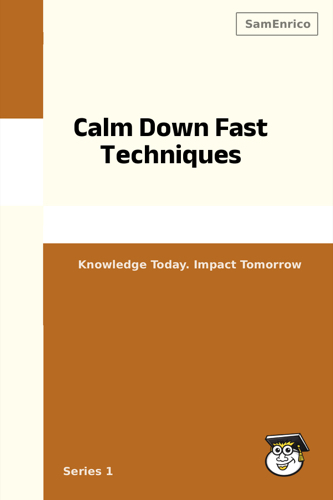
Calm Down Fast Techniques eBook
Use physiological sighs and grounding methods to l
by Dunn Johnnie
Use physiological sighs and grounding methods to lower rage within sixty seconds.
Formats
Free sample
Chapter 1: The Explosion Lie--You have been told your whole life that rage is a moral failure. That losing your temper means you lack discipline, or character, or love. That calm people are simply better people.Every single one of those statements is scientifically false.The explosion of rage you feel in your chest, the heat behind your eyes, the urge to throw something or scream or punch a wall—none of that means you are broken, weak, or bad. It means your nervous system is doing exactly what evolution designed it to do: protect you from a threat. The problem is that your brain cannot reliably tell the difference between a saber-toothed tiger and a rude email from your boss.
It cannot distinguish between someone cutting you off in traffic and someone actually trying to kill you. To your amygdala—the almond-shaped cluster of neurons deep in your brain that serves as your emotional alarm system—both events look remarkably similar.This chapter is going to dismantle everything you think you know about rage. You will learn why the standard advice to "just breathe" or "count to ten" fails precisely when you need it most. You will discover the seventy-second window of biochemical opportunity that exists inside every rage episode. And you will begin to see your anger not as an enemy to be eliminated, but as a signal to be interpreted and a physiological event to be managed.By the end of this chapter, you will never blame yourself for feeling rage again.
And more importantly, you will understand exactly why the techniques in the rest of this book work so quickly.The Three-Second Hijack Let us start with a simple experiment. Right now, without warning, try to recall the most infuriating moment of your life. Do not dwell on it—just let the memory surface.Did you notice what happened in your body? Perhaps your jaw tightened. Maybe your breathing became shallower.
You might have felt a flush of heat across your chest or face. If you are like most people, the memory alone triggered a physical response within three seconds.That is the amygdala hijack in action.The term was coined by psychologist Daniel Goleman in his groundbreaking work on emotional intelligence, but the phenomenon has been understood in neuroscience for decades. Here is what happens: sensory information from your environment travels to your brain along two pathways. The first pathway is the "low road"—a direct, lightning-fast connection from your thalamus (the brain's relay station) straight to your amygdala. This route takes approximately twelve milliseconds.
The second pathway is the "high road"—a slower, more detailed route from your thalamus up to your neocortex (the thinking brain) for analysis, then down to the amygdala. This route takes several hundred milliseconds.Twelve milliseconds versus several hundred. That difference—that tiny slice of time—is the entire reason rage feels uncontrollable.When you perceive a threat, your amygdala reacts before your prefrontal cortex (the part of your brain responsible for rational thought, impulse control, and long-term planning) even knows what is happening. Your body is already flooding with stress hormones, your heart rate is already spiking, your muscles are already tensing for fight or flight, and your thinking brain is still back at the starting line, trying to figure out what just happened.This is not a design flaw. It is a survival feature.
If you are standing in a field and a lion charges at you, you do not want to wait for your neocortex to carefully analyze the lion's body language, consider the historical context of lion behavior, and weigh the pros and cons of running away. You want your body to move immediately. The amygdala hijack is what makes that possible.The problem is that modern life is full of "lions" that are not actually lions. A critical email. A partner's sarcastic comment.
A driver who takes the parking spot you were waiting for. A child who spills juice on the carpet for the fifth time. Your amygdala cannot tell the difference. It treats every frustration as a survival threat, and it responds with the same full-body mobilization every single time.This is the first lie we need to correct: rage is not a choice you make in the moment. It is a physiological event that happens to you.
The choice comes in what you do during the next sixty to ninety seconds.The Chemistry of Combustion To understand why rage feels so overwhelming, we need to look at what is actually happening inside your body during those first few seconds after a trigger.The Adrenaline Surge Within seconds of the amygdala's alarm, your adrenal glands—small organs sitting on top of your kidneys—release a flood of epinephrine (adrenaline) into your bloodstream. Adrenaline is your body's primary accelerator pedal. It increases your heart rate, raises your blood pressure, expands your airways, and redirects blood flow away from non-essential systems (like digestion) toward your large muscles. Your pupils dilate. Your hearing becomes more acute.
Your non-essential functions begin to shut down. This is why, in the middle of a rage episode, you might not feel hungry, you might not notice minor pains, and you might not hear someone trying to get your attention.The Cortisol Cascade Approximately twenty to thirty seconds after the adrenaline surge, your body releases cortisol. While adrenaline is the accelerator, cortisol is the fuel pump. It keeps your body in a state of high alert, ensuring that glucose (sugar) is available for immediate energy, and it suppresses systems that are not immediately necessary for survival, including your immune response and your reproductive system. Cortisol is the reason rage can linger.
It is the hormone that turns a momentary flash of anger into a simmering resentment that lasts for hours.The Respiratory Shift Perhaps most important for our purposes is what happens to your breathing. Under the influence of adrenaline and cortisol, your body shifts from slow, deep diaphragmatic breathing (belly breathing) to fast, shallow thoracic breathing (chest breathing). Your breath rate increases. Your inhales become shorter and more forceful. Your exhales become passive and incomplete.
This pattern serves a purpose in genuine physical danger: it oxygenates your blood quickly and prepares your muscles for explosive action. But it also creates a feedback loop. Rapid, shallow breathing signals to your brain that you are still in danger, which keeps the stress hormones flowing, which keeps your breathing rapid and shallow.This is why telling someone in a rage to "just breathe" is not just unhelpful—it is actively frustrating. Their body is already breathing. It is breathing in a high-arousal pattern.
Telling them to breathe without telling them how to change the pattern is like telling someone who is drowning to "just swim" without teaching them a stroke.The Prefrontal Cortex Blackout The most critical piece of this chemical puzzle is what happens to your prefrontal cortex (PFC). Your PFC is the part of your brain right behind your forehead that handles executive functions: impulse control, planning, decision-making, social cognition, and emotional regulation. Under normal conditions, your PFC acts as a brake on your emotional impulses. It is the part of you that…
This is the end of the free sample. Get the eBook to keep going. Buy now
About this book
Details
- Author
- Dunn Johnnie
- Publisher
- SamEnrico
- Language
- English
- Genre
- Non-Fiction, Self-Help, Anger Management
- Released
- 2026-06-10
- Pages (approx.)
- 148
- Available as
- eBook, Audiobook

Read better in the ZLOADR app
Your eBooks on your phone or tablet. Sign in with your SamEnrico account and start reading.
More by Dunn Johnnie
 Hong Kong Handover 1997Dunn Johnnie$11.99
 Social Security Life ExpectancyDunn Johnnie$11.99
 Hinton Execution Dates AvoidedDunn Johnnie$11.99
 Demand Variability Safety StockDunn Johnnie$11.99
 Memory Palace For Yoga SequencesDunn Johnnie$11.99
 Recurring Dream AnalysisDunn Johnnie$11.99
 Pomodoro for EngineersDunn Johnnie$11.99
 The Double Life of Mata Hari: A Spy’s Last DanceDunn Johnnie$11.99
 Iron Storm: The Hittites' Last Stand at KadeshDunn Johnnie$11.99
 Mastering The SternocleidomastoidDunn Johnnie$11.99
 How to Produce Pottery and EnamelDunn Johnnie$11.99
 Meeting Recovery Micro-Break GuideDunn Johnnie$12.99
You may also like
Hong Kong Handover 1997Dunn Johnnie$11.99 Zumba For Postnatal Recovery CourseNeal Christian$11.99
 Zumba for BeginnersLadner Nikia$11.99
 YouTube Comment Mining GuideHumes Pandora$12.99
 Worry Box MeditationCarlin Rudy$11.99
 Workplace Stress MeditationNguyen Lynn$11.99
 Workplace Stress and Sleep RepairHawley Ivory$11.99
 Workplace Perfectionism CureDelaney Jeffry$11.99
 Workplace Injustice Anger GuideWallen Isabelle$11.99
 Work Addiction and Burnout LinkGreenwood Ester$11.99
 Women in Yoga and WellnessBeattie Galina$11.99
 Women in Stand Up ComedyChun Evangeline$11.99