
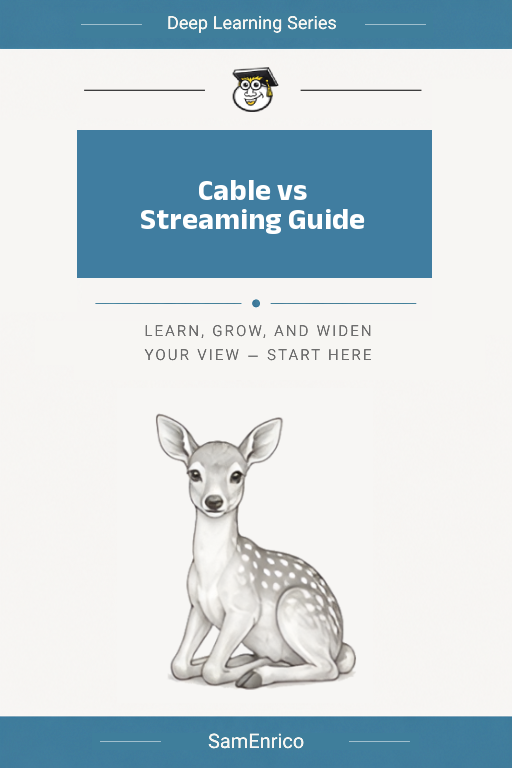
Non-FictionConsumer Mind ReportEntertainment
Cable vs Streaming Guide Audiobook
Contrast traditional pay-TV, virtual MVPDs, ad-sup
Contrast traditional pay-TV, virtual MVPDs, ad-supported tiers, and password sharing attitudes across generations.
Formats
Free sample
Chapter 1: The Great Disruption--–- In 1995, the average American television viewer had a simple, predictable, and expensive relationship with their entertainment. They paid one bill—typically between 35and35 and 35and50 per month—to one company: the local cable monopoly or the regional satellite provider. That bill purchased access to a carefully curated bundle of 40 to 80 channels, delivered through a coaxial cable or a small satellite dish mounted on the side of the house. The experience was linear, passive, and communal. You did not choose what to watch so much as you surfed through what was available.
The guide was a scrolling grid of channel numbers and show titles. Recording required a separate VCR or a clunky DVR box that cost an extra $10 per month. And if you wanted to cancel, you called a customer service number and spent forty-five minutes on hold while a retention agent tried to convince you to stay.That world is dead. It did not die overnight, and it did not die quietly. It died through a thousand small cuts: the arrival of a red envelope in the mail, the first time you streamed a movie without buffering, the month you realized you had not turned on your cable box in six weeks, and the day you finally called to cancel and felt a small sense of liberation.
The story of how we got from the cable bundle of 1995 to the fragmented streaming landscape of 2026 is not merely a technological tale. It is a story about consumer psychology, failed industry foresight, unintended consequences, and a paradox that defines modern entertainment: we have never had more choice, and we have never been more frustrated.The Golden Age of Cable To understand the disruption, we must first understand what was disrupted. The cable television system that reigned from the late 1980s through the mid-2000s was, for its time, a marvel of engineering and economics. It solved several problems simultaneously. It delivered better picture quality than over-the-air broadcast.
It offered dozens—then hundreds—of channels where broadcast had offered only three or four. It created a stable revenue model that funded the most ambitious and expensive television production in history. The 1990s and 2000s produced shows like The Sopranos, The Wire, Breaking Bad, Mad Men, The West Wing, and Lost—prestige dramas that would have been impossible under the old advertising-only broadcast model. Cable subscriptions peaked in 2011 at approximately 100…
This is the end of the free sample. Get the Audiobook to keep going. Buy now
About this book
Details
- Author
- Earley Lakendra
- Publisher
- SamEnrico
- Language
- English
- Genre
- Non-Fiction, Consumer Mind Report, Entertainment
- Released
- 2026-06-01
- Pages (approx.)
- 146
- Available as
- eBook, Audiobook

Listen in the VoxFlicks app
Audiobooks and audio dramas wherever you go. Sign in with your SamEnrico account and press play.
More by Earley Lakendra
 International Franchise Exit StrategyEarley Lakendra$11.99
 Vietnamese Seller Amazon USEarley Lakendra$11.99
 Self Hypnosis for Pain ReliefEarley Lakendra$11.99
 Field of Light VisualizationEarley Lakendra$11.99
 The Metta for Imposter SyndromeEarley Lakendra$11.99
 Roar of the Crowd: How 19th-Century Football Stadiums Shaped Australia and New Zealand’s Sporting SoulEarley Lakendra$11.99
 African Marketplaces ComparisonEarley Lakendra$12.99
 How to Start a Nailing Machines Business (Beginners Guide)Earley Lakendra$11.99
 Understanding Reinhardt–pfeiffer SyndromeEarley Lakendra$17.99
 InstructorEarley Lakendra$11.99
You may also like
 Hong Kong Handover 1997Dunn Johnnie$11.99
 Zumba For Postnatal Recovery CourseNeal Christian$11.99
 Zumba for BeginnersLadner Nikia$11.99
 YouTube Comment Mining GuideHumes Pandora$12.99
 Worry Box MeditationCarlin Rudy$11.99
 Workplace Stress MeditationNguyen Lynn$11.99
 Workplace Stress and Sleep RepairHawley Ivory$11.99
 Workplace Perfectionism CureDelaney Jeffry$11.99
 Workplace Injustice Anger GuideWallen Isabelle$11.99
 Work Addiction and Burnout LinkGreenwood Ester$11.99
 Women in Yoga and WellnessBeattie Galina$11.99
 Women in Stand Up ComedyChun Evangeline$11.99