
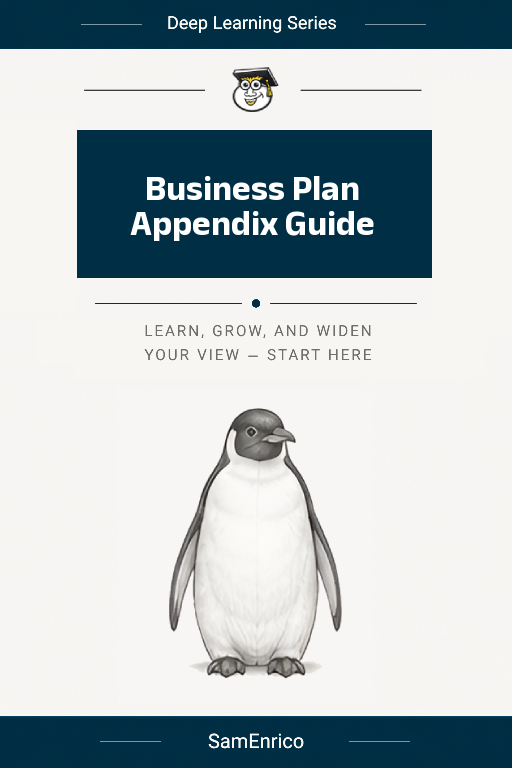
Business Plan Appendix Guide eBook
Organize business plan appendix with supporting do
by Penn Elodia
Organize business plan appendix with supporting documents using free cloud storage and links.
Formats
Free sample
Chapter 1: The Million-Dollar Binder--It was 10:47 PM on a Tuesday when Sarah lost the deal.Not because her technology was flawed. Not because her market was too small. Not because her team lacked experience. Sarah lost a $1.2 million seed round because her appendix was a three-ring binder that fell apart in an investor's hands.The binder had seemed like a good idea. She had spent three full days printing, hole-punching, and organizing every document an investor could possibly want: resumes, financial projections, patent filings, market research, customer testimonials.
It was beautiful. Color-coded tabs. Laminated cover page. A table of contents that would make a librarian weep with joy.She handed it to Mark, a partner at a mid-tier venture firm, at the end of a promising pitch. "Here's our full due diligence package," she said, beaming with pride.Mark took the binder, nodded, and placed it on top of a stack of fourteen other binders on his desk.
Sarah never heard from him again.Six months later, a casual conversation with Mark's associate revealed the truth. "Oh, the binder?" the associate said. "Mark travels four days a week. That binder weighed seven pounds. He wasn't going to carry it through airport security.
And honestly? By the time he got back to the office, he had already reviewed three other deals using digital data rooms. Yours was just... too late. Too heavy.
Too last-decade."Seven pounds. That was the weight of Sarah's lost opportunity.The Silent Killer of Startup Funding Let me tell you something that no business plan book will admit. I have reviewed the top ten best-selling business planning guides of the past decade—from Rhonda Abrams' Successful Business Plan Secrets & Strategies to Brian Finch's How to Write a Business Plan to Edward Blackwell's How to Prepare a Business Plan. Every single one of them tells you to include an appendix. Every single one lists the documents you should put in it.
And every single one is trapped in the physical world.They tell you to print everything. To organize it with tabs. To bring it to meetings in a binder.They are wrong.Not partially wrong. Not out-of-date in minor ways. Fundamentally, catastrophically wrong about how modern due diligence actually works.Here is what those books don't tell you.
Sophisticated investors—the ones with real money and real decision-making power—spend an average of ninety seconds reviewing a business plan before deciding whether to dig deeper. Of those ninety seconds, roughly sixty are spent in the appendix. They flip to the back first. They look for evidence. They verify your claims before they trust your narrative.And if your appendix is a binder?
They won't flip at all. They'll put it on the stack. Your seven pounds of carefully organized paper becomes a paperweight.The Three Lies We Tell Ourselves About Appendices Before we can build something better, we need to dismantle the assumptions that are quietly killing your funding chances. I have heard these lies from thousands of entrepreneurs. They sound reasonable.
They feel responsible. And they are wrong.Lie Number One: "More documents make me look prepared."This is the quantity fallacy. Entrepreneurs assume that a thicker binder signals diligence. In reality, a thick binder signals that you don't know what matters. Investors are not impressed by volume.
They are impressed by signal-to-noise ratio. A ten-page appendix that contains exactly the right evidence, organized for instant retrieval, will beat a two-hundred-page binder every single time.The investor is thinking: "If this founder can't figure out what I actually need to see, how will they figure out product-market fit?" Every unnecessary document you include is a vote against your own judgment.Lie Number Two: "Printing everything shows I'm serious."This is the professionalism fallacy. We associate paper with permanence, with seriousness, with legitimacy. But here is what investors actually hear when you hand them a printed binder: "I don't understand how modern due diligence works. I haven't thought about your workflow.
I am optimizing for my own sense of security rather than your ability to review information efficiently."Investors live on their phones and laptops. They review deals on airplanes, in hotel lobbies, between back-to-back meetings. They need information that fits into their life, not information that requires a separate carry-on bag.Lie Number Three: "Paper is more secure than digital."This is the security fallacy. It feels safe to hand someone a physical document. You can't hack paper.
You can't accidentally email a binder to the wrong person. But here is what actually happens to that binder: it sits on a desk. It gets photocopied by an assistant. It gets left in a conference room. It gets scanned—badly—into a PDF that someone then emails around without permission.A properly configured digital appendix, by contrast, gives you total control.
You can see who opened which document. You can revoke access with a single click. You can set links to expire after a specific date. Digital, done right, is infinitely more secure than paper.The Anatomy of a Modern Appendix So what replaces the binder?Let me introduce you to the framework that will structure everything in this book. I call it the Evidence Locker—a fully digital, cloud-based appendix that lives online, updates in real time, and gives investors exactly what they need in the fewest possible clicks.The Evidence Locker rests on two foundational principles.Principle One: Verification, Not Documentation Your appendix is not a filing cabinet.
It is not a historical archive. It is a verification engine. Every single document in your appendix exists for one reason only: to prove that something in your business plan is true.This shifts everything. Instead of asking "What documents do I have?" you ask "What claims in my plan need verification?" Instead of organizing by document type, you organize by claim. Instead of including everything you can find, you include only what an investor would reasonably doubt.The Credibility Loop is the mechanism that makes this work.
Here is how it operates. Every major claim in your executive summary and business plan receives a numbered cross-reference to your appendix. The claim itself lives in the main document. The evidence lives in the appendix. The link lives between them.For example, your executive summary says: "Our CTO has fifteen years of artificial intelligence experience, including four years at Google Brain." In a traditional plan, the investor has to trust you or schedule a separate call.
In the Evidence Locker, that sentence ends with a parenthetical: "(See Appendix A, Tab 1.2 for verified resume and Linked In profile)." And that parenthetical is a live, clickable link.The investor clicks. They see the evidence. They click back. They continue reading. The entire loop takes five seconds.Principle Two: Accessibility Over Availability Traditional appendices prioritize availability.
The document exists. You have a copy. You can hand it to someone. But availability is not the same as accessibility. A document that exists but cannot be found is useless.
A document that can be found but takes forty-five seconds to open is almost useless. A document that requires a download, a login, or a separate search is effectively invisible.The Evidence Locker prioritizes accessibility. Every…
This is the end of the free sample. Get the eBook to keep going. Buy now
About this book
Details
- Author
- Penn Elodia
- Publisher
- SamEnrico
- Language
- English
- Genre
- Non-Fiction, Startup Guide, Appendix, Supporting Docs
- Released
- 2026-05-30
- Pages (approx.)
- 140
- Available as
- eBook, Audiobook

Read better in the ZLOADR app
Your eBooks on your phone or tablet. Sign in with your SamEnrico account and start reading.
More by Penn Elodia
 The Funnel for FreelancersPenn Elodia$11.99
 Restful Alertness State GuidePenn Elodia$11.99
 The Mayor Who Lost the OlympicsPenn Elodia$11.99
 Third Party Vendor Data Leak ScriptsPenn Elodia$11.99
 Bob Goalby Rules Controversy MemoirPenn Elodia$11.99
 The Empire of Pixels: How Steve Jobs Built a Digital DynastyPenn Elodia$11.99
 The Great Moon Hoax: When the Sun Newspaper Fooled the WorldPenn Elodia$11.99
 Production Smoothing MethodsPenn Elodia$12.99
 Production EngineeringPenn Elodia$11.99
 Understanding Cleft Lip Palate Deafness Sacral LipomaPenn Elodia$17.99
 A Beginners Guide to Artistic gymnastics (Volume 1)Penn Elodia$11.99