
Non-FictionInformativeEducational
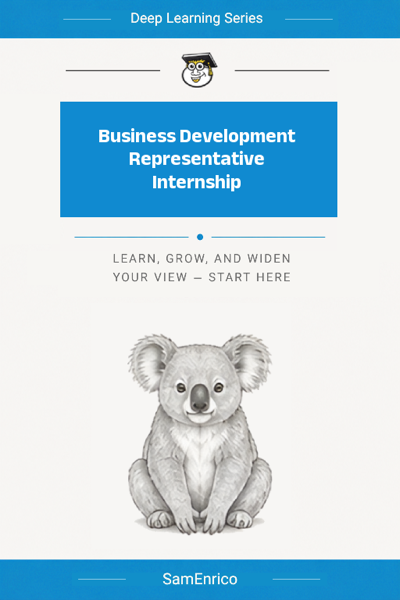
Business Development Representative Internship eBook
A Coursebook on Business Development Representativ
A Coursebook on Business Development Representative Internship
Formats
Free sample
Chapter 1: The Internship Trap--Most college students walk into their first Business Development Representative internship thinking they’re about to learn how to sell. They’re wrong. Not partially wrong. Completely, fundamentally, “I just spent three months doing the wrong thing” wrong. The BDR role, as it exists in modern B2B technology companies, is not a sales role in the way your parents understand sales.
It is not about persuasion. It is not about charisma. It is not about talking fast or closing hard or any of the stereotypes from movies about finance bros in cheap suits.The BDR internship is something else entirely. It is a pipeline generation apprenticeship. It is a meritocratic proving ground where your output is measured not in charm but in meetings booked, conversations started, and opportunities created.
And here is the truth that no job description will tell you: the interns who succeed are not the ones who can sell ice to Eskimos. They are the ones who can handle rejection without flinching, who can organize a spreadsheet better than they can tell a joke, and who understand that “no” is not a judgment on their worth but a data point to be logged and learned from.This chapter is your onboarding. By the time you finish it, you will understand exactly what a BDR does, what a BDR does not do, and why the confusion between the two has ruined more internships than any other single factor. You will learn the economic reality of the role, the metrics that actually matter, and the single most important distinction that separates interns who get full-time offers from those who get a polite “thank you for your time.”Welcome to the internship trap. Here is how to escape it.The Great Confusion: Marketing, BDR, and Sales Before you can succeed as a BDR intern, you need to understand where you sit in the organizational structure.
Most companies have three distinct functions that touch the customer, and confusing them is the fastest way to look incompetent on day one.Marketing owns the top of the funnel. Their job is to create awareness, generate interest, and attract leads through content, advertising, events, and campaigns. When you download a white paper, attend a webinar, or fill out a “contact us” form, you are responding to marketing. Marketing’s metrics are things like website traffic, form fills, and cost per lead. They hand off warm bodies to the BDR team.Business Development sits between marketing and sales.
This is you. Your job is to take the leads that marketing generates—plus the leads you find on your own through research and outreach—and determine whether they are worth an Account Executive’s time. You are the gatekeeper. You are the triage nurse. You do not close deals.
You open conversations. You qualify or disqualify based on information you gather. Then you pass the warmest, most promising leads to the sales team.Sales (specifically Account Executives, or AEs) owns the bottom of the funnel. Their job is to take the qualified opportunities you create and turn them into closed-won revenue. They run demos, negotiate contracts, handle procurement, and sign paperwork.
Their metrics are quota attainment, deal size, and win rate.Here is the critical insight that most interns miss: the BDR is not a junior AE. You are not “learning to sell” by doing a smaller version of what the AEs do. You are learning a completely different skill set—prospecting, qualifying, and pipeline management—that happens to be the traditional entry point to an AE role. Think of it like medicine. A nurse and a surgeon both work in the operating room, but they have different jobs.
A great nurse might become a great surgeon someday, but only after learning that nursing is not “surgery lite.”The BDR who tries to close deals will fail. The BDR who tries to run demos will fail. The BDR who focuses on persuasion instead of diagnosis will fail. Your job is not to convince anyone to buy anything. Your job is to answer three questions about every prospect:Do they have a problem that your company solves?Do they have the budget, authority, need, and timeline to consider solving it?Are they worth five minutes of an Account Executive’s calendar?That is it.
Everything else is noise.The Hunter Mindset: Why Curiosity Beats Charisma If the BDR role is not about persuasion, what is it about? The answer is a set of traits that hiring managers call the “hunter mindset.” And counter to what most students believe, the most important of these traits is not extroversion, not confidence, and certainly not the ability to talk fast.The number one predictor of BDR success is curiosity.Not the polite, interview-appropriate kind of curiosity (“So what does your company do?”). The aggressive, almost annoying kind of curiosity that refuses to accept surface-level answers. The kind that hears “We’re happy with our current vendor” and immediately thinks, “Happy about what exactly? What would make you happier?
What does the vendor do that you tolerate rather than love?”Curious BDRs outperform charismatic BDRs in every measurable way. Here is why: charisma helps you get past the first five seconds of a call. Curiosity helps you get to the fifth minute. Charisma gets you a “maybe.” Curiosity gets you a “yes” or a clear “no” that lets you move on.The second most important trait is organizational ruthlessness.AEs can afford to be messy. They have five deals in flight at once.
They know every detail of each because they talk to the same people every week. You, as a BDR, might touch fifty or a hundred prospects in a single day. You will not remember who said what. You will not remember which prospect mentioned a budget constraint and which one mentioned a competitor. If you do not log that information immediately—in a structured, searchable way—you will lose it forever.
And when you lose it, you will waste hours re-asking questions that prospects already answered, which is the fastest way to make them annoyed with you.The third trait is resilience, but not the kind you think.Resilience in the BDR role is not about “bouncing back” from a bad day. It is about refusing to attach your self-worth to outcomes you cannot control. You can make the perfect call: the right script, the right trigger event, the right tone. The prospect can still say no because their dog just died, their budget just got cut, or they are simply in a bad mood. You will never know which it was.
If you take that “no” personally, you will burn out by Wednesday of week two.Resilient BDRs treat every interaction as a probability. One hundred calls. Ten conversations. One meeting booked. That is the math.
If you expect anything different, you are not resilient—you are delusional. Resilience means accepting the ratio, playing the numbers, and never letting a single “no” change your behavior on the next call.The Economics of the Pipeline: Quotas, Meetings, and Money Now let us talk about how you will be measured. Because if you do not understand the…
This is the end of the free sample. Get the eBook to keep going. Buy now
About this book
Details
- Author
- Donohue Merrill
- Publisher
- SamEnrico
- Language
- English
- Genre
- Non-Fiction, Informative, Educational
- Released
- 2026-05-11
- Pages (approx.)
- 141
- Available as
- eBook, Audiobook

Read better in the ZLOADR app
Your eBooks on your phone or tablet. Sign in with your SamEnrico account and start reading.
More by Donohue Merrill
 Teen Affirmations That WorkDonohue Merrill$11.99
 Volunteer Leader Burnout GuideDonohue Merrill$11.99
 CrossFit Olympic Lifting PrimerDonohue Merrill$11.99
 Cyberstalking Corporate Espionage CasesDonohue Merrill$11.99
 Antwerp Diamond Heist Victim Impact StoriesDonohue Merrill$11.99
 The Frozen Unknown: Zheng He’s Lost Antarctic Voyage (1421-1422)Donohue Merrill$11.99
 Echoes of the Forgotten: The Battle of Khe Sanh and the Ghosts of VietnamDonohue Merrill$11.99
 How to Start a Ship Building and Repairing BusinessDonohue Merrill$11.99
 Sectoral Bargaining GuideDonohue Merrill$12.99
 AI Invoice Processing GuideDonohue Merrill$12.99
 Understanding Dominant Cleft PalateDonohue Merrill$17.99
You may also like
 Hong Kong Handover 1997Dunn Johnnie$11.99
 Zumba For Postnatal Recovery CourseNeal Christian$11.99
 Zumba for BeginnersLadner Nikia$11.99
 YouTube Comment Mining GuideHumes Pandora$12.99
 Worry Box MeditationCarlin Rudy$11.99
 Workplace Stress MeditationNguyen Lynn$11.99
 Workplace Stress and Sleep RepairHawley Ivory$11.99
 Workplace Perfectionism CureDelaney Jeffry$11.99
 Workplace Injustice Anger GuideWallen Isabelle$11.99
 Work Addiction and Burnout LinkGreenwood Ester$11.99
 Women in Yoga and WellnessBeattie Galina$11.99
 Women in Stand Up ComedyChun Evangeline$11.99