
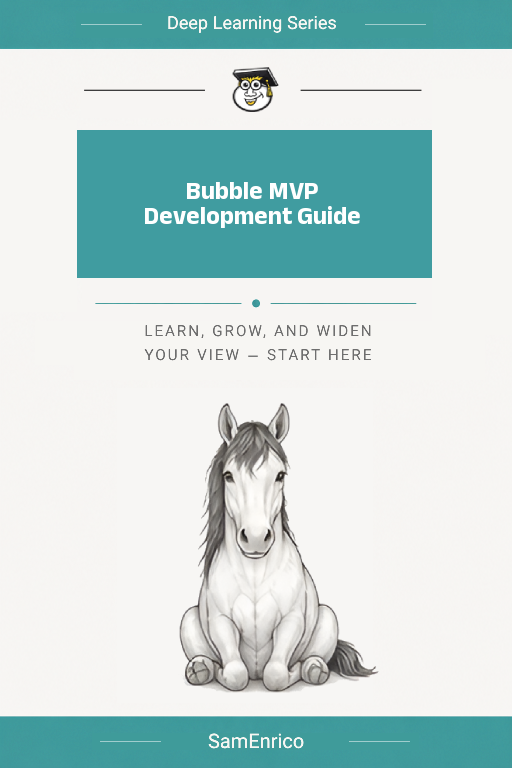
Non-FictionStartup GuideNo-Code Build
Bubble MVP Development Guide eBook
Build your MVP on Bubble without coding. Database
Build your MVP on Bubble without coding. Database design, workflows, and responsive design for web apps.
Formats
Free sample
Chapter 1: The Prototype Lie--–- Every year, thousands of founders pay designers thousands of dollars for beautiful, clickable prototypes made in Figma, Sketch, or Adobe XD. They run user tests, gather feedback, iterate on mockups, and eventually raise money or build a team to "actually build the real thing." Then they fail. Not because the idea was bad. Not because the market was small. But because they spent months validating something that wasn't real.This chapter dismantles the single most destructive assumption in modern software entrepreneurship: that prototyping comes before building.
That you need wireframes, then mockups, then a "minimum viable product" that is still, in truth, a prototype. The hidden truth is that the prototype era is over. In its place is a new paradigm: functional-first development, where your very first version is a working, data-driven application that real users can log into, interact with, and pay for—built entirely without code on Bubble.The old model worked when software required three engineers, a backend developer, a frontend specialist, and three months of runway. But that world is gone. Bubble has inverted the economics of software creation.
The question is no longer "Can I build this?" but "Should I build this?" And the answer comes not from static screens but from live data and real workflows.This chapter is not a technical tutorial. It is a philosophical reset. By the time you finish these pages, you will never again open Figma to "just sketch an idea" before building. You will understand why the wrapper economy is minting millionaires, why technical debt is misunderstood in no-code, and why the only real risk is not launching. Let us begin by examining the lie you have been told about prototypes.The Figma Trap: Why Static Mockups Kill Startups The software industry has spent twenty years perfecting a ritual that makes no sense for founders.
The ritual goes like this: you have an idea. You open a design tool. You draw rectangles, choose fonts, align buttons, and create a clickable simulation. You show it to potential users. They say "looks great." You feel validated.
Then you discover that the design tool cannot actually store a password, send an email, or charge a credit card. You have built a beautiful ghost.This is the Figma Trap. It convinces you that you are making progress when you are merely arranging pixels. The cruel irony is that the most valuable learning from a prototype—does the workflow actually work? does the database scale?
do users return after day three?—cannot be discovered until something is live.Consider two founders. Founder A spends six weeks designing a polished prototype in Figma, runs five rounds of user interviews, and then spends another eight weeks hiring a development agency to rebuild those screens as a real application. Total time to live users: fourteen weeks. Founder B spends three days sketching a rough data model in Bubble, builds a deliberately ugly but fully functional workflow in five days, and puts a link in front of users on day eight. Total time to live users: eight days.
By the time Founder A launches, Founder B has already run three pricing experiments, discovered that users hate the onboarding flow, and rebuilt the core feature twice—all based on actual usage data, not hypothetical feedback.The Figma Trap persists because design tools feel productive. Dragging rectangles is satisfying. Choosing the perfect shade of blue creates a dopamine hit. But these activities are what software engineers call "accidental complexity"—work that feels like progress but does not reduce the risk of your startup.Bubble eliminates the Figma Trap because its visual editor produces real, running code. Every button you place can trigger a real API call.
Every input field can write to a real database. Every page you design can be live on the internet thirty seconds later. The design phase and the development phase are the same phase. This is the first new rule of no-code MVPs: if it isn't running, it isn't real.The Mindset Shift: From Idea Person to Visual Programmer The second new rule is internal. You must stop thinking of yourself as an "idea person" who hires "technical people" to build things.
That binary is obsolete. In the no-code era, the founder who cannot build is not a visionary; they are a bottleneck.Becoming a visual programmer means accepting three uncomfortable truths. First, you will never be as fast as a senior software engineer in raw code—but you do not need to be. You need to be faster than your competitors who are still in Figma. Second, your first version will be ugly, and that is not just acceptable but optimal.
Ugly apps that work generate revenue; beautiful apps that do nothing generate compliments. Third, you must learn to think in data, not in screens. Where a designer sees a "profile page," a visual programmer sees a User data type, a list of Posts, and a privacy rule that hides drafts from other users.This mindset shift has a name in startup literature: "founder-market fit" for tools. The founders who succeed with no-code are not those with the best ideas but those who can translate user needs directly into database operations without an interpreter. Every time you ask a developer to "make a small change," you pay a tax in context switching, explanation time, and delay.
Every workflow you build yourself costs only your own attention.Bubble accelerates this shift because its visual language maps directly to programming concepts without requiring syntax memorization. An "event" is a trigger. An "action" is a response. A "data type" is a table. A "field" is a column.
A "condition" is an if-statement. You are learning to program; you are just doing it with a mouse instead of a keyboard. This is not a lesser form of development. It is a different form—one optimized for speed, iteration, and founder control.The Wrapper Opportunity: Building Million-Dollar Apps on Others' APIs The most profitable category of no-code applications today is not social networks, marketplaces, or content management systems. It is what industry insiders call "wrappers": applications that do almost nothing except present a clean interface around an existing API or AI model.Consider PDF.ai.
The underlying technology—parsing and querying PDF documents—is provided by Open AI, Anthropic, or any of a dozen LLM providers. PDF.ai adds almost no novel technology. It adds a user-friendly interface, a file upload system, a subscription payment flow, and a chat history database. All of these can be built in Bubble in less than a week. PDF.ai generates millions in annual revenue.Photo AI works the same way.
The AI image generation is provided by Stable Diffusion or DALL-E. Photo AI adds a template system, a credit purchase flow, and a gallery of user creations. Built on Bubble. Profitable within months.The wrapper opportunity exists because APIs have become extraordinarily powerful while remaining extraordinarily hard for normal people to use. A developer can call an API with a few lines of code, but a real estate agent who needs to summarize lease agreements cannot.
The gap between "the technology exists" and "a specific person can use it to solve their specific problem" is the…
This is the end of the free sample. Get the eBook to keep going. Buy now
About this book
Details
- Author
- Linares Patria
- Publisher
- SamEnrico
- Language
- English
- Genre
- Non-Fiction, Startup Guide, No-Code Build
- Released
- 2026-05-29
- Pages (approx.)
- 131
- Available as
- eBook, Audiobook

Read better in the ZLOADR app
Your eBooks on your phone or tablet. Sign in with your SamEnrico account and start reading.
More by Linares Patria
 Slack Disaster Recovery GuideLinares Patria$11.99
 Cognitive Restructuring Road RageLinares Patria$11.99
 Spin Class Lighting and AtmosphereLinares Patria$11.99
 Financial Stress and Academic SuccessLinares Patria$11.99
 The ED and Alcohol Link GuideLinares Patria$11.99
 Jewelry Operations AssociateLinares Patria$11.99
 Bach and the Baroque: Music of the Holy Roman EmpireLinares Patria$11.99
 Marketing Role Promotion CaseLinares Patria$12.99
 How to Become a LocksmithLinares Patria$11.99
 Understanding Van Der Woude SyndromeLinares Patria$17.99
You may also like
 Hong Kong Handover 1997Dunn Johnnie$11.99
 Zumba For Postnatal Recovery CourseNeal Christian$11.99
 Zumba for BeginnersLadner Nikia$11.99
 YouTube Comment Mining GuideHumes Pandora$12.99
 Worry Box MeditationCarlin Rudy$11.99
 Workplace Stress MeditationNguyen Lynn$11.99
 Workplace Stress and Sleep RepairHawley Ivory$11.99
 Workplace Perfectionism CureDelaney Jeffry$11.99
 Workplace Injustice Anger GuideWallen Isabelle$11.99
 Work Addiction and Burnout LinkGreenwood Ester$11.99
 Women in Yoga and WellnessBeattie Galina$11.99
 Women in Stand Up ComedyChun Evangeline$11.99