
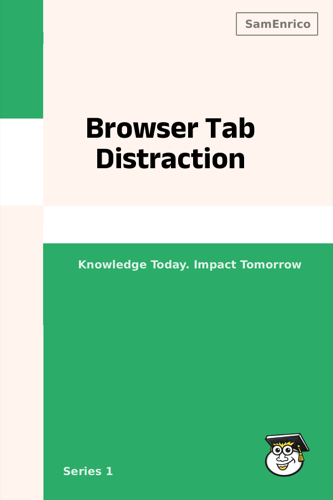
Free sample
Chapter 1: The 47-Tab Brain--–- The email arrived at 9:14 AM. A simple request from her boss: “Can you review the Q3 projections and send me your thoughts by noon?” Sarah nodded to herself, opened the spreadsheet, and began reading. Then, at 9:17 AM, a Slack message pinged. At 9:19 AM, a news alert about a market dip. At 9:22 AM, she remembered she hadn’t replied to her daughter’s school.
At 9:24 AM, she was scrolling Instagram. At 10:11 AM, she closed the spreadsheet. She had written exactly zero comments on the Q3 projections. She had, however, opened forty-two browser tabs, answered eleven non-urgent messages, and felt a low-grade sense of failure that had become as familiar as her morning coffee.This is not a story about laziness. This is not a story about poor time management.
This is a story about a brain that had forty-seven open loops—unfinished thoughts, pending obligations, half-read articles, silent worries—and was asked to do deep, focused work. It failed not because Sarah was weak, but because her brain was full.You have felt this. The sinking realization that you have spent three hours “working” and achieved nothing. The phantom buzz of a phone that hasn’t vibrated. The compulsion to open a new tab before finishing the thought in the current one.
The quiet, exhausted certainty that you are busier than ever and yet producing less than you used to.This book is not a productivity manual. It is an intervention.The metaphor of the “browser tab” is not a cute gimmick. It is a precise, neurological description of what has happened to the human mind over the past fifteen years. Your brain, like a web browser, has a finite amount of working memory. Every tab you open—every unfinished task, every notification you haven’t cleared, every email you’ve left marked “unread,” every worry you’re “holding” rather than resolving—consumes a sliver of your cognitive bandwidth.
Most people are walking around with between forty and sixty tabs open in their heads at any given moment. And then they wonder why they feel tired, irritable, and unable to focus.The operating system of your attention is crashing. This chapter will show you why.The Invention You Didn’t Consent To Fifteen years ago, no one had ever heard of “doomscrolling.” The phrase “browser tab” referred only to a feature in a piece of software, not a diagnosis for a weary soul. The average adult could sit through a two-hour movie without checking a device. Families ate dinner together without a single screen at the table.
Workdays had edges—you left the office, and the work stayed there.That world is gone. And it was taken from you intentionally.Between 2007 (the release of the i Phone) and 2015 (the widespread adoption of infinite scroll, push notifications, and algorithmic feeds), the attention economy completed its hostile takeover of human life. The companies that built this new world—Meta, Google, Byte Dance, Apple, Microsoft—did not stumble into distraction. They engineered it. They hired neuroscientists to understand exactly how to exploit the dopamine system.
They ran millions of A/B tests to determine the precise color of a notification badge that would maximize the likelihood you would click. They discovered that variable rewards (the slot machine mechanism of “pull to refresh”) produced stronger addictive responses than fixed rewards. And they implemented all of it.You did not consent to this. No one sat you down in 2010 and said, “We are about to restructure your brain’s reward pathways. Do you agree?” But here you are, forty-seven tabs open, wondering why you can’t finish a single thought.The average smartphone user now touches their phone 2,617 times per day.
The average knowledge worker switches tasks every three minutes—not because they want to, but because the environment has been designed to interrupt them. A single notification is not a request for your attention. It is a hijacking.Here is the truth that most productivity books will not tell you: You are not the customer of the attention economy. You are the product. And the product is not supposed to be happy, focused, or fulfilled.
The product is supposed to be engaged—endlessly, anxiously, addictively engaged—because engagement generates data, and data generates revenue. Your distraction is their business model.This book will not ask you to “just put your phone down.” That is like telling someone in a rip current to “just swim harder.” The current is stronger than your will. What this book will do is teach you to recognize the current, understand its mechanics, and build a boat.The 47-Tab Brain: A Neurological Autopsy Let us look under the hood. The human brain did not evolve to process forty-seven open loops. It evolved on the savanna, where the primary cognitive demands were spotting predators, finding food, and maintaining a small number of social relationships.
When you had an open loop in that environment—“I haven’t checked the watering hole for threats yet”—it was one loop, maybe two. The brain’s working memory, housed primarily in the prefrontal cortex, has a natural capacity of roughly four chunks of information at any given time. That is not an opinion. That is peer-reviewed cognitive science.When you exceed that capacity, the brain does not simply “try harder.” It begins to leak. Information is shunted from the prefrontal cortex (where conscious reasoning happens) to secondary storage systems.
The result is the feeling of having something “on the tip of your tongue” or walking into a room and forgetting why. You are not getting older. You are not losing your mind. You are simply over capacity.Every time you open a new mental tab—by checking email while on a conference call, by leaving a text message unread, by telling yourself “I’ll remember to buy milk later”—you consume a unit of cognitive load. That load is invisible but measurable.
Psychologists call it “cognitive load theory.” Neuroscientists call it “attentional resource depletion.” You call it “being exhausted for no reason.”The browser tab metaphor becomes literal when we examine the phenomenon of “attention residue.” When you toggle from Tab A (writing a report) to Tab B (checking Slack), you do not fully disengage from Tab A. A piece of your attention remains stuck to it, like a file that didn’t close properly. This residue accumulates. By the time you have toggled to Tab C, Tab D, and Tab E, you are carrying the weight of all of them. No wonder you feel heavy.Consider a simple experiment.
Sit down to write an email. Before you finish, switch to a different task—say, checking the weather. Then switch back to the email. Time how long it takes to reorient yourself to the sentence you were writing. Most people report losing between fifteen and thirty seconds.
That does not sound like much. But multiply it by fifty switches per hour, times eight hours, times five days. You are losing hours of cognitive capacity every week to the friction of switching.And that friction is not neutral. Each switch triggers a small stress response. Your brain detects a shift in context, releases…
This is the end of the free sample. Get the eBook to keep going. Buy now
About this book
Details
- Author
- Ahrens Mertie
- Publisher
- SamEnrico
- Language
- English
- Genre
- Non-Fiction, Self-Help / Digital
- Released
- 2026-06-06
- Pages (approx.)
- 129
- Available as
- eBook, Audiobook

Read better in the ZLOADR app
Your eBooks on your phone or tablet. Sign in with your SamEnrico account and start reading.
More by Ahrens Mertie
 Methamphetamine in Appalachian CommunitiesAhrens Mertie$11.99
 Gambling Addiction and Criminal ChargesAhrens Mertie$11.99
 Asana Portfolio Management DashboardAhrens Mertie$11.99
 Child Bereavement CourseAhrens Mertie$11.99
 Thiamine for AlcoholicsAhrens Mertie$11.99
 Pregnancy Loss and Social MediaAhrens Mertie$11.99
 Gambling Addiction And Toxic RelationshipsAhrens Mertie$11.99
 The Roman Road Builders: Paving the Way for the WorldAhrens Mertie$11.99
 The Forger's Brush: The Great Han Dynasty Art HeistAhrens Mertie$11.99
 A Collector's Handbook to the Renault CaravelleAhrens Mertie$11.99
 Pop Up Retail Future Trends GuideAhrens Mertie$12.99
 Freemium Periodic Data AmnestyAhrens Mertie$12.99
You may also like
 Hong Kong Handover 1997Dunn Johnnie$11.99
 Zumba For Postnatal Recovery CourseNeal Christian$11.99
 Zumba for BeginnersLadner Nikia$11.99
 YouTube Comment Mining GuideHumes Pandora$12.99
 Worry Box MeditationCarlin Rudy$11.99
 Workplace Stress MeditationNguyen Lynn$11.99
 Workplace Stress and Sleep RepairHawley Ivory$11.99
 Workplace Perfectionism CureDelaney Jeffry$11.99
 Workplace Injustice Anger GuideWallen Isabelle$11.99
 Work Addiction and Burnout LinkGreenwood Ester$11.99
 Women in Yoga and WellnessBeattie Galina$11.99
 Women in Stand Up ComedyChun Evangeline$11.99