
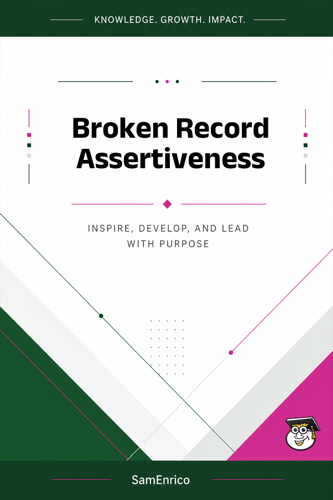
Broken Record Assertiveness eBook
Learn to calmly repeat your position without being
by Held Jayson
Learn to calmly repeat your position without being swayed by manipulation.
Formats
Free sample
Chapter 1: The Gap--–- You know exactly what you want to say. The words are right there, fully formed, rehearsed in your mind with perfect clarity. "No, I cannot take on that project." "No, I will not lend you the money." "No, I am not available to help you move this weekend." In the quiet safety of your own head, the sentence is firm, reasonable, and complete. It requires no justification, no apology, no softening. It is simply true.Then the other person speaks.
Or types. Or even just looks at you with an expression you have learned to recognize as the precursor to disappointment. And something happens. The words that were so clear a moment ago dissolve. Your mouth opens, and instead of the clean, immovable "No" you had prepared, what comes out is something else entirely.
"I'll see what I can do." "Let me think about it." "Maybe, let me check my schedule." "I'll try." Or worst of all: "Okay."You watch yourself say it, as if from outside your own body. A small, horrified part of your brain screams, Why did you say that? That is not what you meant. But the words are already out, already heard, already being treated by the other person as an agreement, or at least as an opening. You have just volunteered for something you did not want to do.
You have just lent money you did not want to lend. You have just committed time you did not have. And you have no one to blame but yourself. Or so you think.This book is about closing that gap. The gap between what you know you want to say and what you actually say.
The gap between your internal clarity and your external compliance. The gap where your boundaries go to die.The Universal Experience of the Unsaid No Let us begin with a simple question, and I want you to answer it honestly before you read another sentence. When was the last time you said "I'll think about it" when you already knew the answer was No? When was the last time you said "Let me get back to you" when you were already certain that you would not, in fact, be getting back to them with a Yes? When was the last time you said "I'll try" when you knew, with absolute certainty, that trying would not change the outcome because the real answer was No?If you are like most of the readers who will pick up this book, the answer is not "years ago." The answer is not "once in a while." The answer is likely "today" or "yesterday" or "within the last week."This is not a minor inconvenience.
It is not a personality quirk. It is not "just being nice." The gap between knowing and saying is the single most expensive habit of the passive and the people-pleaser. It costs you time you do not have, money you cannot afford to lose, energy you need for your own priorities, and—most insidiously—self-respect that erodes one tiny "I guess so" at a time.Consider a few common scenarios. Perhaps you are at work. Your manager appears at your desk thirty minutes before you planned to leave.
"Hey, I need you to stay late tonight to finish the Johnson report. I know it's short notice, but you're the only one who knows the client." Inside your head, a clear voice says: I cannot stay late. I have a doctor's appointment. I have a child to pick up. I have simply worked my eight hours and I am done.
But what comes out of your mouth is: "Okay, I'll see what I can do." You just said yes. You just stayed late. You just missed your appointment or disappointed your child or silently fumed at your desk for three extra hours.Or perhaps it is a personal scenario. A friend calls. "Hey, can you help me move this weekend?
I know it's a big ask, but everyone else bailed." Inside your head: I am exhausted. I have my own obligations. I do not want to spend my one free day hauling furniture. What comes out: "I'll let you know. Let me check my schedule." You have not said No.
You have not said Yes. You have entered a gray zone of maybe that will cost you days of anxiety and a last-minute excuse that makes you feel guilty either way.Or perhaps it is a family scenario. Your parent calls. "We're doing the big family dinner on Sunday. Everyone will be there.
You're coming, right?" Inside your head: I cannot face that drama right now. I have a strained relationship with my sibling. The last three dinners ended in tears. What comes out: "I'll try to make it." You have just committed to an event you dread, or you will have to manufacture a last-minute excuse, or you will simply not show up and be the villain of the family narrative.The gap is everywhere. It is in the small moments—declining a second helping, refusing a sales pitch, saying no to a street fundraiser.
And it is in the large moments—turning down a promotion that would destroy your work-life balance, refusing to lend a family member money you cannot afford to lose, saying no to a wedding invitation from a person you no longer wish to know.The gap is universal. But it is not inevitable.The Neuroscience of Freezing To understand why the gap exists, we have to stop blaming ourselves and start looking at our biology. You did not fail to say No because you are weak. You did not cave because you lack character. You froze because your brain is doing exactly what millions of years of evolution trained it to do.When you perceive a threat, your amygdala—a small, almond-shaped cluster of neurons deep in your brain—sounds the alarm.
This is the same alarm that would have saved your ancestors from predators. The amygdala does not distinguish between a physical threat (a saber-toothed tiger) and a social threat (the look of disappointment on your manager's face). To your ancient brain, social rejection was a death sentence. Being expelled from the tribe meant being alone, unprotected, unlikely to survive. So your brain learned: social conflict = danger.
Disappointing someone = danger. Being perceived as rude, difficult, selfish, or unhelpful = danger.When the amygdala sounds the alarm, your prefrontal cortex—the rational, planning, decision-making part of your brain—goes offline. Blood flow shifts away from the reasoning centers and toward the survival centers. Your heart rate increases. Your breathing becomes shallow.
Your muscles tense. And your ability to formulate a calm, clear "No" vanishes. In its place, the brain defaults to the safest possible response: compliance. Agree. Say okay.
Do not make waves. Survive.This is called the freeze response. You have heard of fight or flight. Freeze is the third option—the one where you become still, compliant, and agreeable because that is what historically kept you alive. The problem is that the freeze response is completely inappropriate for a conversation with your boss about staying late.
There is no tiger. There is no tribal exile. The worst that will happen is that someone will be momentarily…
This is the end of the free sample. Get the eBook to keep going. Buy now
About this book
Details
- Author
- Held Jayson
- Publisher
- SamEnrico
- Language
- English
- Genre
- Non-Fiction, Self-Help, Persuasion
- Released
- 2026-06-06
- Pages (approx.)
- 135
- Available as
- eBook, Audiobook

Read better in the ZLOADR app
Your eBooks on your phone or tablet. Sign in with your SamEnrico account and start reading.
More by Held Jayson
 Anxiety Emotion GuideHeld Jayson$11.99
 ABCDE For Decluttering GuideHeld Jayson$11.99
 Validation for Caregiver BurnoutHeld Jayson$11.99
 Metta For Beginners Practice GuideHeld Jayson$11.99
 Asking Someone to Be Your MentorHeld Jayson$11.99
 The MBSR Sleep SolutionHeld Jayson$11.99
 Hyderabad Loyalty AnalysisHeld Jayson$11.99
 Reciprocity In BusinessHeld Jayson$11.99
 From Dust to Diamonds: The Untold Journey of the 'Paper Son' Who Built a FortuneHeld Jayson$11.99
 The Lion and the Rose: The Tudor Dynasty's Golden AgeHeld Jayson$11.99
 How to Become a Metallic-yarn-slitting-machine OperatorHeld Jayson$11.99
 The Mineral Guide to PumpellyiteHeld Jayson$11.99
You may also like
 Collaborative Idea Pitching GuideLand Joan$11.99
 Persuasive Speaking GuideBarlow Emmie$11.99
 The Broken Record Technique GuideKozlowski Cleora$11.99
 Group Creative Pitching Techniques CourseMurray Faye$11.99
 The Persuasive PresentationGeary Kimberli$11.99
 Assertive Requests That Get ResultsRutledge Minh$11.99
 Remote Persuasion GuideBranham Karlyn$11.99
 Closing With Impact GuideBest Debroah$11.99
 Closing With Call To ActionFarrington Kelsey$11.99
 Persuasion Psychology HandbookClick Staci$11.99