
Non-FictionSelf-HelpIntergenerational Trauma
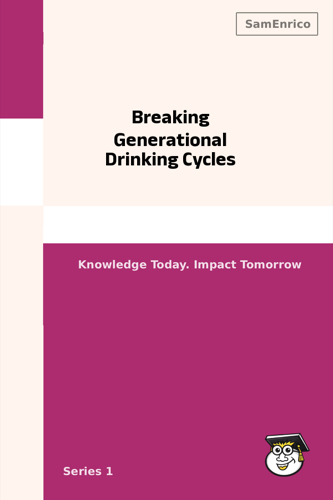
Breaking Generational Drinking Cycles eBook
Heal family trauma, model sobriety for children, a
Heal family trauma, model sobriety for children, and stop inherited patterns of alcohol abuse.
Formats
Free sample
Chapter 1: The Family Ghost...--–- The first time four-year-old Maya heard glass breaking in the kitchen, she learned something that no child should ever have to learn: that the people who are supposed to protect you can also be the ones you need protection from. She did not have words for it then. None of us do. But her body remembered. Her nervous system logged the sound of shattering, the smell of whiskey, the silence that followed her mother's apology, and the way her father's face changed when he drank—the slack jaw, the unfocused eyes, the hand that reached for her cheek and grabbed too hard.
By the time Maya was thirty-two, she had not spoken to her father in fourteen years. She had never had a glass of alcohol in her life. She had two degrees, a quiet husband, and a daughter of her own. And still, every time her husband came home from work five minutes late, her chest tightened. Every time her daughter spilled milk at dinner, Maya felt a rage that terrified her—hot, immediate, and entirely out of proportion to a puddle of dairy.
She was not drinking. She had never been the problem. And yet something was moving through her, from her father to her, from her to her daughter, like a ghost she could not see but could feel pressing against her ribs every single day.This is the central deception of generational addiction: the belief that if you do not drink, you have broken the cycle. It is a lie that has kept millions of families trapped for generations. You can be completely abstinent, utterly sober, morally opposed to alcohol, and still pass down the trauma of alcoholism to your children.
Because addiction is not primarily a substance problem. It is a family system problem. The alcohol is only the loudest symptom. The real inheritance is the chaos, the rules, the roles, the emotional starvation, and the coping mechanisms that children learn before they can speak. And unless you name those things, they will continue to operate under the surface of your life, dictating your reactions, your relationships, and your parenting, regardless of whether you have ever touched a drop.This book is for anyone who grew up in the shadow of a drinking parent and now recognizes, with a mixture of horror and determination, that the shadow has followed them into their own home.
It is for the sober parent who cannot understand why their teenager still walks on eggshells. It is for the adult child of an alcoholic who swore they would never be like their mother and then heard their mother's exact words come out of their own mouth during an argument with their spouse. It is for the person who has done the work—therapy, meetings, medication, meditation—and still feels something unfinished, something that will not rest, something that shows up in the small hours when their child cries and they feel not compassion but an inexplicable, overwhelming urge to escape.You are not broken. You are not uniquely damaged. You are not a failure because you still struggle.
You are, however, caught in a system that you did not create and that you cannot see. The purpose of this chapter—and this book—is to help you see it. To map the invisible architecture of your childhood home. To name the rules that still run your life. To understand why quitting drinking, while noble and necessary for many, is not the same as breaking the cycle.
And to give you the first set of tools you will need to begin the real work: healing the family system that shaped you, so that you can stop passing down what was passed to you.The Myth of the Sober Cycle-Breaker Let us name the myth directly. It goes like this: Alcoholism is a disease that affects individuals. If that individual stops drinking, the problem is solved. If their children grow up and also avoid alcohol, the cycle is broken. This is the story our culture tells because it is clean, linear, and offers the comforting illusion that we can control our legacies through sheer willpower.
It is also, by the evidence of millions of families, almost entirely wrong.Consider the research. Studies of adult children of alcoholics (ACAs) have consistently found that even those who never develop a substance use disorder of their own show significantly higher rates of anxiety, depression, relationship instability, and difficulty with emotional regulation than their peers from non-addicted homes. They are more likely to marry alcoholics or other emotionally unavailable partners. They are more likely to struggle with workaholism, perfectionism, or chronic people-pleasing. They are more likely to report feeling "different" or "damaged" without being able to articulate why.
And crucially, their children—the grandchildren of the original drinker—show elevated rates of these same difficulties, even when the middle generation never drank at all.This is the multigenerational transmission of trauma. It does not require alcohol to continue. It requires only the family system that alcoholism created. And that system lives on, long after the last bottle is emptied, in the rules, roles, and relational patterns that children absorb like language.Let me be clear about what I am not saying. I am not saying that sobriety is unimportant.
For millions of readers, stopping drinking is the essential first step, without which nothing else is possible. I am not saying that your choice to abstain or to pursue recovery is meaningless. It is meaningful. It is heroic. It is often the hardest thing a person will ever do.
What I am saying is that sobriety is not sufficient. It is the floor, not the ceiling. It is the clearing of the ground, not the building of the house. And if you mistake abstinence for healing, you will find yourself years later, still sober, still confused, still watching the same patterns play out in your marriage and in your children, wondering what you missed.What you missed is the family system.The Family as a Mobile: Understanding Systems Imagine a mobile hanging over a baby's crib. You know the kind: several delicate pieces of glass or plastic, suspended from strings, connected by crossed wires to a central hook.
When the mobile is still, each piece hangs in its own space, balanced, separate, calm. But here is the crucial thing about a mobile: when one piece moves, every other piece moves. You cannot touch one part without affecting all the parts. The mobile is not a collection of independent objects. It is a system.Your family is a mobile.
For years, perhaps generations, one piece of that mobile has been erratic: the drinking piece. It swings wildly. It crashes into other pieces. It hangs lower than the rest, dragging everything down. And the other pieces—the children, the non-drinking parent, the extended family—have adapted.
They have learned to compensate. They have developed strategies to keep the mobile from crashing entirely. These strategies are not chosen. They are not conscious. They are simply what the system requires to survive.If you grew up in an alcoholic home, you were one of those adapting…
This is the end of the free sample. Get the eBook to keep going. Buy now
About this book
Details
- Author
- Collins Priscilla
- Publisher
- SamEnrico
- Language
- English
- Genre
- Non-Fiction, Self-Help, Intergenerational Trauma
- Released
- 2026-06-10
- Pages (approx.)
- 156
- Available as
- eBook, Audiobook

Read better in the ZLOADR app
Your eBooks on your phone or tablet. Sign in with your SamEnrico account and start reading.
More by Collins Priscilla
 Social Media Fitness ComparisonCollins Priscilla$11.99
 Negotiation Trust Building GuideCollins Priscilla$11.99
 Home HIIT No EquipmentCollins Priscilla$11.99
 The Accomplishment Log PracticeCollins Priscilla$11.99
 The Association Memory TechniqueCollins Priscilla$11.99
 Divorce and MedicationCollins Priscilla$11.99
 Organ Donation LegacyCollins Priscilla$11.99
 The Daring Defiance of Luis Salva: Argentina's First Olympic GymnastCollins Priscilla$11.99
 Diego and Fidel: The Unlikely Portrait That Defined a RevolutionCollins Priscilla$11.99
 A Collector's Handbook to the Riley 2½-litre RmbCollins Priscilla$11.99
 How to Produce Logistics ServicesCollins Priscilla$11.99
 Growing BeaufortiaCollins Priscilla$11.99
You may also like
 Hong Kong Handover 1997Dunn Johnnie$11.99
 Zumba For Postnatal Recovery CourseNeal Christian$11.99
 Zumba for BeginnersLadner Nikia$11.99
 YouTube Comment Mining GuideHumes Pandora$12.99
 Worry Box MeditationCarlin Rudy$11.99
 Workplace Stress MeditationNguyen Lynn$11.99
 Workplace Stress and Sleep RepairHawley Ivory$11.99
 Workplace Perfectionism CureDelaney Jeffry$11.99
 Workplace Injustice Anger GuideWallen Isabelle$11.99
 Work Addiction and Burnout LinkGreenwood Ester$11.99
 Women in Yoga and WellnessBeattie Galina$11.99
 Women in Stand Up ComedyChun Evangeline$11.99