
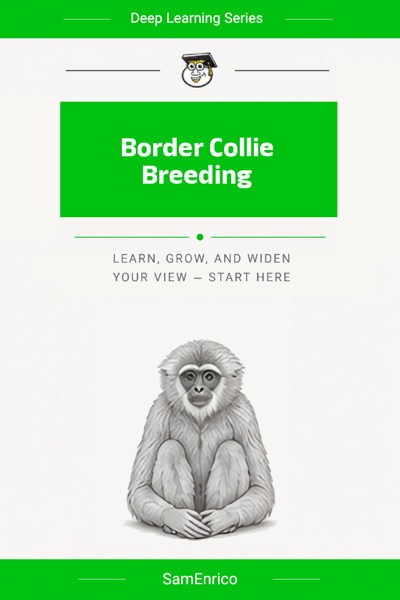
Non-FictionInformativeEducational
Border Collie Breeding eBook
A Coursebook on Border Collie Breeding
by Maki Evon
A Coursebook on Border Collie Breeding
Formats
Free sample
Chapter 1: Beyond the Pet Market...--The first question every prospective Border Collie breeder must answer is not "What color should I aim for?" or "How much can I charge for puppies?" It is a far more unsettling question: Should I breed at all?This chapter exists because breeding Border Collies is fundamentally different from breeding any other dog breed. The difference is not political or aesthetic—it is existential. The Border Collie was not created for companionship, show rings, or casual sport. For over four centuries, this breed has been shaped by a single, unforgiving criterion: the ability to work livestock in partnership with a human handler, often at distances of half a mile or more, responding to whistles and hand signals with the precision of a finely tuned instrument.When you breed Border Collies without that criterion at the center of your decision-making, you are not preserving a breed. You are manufacturing a tragedy.The Washout Rate: A Crisis of Our Own Making Let us begin with a number that should chill every prospective breeder to the bone: approximately 30-40% of Border Collies surrendered to breed-specific rescues are between 1 and 3 years old.
These are not old dogs with age-related health problems. These are young dogs in the prime of their physical lives, surrendered because they became "too much" for the homes that acquired them.The reasons cited by surrendering owners form a rogues' gallery of predictable outcomes:"Too hyper – can't settle down""Chases my children – nipped my toddler""Herds the cat / cars / bikes – won't stop""Destructive when left alone – ate through a wall""Aggressive toward strangers – bit the mailman"Read that list again. Every single one of these behaviors is a predictable consequence of breeding a high-drive working dog without understanding what you are creating and without preparing the buyer for what they are receiving. These dogs are not broken. They are Border Collies behaving exactly as Border Collies were designed to behave—intensely, obsessively, tirelessly—but placed in environments that cannot accommodate those needs.The breeders who produced these dogs did not set out to cause harm.
Most of them, perhaps, loved their dogs and thought that producing a litter of puppies would be a rewarding experience. But love without knowledge is not enough. Good intentions without rigorous selection criteria produce the washout rate.The washout rate is not an accident. It is the direct result of breeding without purpose.The Three Legitimate Purposes for Breeding Border Collies If you are reading this book, you have already demonstrated a level of commitment beyond the casual puppy producer. But commitment alone is insufficient.
You must have a defensible reason for bringing new Border Collies into the world.This book recognizes three legitimate purposes for breeding:1. Herding (Livestock Work)The original and still primary purpose of the breed. A herding Border Collie must demonstrate the ability to gather, drive, and pen livestock (sheep, cattle, goats, or ducks) under the direction of a handler. The dog must possess: a functional outrun (the ability to circle the stock without disturbing them), a reliable stop (the ability to halt instantly on command), appropriate grip (the willingness to bite when necessary, but never excessively), and biddable temperament (the desire to take direction rather than freelance).Verifiable evidence of herding ability includes: USBCHA trial placements, AHBA titles (Herding Test, Pre-Trial, Trial), AKC Herding titles (at least Started level or above), or documented working experience on a commercial farm with video evidence and third-party verification from an experienced stockman.2. High-Level Sport (Agility, Disc, Flyball, Obedience)The second legitimate purpose acknowledges that many Border Collies now work in venues other than livestock.
The best sport Border Collies demonstrate drive, focus, and biddability that rivals—and sometimes exceeds—their herding cousins. A top agility Border Collie running a 5-second jumpers course is engaging in work that requires intense concentration, physical precision, and partnership with a handler.However, a critical distinction must be made: Not all sport participation qualifies as a legitimate breeding purpose. A dog that competes occasionally at low levels, or that has never earned titles, is not "proven" simply because the owner enjoys doing agility on weekends. Legitimate sport breeding requires verifiable achievement at competitive levels: agility MACH (Master Agility Champion) or equivalent, disc dog world qualifier status, flyball titles, or obedience championships (OTCH).3. Service Work (Search and Rescue, Detection, Disability Assistance)The third legitimate purpose encompasses dogs that work in service to humans in non-livestock, non-sport contexts.
Search and Rescue (SAR) Border Collies must demonstrate extreme environmental stability, focus under pressure, and the ability to work independently at great distances. Detection dogs (drugs, explosives, bed bugs, medical alert) require obsessive focus on odor differentiation. Service dogs for mobility or psychiatric disability require rock-solid temperament and biddability in chaotic public environments.Verifiable evidence includes: certification through recognized SAR organizations (NASAR, depending on country), successful deployment on actual searches, detection certification through legitimate training organizations, or placement with a legitimate service dog agency.The Single Unacceptable Reason to Breed There is one reason that appears repeatedly in the stories of dogs who end up in shelters, and it must be named explicitly:Breeding solely for pet homes.This is not a value judgment about pet owners. Many wonderful families want a Border Collie as a companion, and some of those families provide excellent homes for the right individual dog. The problem is not the pet home.
The problem is breeding with the intent to produce pets—selecting parents based on temperament that is "nice" rather than "driven," ignoring working ability, skipping health testing, and producing puppies with no clear purpose other than to be sold.Here is the uncomfortable truth that many breeders do not want to hear: A Border Collie bred without working purpose is a genetic lottery ticket. You might get a moderate-drive dog that does fine as a pet. Or you might get a ticking time bomb of unfulfilled instinct that destroys the owner's home and ends up in a rescue. The washout rate exists because the second outcome is far more common than the first.This book takes the position that breeding for pet homes is a primary contributor to the breed's crisis. If you intend to breed Border Collies solely for the pet market, close this book now and return it.
There is nothing in these pages for you.The Split in the Breed: Working Lines vs. Show Lines No discussion of Border Collie breeding would be complete without addressing the painful schism that has developed over the past century: the split between working lines (registered primarily with the International Sheep Dog Society, or ISDS) and show lines (registered with kennel clubs such as the AKC and KC).The Working Line Tradition Working line Border Collies have been bred continuously for livestock working ability since the breed's origins in the Anglo-Scottish border country. The ISDS, founded in 1906, maintains a stud book that prioritizes performance over appearance. A dog can be registered with the ISDS only if it can demonstrate working ability in trials documented by the stud book's requirements for entry.The result of this performance-based registration is a population of dogs that remain remarkably true to the original working type: moderate in size…
This is the end of the free sample. Get the eBook to keep going. Buy now
About this book
Details
- Author
- Maki Evon
- Publisher
- SamEnrico
- Language
- English
- Genre
- Non-Fiction, Informative, Educational
- Released
- 2026-05-09
- Pages (approx.)
- 158
- Available as
- eBook, Audiobook

Read better in the ZLOADR app
Your eBooks on your phone or tablet. Sign in with your SamEnrico account and start reading.
More by Maki Evon
 Step Eight Making Amends ListsMaki Evon$11.99
 The Remote 1 on 1 GuideMaki Evon$11.99
 Body Scan for Leg TensionMaki Evon$11.99
 Cpr While Pregnant SelfMaki Evon$11.99
 The Last Broadcast of Radio KryptonMaki Evon$11.99
 US Credit for Startups GuideMaki Evon$12.99
 How to Produce Board GamesMaki Evon$11.99
 How to Start a Nitrates and Nitrites of Potassium Business (Beginners Guide)Maki Evon$11.99
You may also like
 Hong Kong Handover 1997Dunn Johnnie$11.99
 Zumba For Postnatal Recovery CourseNeal Christian$11.99
 Zumba for BeginnersLadner Nikia$11.99
 YouTube Comment Mining GuideHumes Pandora$12.99
 Worry Box MeditationCarlin Rudy$11.99
 Workplace Stress MeditationNguyen Lynn$11.99
 Workplace Stress and Sleep RepairHawley Ivory$11.99
 Workplace Perfectionism CureDelaney Jeffry$11.99
 Workplace Injustice Anger GuideWallen Isabelle$11.99
 Work Addiction and Burnout LinkGreenwood Ester$11.99
 Women in Yoga and WellnessBeattie Galina$11.99
 Women in Stand Up ComedyChun Evangeline$11.99