
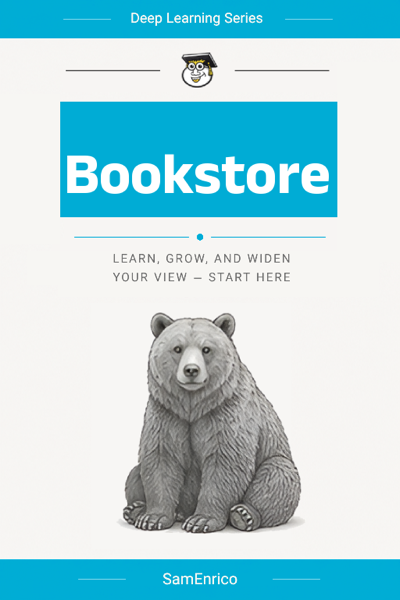
Non-FictionInformativeEducational
Bookstore eBook
A Coursebook on Bookstore
A Coursebook on Bookstore
Formats
Free sample
Chapter 1: The Survivor’s Paradox--The first thing you need to know about opening a bookstore is that everyone will tell you you’re insane. Your mother will say it with concern. Your accountant will say it with a spreadsheet. Your friends will say it with a laugh that trails off into awkward silence. And somewhere, in the fluorescent-lit break room of an Amazon fulfillment center, a algorithm will process your dream as a data point: physical book sales declined 2.3% last quarter.
Recommend against.They are not entirely wrong. Between 2000 and 2020, independent bookstores closed at a staggering rate. Borders, once a titan with hundreds of superstores, evaporated entirely. The rise of e-books, the convenience of two-day shipping, and the quiet violence of showrooming—customers browsing in your store then buying online—created a perfect storm that sank thousands of dreams. If you had asked a retail analyst in 2015 whether bookstores had a future, they would have laughed in your face.And yet.Between 2020 and 2025, independent bookstores staged one of the most unexpected retail comebacks in modern history.
Membership in the American Booksellers Association grew by over 30 percent. New stores opened in cities that had been book deserts for a decade. Bestseller lists began featuring indie bookstore recommendations alongside the usual corporate picks. A cultural shift, subtle at first and then undeniable, had occurred: people remembered why they loved bookstores. Not because bookstores had changed, but because everything else had.This chapter is not a eulogy for the past or a utopian fantasy about the future.
It is a hard-nosed, clear-eyed examination of why bookstores survive when everything says they shouldn’t. We will confront the elephant in the room—Amazon, e-books, and the relentless logic of efficiency—and then we will dismantle that elephant piece by piece. We will introduce the concept of the “third place” and show you why it matters more than any single sale. We will walk through iconic case studies of bookstores that became cultural landmarks not despite their location or size, but because of how they understood their role in human lives.But we will also do something most books about bookstores refuse to do: we will name the tension at the heart of every successful bookstore. The tension between the browser and the buyer.
The tension between being a sanctuary and being a business. The tension between welcoming people to stay for hours and needing them to purchase something before they leave. Most aspiring bookstore owners ignore this tension until it bankrupts them. This chapter faces it head-on, and then gives you the framework that the rest of this book will use to resolve it.By the time you finish this chapter, you will understand not just why bookstores still matter, but how a bookstore can matter in your specific community. You will have completed a reality-check exercise that forces you to see your local bookstore—and your future store—with clear, unromantic eyes.
And you will be ready for Chapter 2, where we turn that understanding into an identity, a mission, and a business that can survive.Let us begin with the elephant.The Elephant in the Room: Amazon, E-books, and the Obituary That Never Got Published In 2011, The New York Times published a now-infamous article titled “The End of the Bookstore.” It was not a prediction; it was an obituary. The author had visited dozens of shuttered storefronts, interviewed grieving booksellers, and concluded that the independent bookstore was a beautiful but doomed species, like the passenger pigeon or the neighborhood butcher. The numbers supported him. Between 1995 and 2010, the number of independent bookstores in the United States had fallen by nearly half. Borders had filed for bankruptcy.
Barnes & Noble was bleeding money. Amazon had trained an entire generation to associate book buying with a single click and a brown cardboard box.The obituary was well-written, thoroughly researched, and completely wrong.What the author missed—what almost everyone missed—was that bookstores were not dying because people stopped wanting them. They were dying because the retail landscape had changed faster than bookstore owners could adapt. When Amazon first launched in 1995, most independent bookstores responded with a shrug. They had something Amazon didn’t: physical space, knowledgeable staff, and the pleasant smell of paper and coffee.
They assumed these advantages were permanent. They were not.By the time Amazon introduced free two-day shipping with Prime in 2005, the calculus had shifted. The convenience gap had grown so wide that many customers no longer cared about the experience. Why drive twenty minutes, find parking, and browse when you could click a button and have the book on your doorstep before the weekend? Showrooming—the practice of browsing in a store then buying online—became the death spiral of thousands of shops.
Customers would spend an hour in a bookstore, ask a staff member for recommendations, write down the titles, and then purchase them from their phones while standing in the parking lot.This was not malice. It was efficiency. And efficiency is a hard thing to argue against.But here is what the obituaries missed: efficiency is not the same as satisfaction. A package on a doorstep is not the same as a discovery in a quiet corner. An algorithm’s recommendation (“customers who bought this also bought…”) is not the same as a bookseller looking you in the eye and saying, “You remind me of someone who would love this.” The more Amazon optimized for speed and price, the more it optimized away the human elements that bookstores had always provided for free.By 2020, something unexpected had happened.
A generation raised on instant gratification had grown tired of it. They had spent years scrolling, clicking, and waiting for brown boxes. They wanted to touch things again. They wanted to be surprised. They wanted to walk into a room full of strangers who loved the same things they loved.
They wanted, in short, a third place.The Third Place: Why Your Living Room and Your Office Aren’t Enough Sociologist Ray Oldenburg coined the term “third place” in his 1989 book The Great Good Place. The first place is home. The second place is work. Third places are the neutral, public spaces where people gather without invitation or obligation—the pub, the barbershop, the cafe, the library, and yes, the bookstore.Oldenburg argued that third places are essential to a healthy society because they provide something neither home nor work can: unstructured social time among equals. At home, you are bound by family roles.
At work, you are bound by hierarchy and productivity. In a third place, you can simply be. You can sit alone and read. You can strike up a conversation with a stranger. You can eavesdrop on the book club meeting happening two shelves over.
You can exist without having to produce anything.This is the secret that Amazon cannot replicate. A website is not a third place. You cannot linger on a website. You cannot accidentally meet someone on a website (unless you count the review section, which you should not). A website is a transaction machine.
It begins with a search and ends with a purchase. Every click is measured. Every scroll is tracked. There is…
This is the end of the free sample. Get the eBook to keep going. Buy now
About this book
Details
- Author
- Himes Kimberely
- Publisher
- SamEnrico
- Language
- English
- Genre
- Non-Fiction, Informative, Educational
- Released
- 2026-06-02
- Pages (approx.)
- 131
- Available as
- eBook, Audiobook

Read better in the ZLOADR app
Your eBooks on your phone or tablet. Sign in with your SamEnrico account and start reading.
More by Himes Kimberely
 Resentment After Betrayal GuideHimes Kimberely$11.99
 Infant Microbiome Brain DevelopmentHimes Kimberely$11.99
 The Gambling Trigger Identification GuideHimes Kimberely$11.99
 Sales Executive Quota Stress CourseHimes Kimberely$11.99
 Body Language for Casino StaffHimes Kimberely$11.99
 The Silk Road Heist: How a Shadowy Syndicate Stole Billions from the Dark WebHimes Kimberely$11.99
 India Green Technology GuideHimes Kimberely$12.99
 Test Failure Analyzer ManualHimes Kimberely$12.99
 Understanding Landau–kleffner SyndromeHimes Kimberely$17.99
 How to Start a Stenotype Service BusinessHimes Kimberely$11.99
You may also like
 Hong Kong Handover 1997Dunn Johnnie$11.99
 Zumba For Postnatal Recovery CourseNeal Christian$11.99
 Zumba for BeginnersLadner Nikia$11.99
 YouTube Comment Mining GuideHumes Pandora$12.99
 Worry Box MeditationCarlin Rudy$11.99
 Workplace Stress MeditationNguyen Lynn$11.99
 Workplace Stress and Sleep RepairHawley Ivory$11.99
 Workplace Perfectionism CureDelaney Jeffry$11.99
 Workplace Injustice Anger GuideWallen Isabelle$11.99
 Work Addiction and Burnout LinkGreenwood Ester$11.99
 Women in Yoga and WellnessBeattie Galina$11.99
 Women in Stand Up ComedyChun Evangeline$11.99