
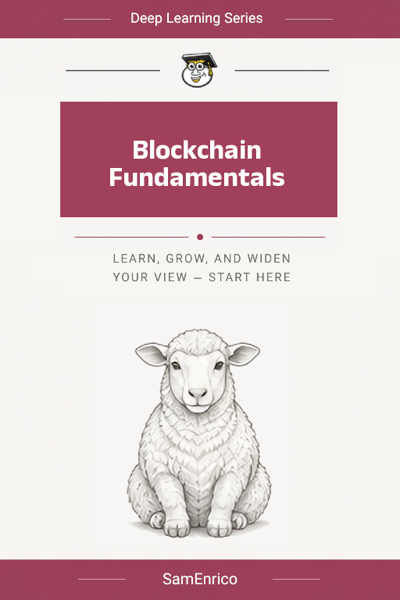
Blockchain Fundamentals eBook
A Coursebook on Blockchain Fundamentals
A Coursebook on Blockchain Fundamentals
Formats
Free sample
Chapter 1: The Money Mirage...–- Think about money for a moment. Not the coins jangling in your pocket or the numbers glowing on your banking app, but the thing itself. What is it, really? If you strip away the physical tokens and digital ledgers, money is nothing more than a shared hallucination—a collective agreement that a particular object or number has value. A hundred-dollar bill costs about fourteen cents to print.
A Bitcoin is a string of code that exists nowhere in physical space. Yet both can buy you dinner, pay your rent, or fund a retirement. That is not magic. That is belief.The problem with belief, however, is that it can shatter.In 2008, the global financial system—the most sophisticated apparatus of value ever constructed—came terrifyingly close to doing exactly that. Banks that had stood for over a century collapsed like paper umbrellas.
Mortgage-backed securities, rated AAA by agencies paid to evaluate them, turned out to be filled with worthless debt. Governments printed trillions of dollars to bail out the very institutions that had caused the crisis. And in the aftermath, a generation of people learned a painful lesson: the trust they had placed in banks, regulators, and politicians was not just naive—it was dangerous.Out of that rubble came an answer. Not from a government, not from a central bank, not from any institution at all. From a pseudonymous figure—or group—known only as Satoshi Nakamoto came a nine-page white paper titled "Bitcoin: A Peer-to-Peer Electronic Cash System." It proposed something radical: a currency that required no trust in any person, bank, or government.
A currency secured not by laws or armies, but by mathematics and code.This chapter tells the story of why that idea was born, what problem it was designed to solve, and why understanding that origin is essential to understanding everything that follows. Because blockchain technology did not emerge from an academic vacuum—it emerged from a crisis of trust that exposed the fault lines in the very foundations of modern money.The Deep History: What Is Money, Really?Before you can understand why blockchain was invented, you must understand what it was meant to replace. That means going back—much further than 2008, further than the gold standard, further even than coins.The standard story of money, taught in economics textbooks for generations, goes something like this: primitive barter economies were inefficient. If you were a baker who needed shoes, you had to find a shoemaker who needed bread—a coincidence of wants. So humans invented money as a medium of exchange, and civilization flourished.This story is almost certainly wrong.Anthropological evidence suggests that barter was rare in pre-monetary societies.
Instead, most early economies operated on systems of credit and debt—I give you a chicken today, you owe me a favor tomorrow. Money emerged not to solve barter's inefficiencies, but as a tool of power. The first known coins appeared around 600 BCE in the kingdom of Lydia (modern-day Turkey), made of electrum, a natural gold-silver alloy. They were stamped with official symbols to guarantee their weight and purity—and to signal whose authority backed them.This pattern repeated across civilizations: China used bronze knife-shaped coins, Rome used denarii stamped with emperors' faces, and the Islamic world used dinars and dirhams. In every case, money was not just an economic tool.
It was a political instrument. Whoever controlled the money supply controlled the economy. Whoever controlled the economy controlled the people.Fast forward to 1971. For most of the twentieth century, the world operated under the Bretton Woods system, where the US dollar was backed by gold at $35 per ounce, and other currencies were pegged to the dollar. But President Richard Nixon faced a problem: the US had printed more dollars than it had gold to back them.
Foreign governments began demanding gold in exchange for their dollars. On August 15, 1971, Nixon closed the gold window—severed the last link between any major currency and a physical commodity.The world entered the era of fiat money: currency declared legal tender by government decree, backed by nothing but trust in that government. Fiat money has enormous advantages: central banks can respond to recessions by printing money (monetary policy) or adjusting interest rates. But it has an equally enormous vulnerability: the value of your savings depends entirely on the discipline and competence of people you have never met.The Three Types of Trust Because trust will be a recurring theme throughout this book—and because it is the single most important concept in understanding blockchain—we need to be precise about what we mean. Most people use the word "trust" as if it has a single meaning.
It does not.Throughout this book, we will distinguish between three distinct types of trust:1. Institutional Trust This is confidence in organizations, systems, and abstract authorities. When you deposit money in a bank, you trust that the bank will not steal it, that the government will insure deposits (in the US, the FDIC covers up to $250,000 per depositor), and that the legal system will enforce your rights if something goes wrong. Institutional trust is the backbone of modern society—but it is also brittle. When institutions fail, they fail spectacularly.2.
Interpersonal Trust This is confidence in specific individuals. When you lend a friend money, you trust that they will pay you back. When you enter a business partnership, you trust that the other party will not cheat you. When you hire a contractor, you trust that they will do the work they promised. Interpersonal trust scales poorly—you cannot personally know every person you transact with.3.
Verifiable Truth This is not trust in the traditional sense at all. It is confidence derived from mathematical proof. When you solve a mathematical equation, you do not "trust" the answer—you verify it. When you check a cryptographic hash (more on that in Chapter 3), you do not rely on any institution or person. You perform the calculation yourself and confirm the result.
Blockchain's revolutionary promise is to convert economic and social relationships from the first two types of trust into the third.Here is the crucial insight that most people miss: blockchain does not eliminate trust. That is a marketing slogan, not a technical reality. Blockchain redistributes trust. It moves trust away from institutions and individuals—fallible humans with conflicting incentives—and places it onto code, cryptography, and economic incentives that can be verified by anyone.Satoshi Nakamoto understood this intuitively. The Bitcoin white paper begins with a direct attack on institutional trust: "Commerce on the Internet has come to rely almost exclusively on financial institutions serving as trusted third parties to process electronic payments.
While the system works well enough for most transactions, it still suffers from the inherent weaknesses of the trust based model."The "trust based model" means institutional trust. And its weaknesses, as Satoshi saw them, were not theoretical—they were about to be exposed to the entire world.The Crisis That Broke Trust On September 15, 2008, Lehman Brothers—a 158-year-old investment bank with over $600 billion in assets—filed for bankruptcy. It remains the largest bankruptcy filing in US history. But the collapse did not happen in…
This is the end of the free sample. Get the eBook to keep going. Buy now
About this book
Details
- Author
- Davidson Emilio
- Publisher
- SamEnrico
- Language
- English
- Genre
- Non-Fiction, Informative, Educational
- Released
- 2026-05-11
- Pages (approx.)
- 155
- Available as
- eBook, Audiobook

Read better in the ZLOADR app
Your eBooks on your phone or tablet. Sign in with your SamEnrico account and start reading.
More by Davidson Emilio
 Casino Environment PsychologyDavidson Emilio$11.99
 White Knuckle Sobriety vs HealingDavidson Emilio$11.99
 Acrophobia Heights MasteryDavidson Emilio$11.99
 Sleep Deprivation Work CycleDavidson Emilio$11.99
 The Senior Self Compassion WorkbookDavidson Emilio$11.99
 Panic Attack Meditation KitDavidson Emilio$11.99
 The Fake Taxi NightmareDavidson Emilio$11.99
 Cramming Prevention HandbookDavidson Emilio$11.99
 The Panama Papers ExposureDavidson Emilio$11.99
 Eclipsing the Heavens: The Harmonic Revolution of Western MusicDavidson Emilio$11.99
 The Celestial Forge: Vishwakarma’s Tower of the GodsDavidson Emilio$11.99
 How to Start a Hobby in General Martial ArtsDavidson Emilio$11.99