
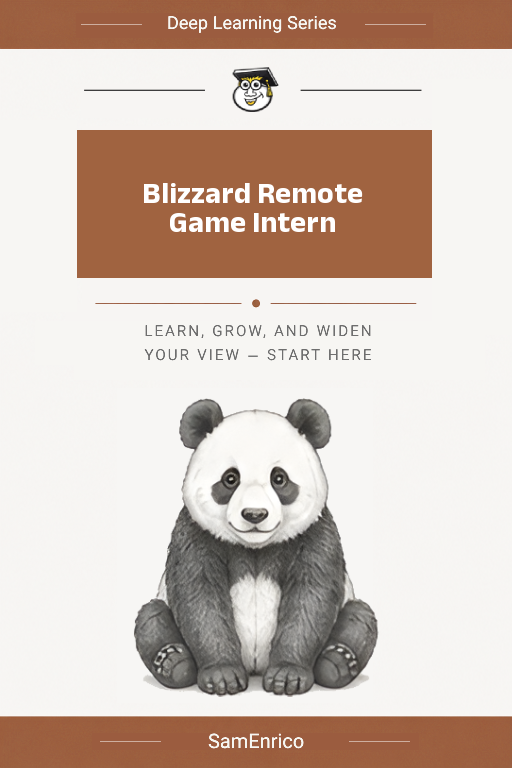
Non-FictionStudent's ShortcutEsports InternshipBlizzard Careers
Blizzard Remote Game Intern eBook
Work remotely for Blizzard Entertainment on game b
by Hood Libby
Work remotely for Blizzard Entertainment on game balance esports or online infrastructure with passionate players.
Formats
Free sample
Chapter 1: The Portal Problem...--–- The email arrived at 11:47 PM on a Tuesday. I was mid-way through a losing streak in competitive Overwatch, my third rage queue of the evening, when my phone buzzed with a subject line that made my stomach drop: "Blizzard Entertainment – Remote Internship – Next Steps." For three weeks, I had assumed my application had been swallowed by the void. I had filled out the forms, attached my resume, written a cover letter that felt simultaneously desperate and grandiose, and then... nothing. But here it was.
An invitation to a technical screening. Not for a generic "game design internship" that would have me fetching coffee and organizing spreadsheets. This was for something specific. Something I had barely allowed myself to hope for. A role that sat at the intersection of everything I loved: competitive integrity, online systems, and the messy, glorious chaos of millions of players logging in at the same time.
The role was listed as "Remote Game Intern – Live Operations Support." I had applied on a whim, assuming I would never hear back. Now, staring at the screen, I realized I had no idea what I had actually signed up for.This book is not a motivational poster. It is not a collection of inspirational quotes about following your dreams. It is a field manual for surviving and thriving in one of the most specific, demanding, and exhilarating remote work environments that exists in the modern gaming industry. It is for the person who has spent ten thousand hours in Azeroth, or the competitive ladder of Overwatch, or the endless dungeon crawls of Sanctuary, and who has looked at those experiences and thought: I could help make this better.
I could be the one tuning that damage coefficient. I could be the one watching the server dashboards when a million players try to log in at the same time.But wanting to help and being able to help are two very different things. And doing either one from your childhood bedroom, or a cramped apartment, or a shared living room while your roommate watches Netflix in the background, adds a layer of complexity that no amount of game knowledge can prepare you for.The Fundamental Misunderstanding Before we go any further, we need to clear up a dangerous misconception. When most people hear "remote internship," they imagine flexibility. They imagine rolling out of bed five minutes before standup, answering emails in sweatpants, and having the freedom to structure their day around their natural rhythms.
And for some remote jobs, that is exactly what happens. Data entry. Customer support. Certain kinds of software development where the only thing that matters is the code you push, not the hour you push it.This is not that.A remote internship at Blizzard, specifically in the domains of game balance or online infrastructure, is not remote because it is convenient. It is remote because the company has decided, for better or worse, that physical presence is less valuable than access to a global talent pool.
But the expectations of that role are not relaxed. If anything, they are heightened. You are not being given flexibility. You are being given autonomy, and autonomy is a double-edged sword. It means you are trusted to perform at a high level without someone looking over your shoulder.
It also means that when you fail, there is no one to blame but yourself, and the visibility of that failure is often higher than it would be in an office, because every Slack message, every missed deadline, every lag spike during a critical incident is a data point that your team is silently collecting.I learned this the hard way. Not during my internship, but during the screening process. The technical interview was conducted over Zoom, and I had prepared for weeks. I had reviewed my networking fundamentals. I had practiced explaining the difference between TCP and UDP, which any aspiring infrastructure intern should know.
I had theorycrafted balance changes for a hypothetical hero, complete with spreadsheets showing projected win rate impacts. I was ready.What I was not ready for was my internet connection dropping three minutes into the call.It was not a dramatic failure. There was no thunderstorm, no construction crew cutting a cable. My router simply decided, at the worst possible moment, to restart itself for a firmware update that I had forgotten to disable automatic installation on. When I reconnected, flustered and apologizing, the interviewer – a senior engineer with the kind of calm, patient demeanor that suggested she had seen far worse – simply said, "It happens.
Let's continue." But I could see it in her eyes. She was already making a mental note. This candidate does not have their home environment under control.I passed the interview, but barely. And I carried that embarrassment with me for the entire first week of my internship, double-checking my network settings before every single meeting, running ping tests in the background, and living in fear of another unexplained disconnect. That fear, as it turned out, was not irrational.
It was the first lesson of remote game operations: your home is now a critical piece of infrastructure, and it will be treated as such.What This Book Actually Covers Over the next eleven chapters, we are going to dismantle the remote game internship experience piece by piece. We will cover the hard skills – the Python scripts, the AWS dashboards, the Excel models that turn player behavior into balance levers. We will cover the soft skills – the written communication that replaces hallway conversations, the emotional regulation that lets you read a forum thread calling for your firing without crying, the security hygiene that keeps unannounced heroes from leaking because you screenshared the wrong window. And we will cover the meta-skills, the ones that no job description ever lists: how to build relationships when you are just a name on a screen, how to ask for help without sounding incompetent, how to turn a twelve-week trial into a career.But Chapter 1 has a specific job. Before you can succeed at any of that, you need to understand what you are actually applying for.
And more importantly, you need to understand whether you are the kind of person who can do this work from home without losing your mind, your credibility, or your job.The Two Paths: Balance vs. Infrastructure Blizzard's remote internship program, at least for the roles we care about in this book, splits into two main tracks. They share some foundational skills, but they diverge sharply in terms of daily workflow, stress profile, and the kind of person who thrives in each.Track One: Game Balance (Esports Focus)This is the glamorous one, at least from the outside. The balance intern is the person who looks at a hero with a 55% win rate and a 90% pick rate and decides to shave five damage off their primary fire. They are the ones who read through thousands of lines of telemetry data – not just wins and losses, but engagement distances, ability usage frequency, ultimate economy – and translate those numbers into tuning knobs that actual players will feel.
They work in spreadsheets as often as they work in code. They write patch notes that will be read by…
This is the end of the free sample. Get the eBook to keep going. Buy now
About this book
Details
- Author
- Hood Libby
- Publisher
- SamEnrico
- Language
- English
- Genre
- Non-Fiction, Student's Shortcut, Esports Internship, Blizzard Careers
- Released
- 2026-06-01
- Pages (approx.)
- 132
- Available as
- eBook, Audiobook

Read better in the ZLOADR app
Your eBooks on your phone or tablet. Sign in with your SamEnrico account and start reading.
More by Hood Libby
 The Magen AvrahamHood Libby$11.99
 Panic Disorder Differential Diagnosis GuideHood Libby$11.99
 SEAL Team Rescue MissionHood Libby$11.99
 Fasting for Growth Hormone SpikeHood Libby$11.99
 Face Replacement and Reaging EffectsHood Libby$11.99
 The First Divers: Prehistoric Pioneers of the Great Barrier ReefHood Libby$11.99
 The Night the Sky Turned Red: The 2017 Las Vegas Mass ShootingHood Libby$11.99
 Understanding Brachydactyly Scoliosis Carpal FusionHood Libby$17.99
 Ecommerce Regional Market PredictionsHood Libby$12.99
 10 Ways to Use Citrus Oils (Recipe Book)Hood Libby$11.99
 Drop-leaf Table CraftHood Libby$11.99
You may also like
 Hong Kong Handover 1997Dunn Johnnie$11.99
 Zumba For Postnatal Recovery CourseNeal Christian$11.99
 Zumba for BeginnersLadner Nikia$11.99
 YouTube Comment Mining GuideHumes Pandora$12.99
 Worry Box MeditationCarlin Rudy$11.99
 Workplace Stress MeditationNguyen Lynn$11.99
 Workplace Stress and Sleep RepairHawley Ivory$11.99
 Workplace Perfectionism CureDelaney Jeffry$11.99
 Workplace Injustice Anger GuideWallen Isabelle$11.99
 Work Addiction and Burnout LinkGreenwood Ester$11.99
 Women in Yoga and WellnessBeattie Galina$11.99
 Women in Stand Up ComedyChun Evangeline$11.99