
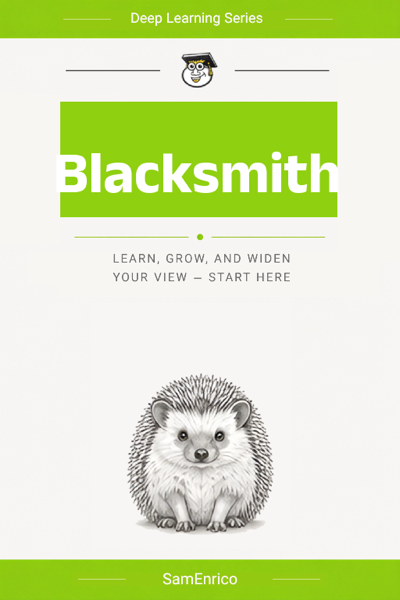
Blacksmith eBook
A Coursebook on Blacksmith
by Ruby Ngoc
A Coursebook on Blacksmith
Formats
Free sample
Chapter 1: The Burning Question...--Why would anyone choose to stand in front of an open fire, swing a hammer until their arms ache, and risk third-degree burns for the sake of a piece of metal? That is the first question every aspiring blacksmith must answer—not for anyone else, but for themselves. Because the forge does not care about your resume, your You Tube subscriber count, or how many episodes of Forged in Fire you have watched. It only cares about your focus, your humility, and your willingness to fail hot.This chapter exists to answer that burning question before you ever light a match. It will give you the historical context to understand why blacksmithing mattered for three thousand years, why it nearly disappeared in one generation, and why it is surging back now in ways nobody predicted.
More importantly, it will give you the safety foundation that separates a lifelong craft from a trip to the emergency room. You will learn about the four distinct paths available to modern smiths, the non-negotiable rules of the workshop, and—most critically—how to walk into a smithy and not walk out injured. By the end of this chapter, you will have signed an internal safety contract with yourself. The forge will test that contract on your first day. Pass that test, and you will earn the right to call yourself a beginner.
Fail it, and you may never come back.Let us start with a story.The Day the Anvil Went Silent In the small village of Wroxall, England, in the year 1924, there stood a blacksmith's shop that had operated continuously since the reign of Queen Elizabeth I. The same anvil had been struck by seven generations of the same family. The same post vise had held hot iron for Cromwell's soldiers, for plowshares during the Agricultural Revolution, and for wagon wheels bound for London. On a Tuesday morning in September, the last smith—a man named Thomas Fletcher—closed the doors for the final time. The anvil went silent.Thomas was not old.
He was fifty-three, strong as a draft horse, and perfectly capable of swinging a sledge. But there were no more horses to shoe in Wroxall. The tractor had replaced the plow horse. The automobile had replaced the carriage. The factory had replaced the village smithy.
Thomas hung his apron on a nail, walked out, and never lit his forge again. Within two decades, the number of blacksmiths in England had fallen from over sixty thousand to fewer than five thousand. In America, the collapse was even steeper. By 1970, traditional blacksmithing was functionally dead as a trade. Anvil sales had stopped.
Forge manufacturers had closed. The knowledge was kept alive by a handful of hobbyists, farriers who still needed to shape horseshoes, and a few preservationist blacksmiths at colonial reenactment sites like Williamsburg.Then something unexpected happened. The anvil came back.The Modern Revival: Why Blacksmithing Refused to Die The revival began quietly in the 1980s, driven by two unlikely forces: the back-to-the-land movement and the early stirrings of what would become the Maker Movement. People who had grown up in the age of plastic and disposable goods found themselves drawn to the permanence of iron. A hand-forged gate would outlast its maker by a century.
A forged knife could be sharpened and passed down for generations. In a world of planned obsolescence, blacksmithing offered something nearly extinct: durability.The real explosion, however, came with cable television and the internet. Forged in Fire, which premiered in 2015, brought bladesmithing into millions of living rooms. For the first time, people saw the process—the orange glow of the forge, the rhythmic hammering, the dramatic quench—in high definition. Applications to blacksmithing schools increased by 400 percent within two years.
ABANA (the Artist-Blacksmith's Association of North America) saw its membership double. On You Tube, channels like Alec Steele, Black Bear Forge, and Christ Centered Ironworks accumulated hundreds of millions of views. A trade that had nearly vanished was now, suddenly, cool.But there is a deeper reason for the revival, one that goes beyond entertainment. We live in what the sociologist Richard Sennett calls "the culture of the incomplete." We buy flat-pack furniture that falls apart. We use phones that are designed to be replaced, not repaired.
Our work is increasingly abstract—spreadsheets, emails, meetings—leaving us with nothing physical to show for our labor. Blacksmithing offers the opposite. In one hour at the forge, you can take a straight piece of steel and turn it into something functional and beautiful. The feedback is immediate. Hit too hard, and the metal moves too far.
Hit too soft, and nothing happens. The anvil never lies. That honesty is addictive.The Four Paths of the Modern Smith Before you build a forge or buy a hammer, you need to know where you are going. Not because you must choose forever—many smiths walk multiple paths—but because each path demands different tools, different techniques, and different mindsets.The Farrier is the oldest continuous blacksmithing tradition. Farriers specialize in equine hoof care: shaping horseshoes, trimming hooves, and nailing or gluing shoes in place.
A farrier typically works outdoors, in barns, or in mobile rigs. The skills required include not only forging but also veterinary knowledge (hoof anatomy, lameness diagnosis) and significant physical strength (holding a horse's leg while hammering a shoe). Farrier tools are specialized: hoof knives, nippers, rasps, and a distinctive anvil with a long horn for shaping shoes. If you love horses and want to work with your hands outdoors, this path may call you.The Bladesmith is the path that most newcomers see on television. Bladesmiths forge knives, swords, axes, and other edged tools.
The techniques demand extreme precision: blade geometry, heat treatment, handle fitting, and finishing. A bladesmith's shop is typically organized around belt grinders, kilns for heat treatment, and specialized jigs for bevel grinding. Bladesmithing is the most visually dramatic path—the quench, the spark shower, the gleaming finished blade—but it is also the most technically demanding. A crack in a blade means starting over from scratch. A failed heat treatment means a blade that shatters on first use.
If you have the patience for precision and the eye for symmetry, this path may be yours.The Industrial or Architectural Smith works on a larger scale: gates, railings, furniture, tools, repair work. This is the closest to what a village blacksmith would have done two hundred years ago. The work is often structural, requiring forge welding, precise bending, and knowledge of engineering principles. An architectural smith needs to understand not only forging but also welding (arc and MIG), fabrication, and sometimes CAD (computer-aided design) for complex projects. The rewards include seeing your work installed in buildings, parks, and homes—functional art that people interact with daily.The Artistic Smith prioritizes expression over function.
Sculptural gates, abstract fire bowls, forged flowers, kinetic sculptures—these are the works of the artistic smith. While all blacksmithing has an artistic component, the artistic smith pushes the material to its limits, creating forms that have no practical purpose other than beauty. This path requires the most creative freedom and the least adherence to tradition.…
This is the end of the free sample. Get the eBook to keep going. Buy now
About this book
Details
- Author
- Ruby Ngoc
- Publisher
- SamEnrico
- Language
- English
- Genre
- Non-Fiction, Informative, Educational
- Released
- 2026-05-04
- Pages (approx.)
- 146
- Available as
- eBook, Audiobook

Read better in the ZLOADR app
Your eBooks on your phone or tablet. Sign in with your SamEnrico account and start reading.
More by Ruby Ngoc
 Deep Work Scheduling HandbookRuby Ngoc$11.99
 Single Parent Anger Management GuideRuby Ngoc$11.99
 Diversity Hiring Scaling GuideRuby Ngoc$11.99
 Whispers in the Ice: The Frozen Muse of the ArcticRuby Ngoc$11.99
 The Midnight Coup: The 1974 Impeachment That Almost Toppled a PresidentRuby Ngoc$11.99
 Understanding Hyperimmunoglobulin E Recurrent Infection SyndromeRuby Ngoc$17.99
 Field Office Deployment ManualRuby Ngoc$12.99
 Insurer Telehealth Outlook 2026Ruby Ngoc$12.99
 How to Start a Paste Made of Aluminium Business (Beginners Guide)Ruby Ngoc$11.99