
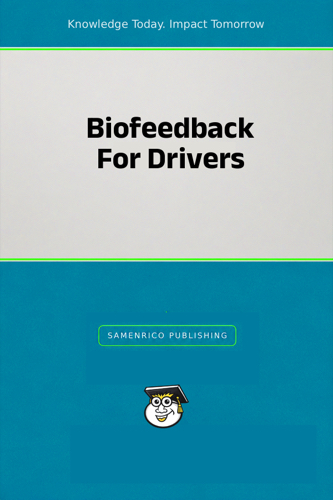
Biofeedback For Drivers
Use heart rate monitors to recognize and reduce dr
Use heart rate monitors to recognize and reduce driving stress.
Formats
About this book
Free sample
Chapter 1: The Hidden Toll--–- The first time Maya’s heart rate monitor alerted her during a drive, she was merging onto the I-405 in Los Angeles, trapped between a speeding semi-truck and a sedan that refused to let her in. Her smartwatch vibrated against her wrist—three short taps, the preset signal for “heart rate exceeding 120 beats per minute.” She glanced down for a fraction of a second (too long, as she would later learn) and nearly clipped the sedan’s bumper. That near-miss, she later told a friend, was her wake-up call. Not the watch. Not the traffic.
The realization that her body had been screaming at her for years, and she had never thought to listen.Maya is not an anxious person. She does not have a clinical phobia of driving. She commutes twenty-two miles each way, five days a week, and has done so for over a decade. By every external measure, she is a competent, even exemplary driver. But her heart rate data told a different story.
Over the course of a single seventy-five-minute commute, her heart rate spiked into the “vigorous exercise” zone (141–160 beats per minute) no fewer than eleven times. That is eleven moments per drive—fifty-five per week, nearly three thousand per year—when her cardiovascular system was operating as if she were sprinting up a flight of stairs. And yet she was sitting down. Air-conditioned. Listening to a podcast.
The gap between her subjective experience (“I’m fine, just a little annoyed”) and her physiological reality (“I am in full fight-or-flight activation”) is the central problem this book exists to solve.The Stress Spillover Effect: Why Work Doesn't Stay at Work Every weekday morning, millions of drivers do the same thing: they finish a stressful meeting, hang up on a difficult phone call, or rush out the door after an argument with a partner, and then they get behind the wheel. The common assumption is that driving serves as a kind of reset button—a transitional space between the chaos of home and the demands of the office. The research suggests otherwise. What psychologists…
This is the end of the free sample. Get the eBook to keep going. Buy now
Contents
- Chapter 1
- Chapter 2
- Chapter 3
- Chapter 4
- Chapter 5
- Chapter 6
- Chapter 7
- Chapter 8
- Chapter 9
- Chapter 10
- Chapter 11
- Chapter 12
Details
- Author
- Blackmon Carolyne
- Publisher
- SamEnrico
- Language
- English
- Genre
- Non-Fiction, Self-Help, Biofeedback
- Released
- 2026-06-08
- Pages (approx.)
- 153
- Available as
- eBook, Audiobook

Read better in the ZLOADR app
Your eBooks on your phone or tablet. Sign in with your SamEnrico account and start reading.
More by Blackmon Carolyne
 Bridge Visualization Crossing GuideBlackmon Carolyne$11.99
 Latin America Consumer GuideBlackmon Carolyne$11.99
 Trustee Responsibilities PrimerBlackmon Carolyne$11.99
 Commitment and Consistency TacticsBlackmon Carolyne$11.99
 The Lost Voyages of the Punt Expeditions: Africa's Ancient MarinersBlackmon Carolyne$11.99
 Understanding Osteosarcoma Limb Anomalies Erythroid MacrocytosisBlackmon Carolyne$17.99
 Web Application DeveloperBlackmon Carolyne$11.99
 How to Become a Type-rolling-machine OperatorBlackmon Carolyne$11.99
 White Label Terms of Service GuideBlackmon Carolyne$12.99
 Tutoring Chinese University Application EssaysBlackmon Carolyne$12.99
You may also like
 The Chronic Stress Biofeedback GuideGarza Larry$11.99
 Self Hypnosis BiofeedbackHiggs Codi$11.99
 The Quit Smoking Breath TestKlein Bryant$11.99
 Dreams in Biofeedback Trauma WorkGuerra Isis$11.99
 Nicotine Blood Test Reduction GuideJung Reid$11.99
 Body Scan for BiofeedbackMorgan Richard$11.99
 Stress Heart Rate VariabilityShepherd Felecia$11.99
 Anger Trigger Wearable AlertAlexander George$11.99
 Burnout Recovery Biofeedback GuideCase Andera$11.99
 Heart Rate Variability TrainingPrater Lauryn$11.99