
Non-FictionInformativeEducational
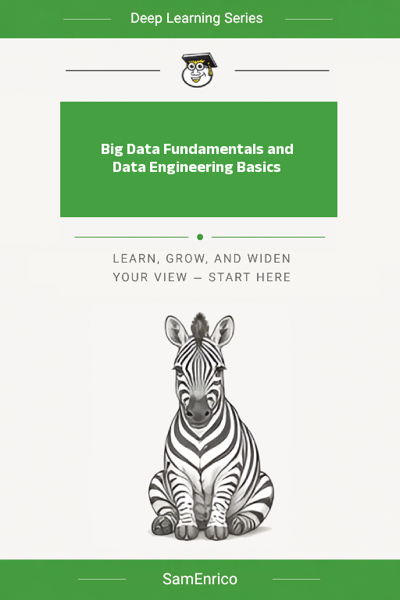
Big Data Fundamentals and Data Engineering Basics eBook
A Coursebook on Big Data Fundamentals and Data Eng
A Coursebook on Big Data Fundamentals and Data Engineering Basics
Formats
Free sample
Chapter 1: The Silent Tsunami--–- In 2012, Target Corporation’s data analytics team performed a seemingly impossible feat. Using purchase history, demographic data, and behavioral patterns, they identified a teenage girl as pregnant before her own father knew. The store began mailing her coupons for baby clothes and cribs. When the father complained to Target’s manager about these “irresponsible” promotions targeting his high school daughter, the manager apologized profusely. Two weeks later, the father called back with a different tone.
“I owe you an apology,” he said. “There have been some changes in my household that I wasn’t aware of. She is indeed due in August.”This story, whether entirely accurate or embellished, captures something essential about our era. Data is no longer just a byproduct of business operations. It has become a form of foresight, a lens into human behavior, and, increasingly, the most valuable asset an organization can possess.
Yet for every Target that successfully predicts pregnancy, there are hundreds of companies sitting on mountains of data they cannot read, lakes of information they cannot navigate, and streams of events they cannot process in time to matter.Welcome to the silent tsunami of Big Data. It is silent because most of it happens invisibly—every click, every swipe, every GPS ping, every transaction, every sensor reading. It is a tsunami because the sheer volume, speed, and variety of this data have overwhelmed traditional ways of storing and analyzing information. And like any tsunami, it presents both existential danger and extraordinary opportunity. Those who learn to ride the wave will thrive.
Those who ignore it will be swept away.This book is not about abstract theory. It is about the fundamentals of Big Data and the practical craft of Data Engineering—the discipline of building systems that collect, store, transform, and deliver data so that it can actually be used. Before we write a single line of code or configure a single server, we must first understand a profound truth: data has no intrinsic value. Zero. None.
A petabyte of raw clickstream logs sitting on a hard drive is worth exactly the same as a petabyte of random noise. Value emerges only when data is transformed into insight, and insight into action. Data engineering is the bridge between raw bytes and business decisions.In this opening chapter, we will explore why Big Data has become a business imperative rather than a technical curiosity. We will examine the four drivers of data-driven transformation: operational efficiency, customer insight, innovation, and competitive advantage. We will learn how to translate vague business questions into precise technical requirements—a skill that separates effective data engineers from mere tool operators.
We will define the success metrics that separate successful data projects from expensive failures. And we will introduce the running case study that will accompany us throughout this book: Stream Sphere, a music streaming startup whose struggle to scale from one hundred thousand to five million users will illuminate every concept we cover.By the end of this chapter, you will understand why data engineering is not merely a technical discipline but a strategic one. You will see that the most sophisticated pipeline in the world is worthless if it does not answer the right business question. And you will be prepared to embark on a journey that will transform you from someone who writes code into someone who delivers value.The Four Engines of Data-Driven Business Before we discuss how to build data systems, we must understand why businesses invest in them. The motivations can be grouped into four categories, which I call the Four Engines.
Each engine powers a different type of business value, and most successful data initiatives draw from multiple engines simultaneously.Engine One: Operational Efficiency Operational efficiency is the most straightforward engine. It asks a simple question: can we do what we are already doing, but cheaper, faster, or with fewer errors? Data enables this by revealing waste, optimizing workflows, predicting failures before they happen, and automating decisions that humans currently make slowly or inconsistently.Consider the shipping giant UPS. For decades, drivers followed roughly similar routes each day, relying on experience and intuition. Then UPS equipped its delivery trucks with sensors that tracked every turn, stop, and idle minute.
By analyzing this data, the company discovered that left turns across traffic were disproportionately costly—they burned fuel, wasted time, and increased accident risk. The solution was deceptively simple: optimize routes to minimize left turns. This single insight, derived from massive volumes of telemetry data, saved UPS an estimated ten million gallons of fuel annually and reduced emissions by twenty thousand tons.Operational efficiency does not require glamorous machine learning or real-time dashboards. Often, it requires something simpler: visibility. Most organizations operate with significant blind spots.
They do not know which server is running at fifty percent capacity while another is overworked. They do not know which supplier consistently delivers late. They do not know which customer service scripts actually reduce call duration. Data engineering provides the pipes that carry this visibility from raw logs to executive dashboards.Engine Two: Customer Insight Customer insight asks a different question: what do our customers actually want, even if they cannot articulate it? This engine powers recommendation systems, personalization engines, churn prediction models, and customer lifetime value calculations.Netflix provides the canonical example.
The company does not ask subscribers what they want to watch—because people often do not know, or they give socially desirable answers rather than truthful ones. Instead, Netflix analyzes what subscribers actually watch: which shows they finish, which they abandon after ten minutes, which they rewatch, when they pause, when they skip the intro. This behavioral data, collected from billions of streaming sessions, feeds algorithms that predict with startling accuracy what each subscriber will enjoy next. The result is a personalized home screen for every user, continuously updated as their tastes evolve.Notice what happened here. Netflix did not simply collect data because it was available.
They identified a specific business problem—helping users find content they would enjoy—and designed their data infrastructure to solve that problem. The data engineering choices (what events to capture, how to store them, how to process them, how to serve predictions) all flowed from the business objective. This is the opposite of the “collect everything now, figure it out later” approach that sinks so many data projects.Engine Three: Innovation Innovation asks the most exciting question: what new products, services, or business models become possible when we have data? This engine creates entirely new revenue streams rather than improving existing ones.John Deere, the agricultural equipment manufacturer, transformed itself from a tractor company into a data company. Modern John Deere tractors contain dozens of sensors that measure soil conditions, crop health, moisture levels, and equipment performance.
Farmers who subscribe to John Deere’s data service receive real-time recommendations: plant here, fertilize there, harvest this field next week. The tractor itself becomes a delivery mechanism for data-driven insight. John Deere still sells tractors, but it also sells a recurring revenue stream that has higher margins and more predictable cash flow.Innovation often requires connecting data sources that were previously separate. Waze, the navigation app…
This is the end of the free sample. Get the eBook to keep going. Buy now
About this book
Details
- Author
- Mcneill Gennie
- Publisher
- SamEnrico
- Language
- English
- Genre
- Non-Fiction, Informative, Educational
- Released
- 2026-05-04
- Pages (approx.)
- 159
- Available as
- eBook, Audiobook

Read better in the ZLOADR app
Your eBooks on your phone or tablet. Sign in with your SamEnrico account and start reading.
More by Mcneill Gennie
 Metta for SensitivityMcneill Gennie$11.99
 Drug Dependency and Neonatal Abstinence SyndromeMcneill Gennie$11.99
 Affirmation Journal for WomenMcneill Gennie$11.99
 Anapanasati for QigongMcneill Gennie$11.99
 Saccadic Eye Movements GuideMcneill Gennie$11.99
 The Banting Best InsulinMcneill Gennie$11.99
 Joan Rivers FunnyMcneill Gennie$11.99
 Jim Simons MedallionMcneill Gennie$11.99
 The Siege of Chandax: The Fall of a Byzantine StrongholdMcneill Gennie$11.99
 Gold and Blood: The Yorkist War Chest That Won the Wars of the RosesMcneill Gennie$11.99
 How to Start a Pleasure Boats Rental Business (Beginners Guide)Mcneill Gennie$11.99
 How to Produce a Boat CoverMcneill Gennie$11.99
You may also like
 Hong Kong Handover 1997Dunn Johnnie$11.99
 Zumba For Postnatal Recovery CourseNeal Christian$11.99
 Zumba for BeginnersLadner Nikia$11.99
 YouTube Comment Mining GuideHumes Pandora$12.99
 Worry Box MeditationCarlin Rudy$11.99
 Workplace Stress MeditationNguyen Lynn$11.99
 Workplace Stress and Sleep RepairHawley Ivory$11.99
 Workplace Perfectionism CureDelaney Jeffry$11.99
 Workplace Injustice Anger GuideWallen Isabelle$11.99
 Work Addiction and Burnout LinkGreenwood Ester$11.99
 Women in Yoga and WellnessBeattie Galina$11.99
 Women in Stand Up ComedyChun Evangeline$11.99