
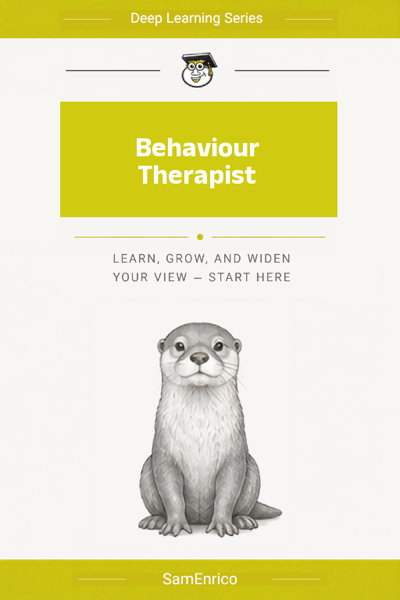
Non-FictionInformativeEducational
Behaviour Therapist eBook
A Coursebook on Behaviour Therapist
by Hyatt Eun
A Coursebook on Behaviour Therapist
Formats
Free sample
Chapter 1: The Architecture of Change--–- Imagine for a moment that you are standing in a room where every object—every chair, every window, every locked door—represents a human behaviour. Some objects are beautiful and functional: a sturdy table where a child sits to complete homework, a comfortable chair where a couple resolves conflict without shouting. Other objects are broken or dangerous: a shattered mirror that cuts anyone who approaches (self-injury during meltdowns), a locked basement door that conceals screaming fits (tantrums that isolate a family), a flickering light that signals impending explosion (the tense silence before verbal aggression). Now imagine that someone has handed you a blueprint and said, “Redesign this room. Not by tearing down the walls or banishing the people inside, but by rearranging what happens before and after every object is used.
You cannot force change. You must understand why each object exists in the first place.”That blueprint is behaviour therapy. And you, as a behaviour therapist, are not a demolition expert. You are an architect of contingencies, a detective of antecedents and consequences, and—above all—a scientist of the observable world who never loses sight of the human being standing in that room.This chapter is not an introduction in the ordinary sense. You will find no dry definitions or historical timelines to memorise.
Instead, this chapter establishes the mindset, ethical backbone, and therapeutic stance that will guide every technique, every data point, and every client interaction across the twelve chapters of this coursebook. By the time you finish reading, you will understand what a behaviour therapist actually does (and does not do), why philosophical assumptions matter for real-world practice, how ethics are not constraints but clinical tools, and why the therapeutic alliance—often mistakenly dismissed as “soft” in behavioural circles—is the bedrock upon which all technical competence rests.What a Behaviour Therapist Actually Does (And Does Not Do)Let us begin with a clear, operational definition of our profession. A behaviour therapist is a practitioner who applies the principles of learning—classical conditioning, operant conditioning, and observational learning—to assess, intervene upon, and evaluate changes in socially significant behaviour. The emphasis on observable and measurable behaviour does not mean behaviour therapists ignore thoughts or feelings. Rather, we treat private events (anxiety, sadness, intrusive thoughts) as behaviours that follow the same natural laws as public actions.
We simply refuse to guess about unobservable constructs like “repressed trauma” or “low self-esteem” when we could instead measure what a person does, says, or feels in ways that two independent observers could agree upon.Clinical Settings. In mental health clinics, behaviour therapists treat anxiety disorders (using exposure therapy derived from extinction principles), depression (using behavioural activation derived from reinforcement schedules), obsessive-compulsive disorder (using exposure and response prevention), habit disorders (tics, trichotillomania), and post-traumatic stress (using prolonged exposure). You will work with adults who avoid elevators because of panic attacks, adolescents who refuse school because of social anxiety, and elderly clients whose isolation has extinguished all sources of positive reinforcement.Educational Settings. In schools, behaviour therapists consult with teachers and special education teams to manage classroom disruption, increase on-task behaviour, teach functional communication to non-verbal students, reduce bullying through contingency systems, and design individualised behaviour intervention plans (BIPs) for students with autism, ADHD, or emotional disturbance. You might spend a morning teaching a first-grade teacher how to deliver praise at a 4:1 ratio to reprimands, then spend the afternoon conducting a functional behaviour assessment for a teenager whose outbursts have led to repeated suspensions.Organisational Settings.
In workplaces, behaviour therapists apply organisational behaviour management (OBM) to improve safety compliance, increase productivity, reduce absenteeism, and train supervisors in performance feedback. You might design a token economy for a manufacturing plant where workers earn points for wearing safety goggles, or implement a behavioural skills training program for call centre staff to reduce customer escalation.What Behaviour Therapists Do NOT Do. We do not diagnose based on intuition or treat based on diagnostic labels alone. A behaviour therapist does not say, “The child has ADHD, so we will use a token economy.” Instead, we say, “The child engages in off-task behaviour (operational definition: looks away from worksheet for more than three seconds) primarily maintained by escape from difficult math tasks (function identified via functional analysis). Therefore, we will teach requesting a break (functional communication training) while gradually increasing task demands (errorless learning).” We do not use aversive procedures (punishment, restraint, seclusion) outside of emergency, legally sanctioned institutional settings—a stance this book takes consistently.
We do not claim that thoughts do not matter; we claim that thoughts become matter only when we can specify the environmental contingencies that shape and maintain them.Why Philosophical Underpinnings Matter for Your First Session You might wonder: why spend time on abstract philosophy when you are eager to learn techniques? Because the philosophy you adopt determines what you measure, what you ignore, and how you explain success or failure. Two major philosophical traditions exist within behaviour therapy, and you must know where you stand.Radical Behaviourism (B.F. Skinner) holds that all behaviour—including thoughts, feelings, and private events—is determined by environmental history and current contingencies. Private events are not causes of action; they are behaviours that themselves require explanation.
A radical behaviourist does not say, “He hit because he was angry.” Instead, they ask, “What environmental contingencies selected hitting as a behaviour, and what verbal community taught him to label that internal state as ‘anger’?” This stance leads to interventions that change the environment directly.Methodological Behaviourism holds that psychology should study only publicly observable events because private events cannot be verified by multiple observers. A methodological behaviourist ignores thoughts not because they are unimportant, but because they are not reliable data. This stance leads to interventions that also change the environment, but for pragmatic rather than philosophical reasons.Why does this matter for your first session? Imagine a client says, “I can’t go to parties because I have social anxiety.” A radical behaviourist hears a verbal statement that itself requires analysis: what reinforcement does the client receive for saying “I have social anxiety” (perhaps sympathy, reduced expectations)? A methodological behaviourist simply notes that “social anxiety” is not measurable and instead asks for specific behaviours: “When you imagine a party, what do you do with your body?
How long does your heart race? What do you say to yourself?” Both arrive at similar assessment questions, but the radical behaviourist maintains a more consistent monism. This book adopts a radical behavioural framework while teaching cognitive-behavioural techniques (Chapter 8) as interventions that treat verbal behaviour (automatic thoughts) through behavioural experiments and contingency management.The Ethical Backbone: Least Restrictive, Reinforcement-First, Assent-Based Ethics in behaviour therapy are not an afterthought or a list of rules to memorise for certification. Ethics are clinical tools that improve outcomes. A client who feels coerced will not cooperate.
A caregiver who is shamed will not implement your plan. A procedure that causes pain will produce escape behaviours that interfere with learning. This coursebook adopts three core ethical principles that weave through every subsequent chapter.Principle 1: Informed Consent as Ongoing Process. At the first session, you will explain—in plain language…
This is the end of the free sample. Get the eBook to keep going. Buy now
About this book
Details
- Author
- Hyatt Eun
- Publisher
- SamEnrico
- Language
- English
- Genre
- Non-Fiction, Informative, Educational
- Released
- 2026-05-04
- Pages (approx.)
- 160
- Available as
- eBook, Audiobook

Read better in the ZLOADR app
Your eBooks on your phone or tablet. Sign in with your SamEnrico account and start reading.
More by Hyatt Eun
 Open Door Policy Modification GuideHyatt Eun$11.99
 Jamaican Power Outage ProtocolHyatt Eun$11.99
 Data Science Essay PromptsHyatt Eun$11.99
 Anger for Emergency Service WorkersHyatt Eun$11.99
 The Gershom Scholem Kabbalah HistorianHyatt Eun$11.99
 The Timbuktu Codex Caper: Stealing Back the Lost Knowledge of AfricaHyatt Eun$11.99
 A Beginners Guide to F1 Powerboat Racing (Volume 1)Hyatt Eun$11.99
 Fire Safety M&A GuideHyatt Eun$12.99
 Brand Voice for YouTube VideosHyatt Eun$12.99
 Understanding Poikiloderma of Rothmund–thomsonHyatt Eun$17.99
You may also like
 Hong Kong Handover 1997Dunn Johnnie$11.99
 Zumba For Postnatal Recovery CourseNeal Christian$11.99
 Zumba for BeginnersLadner Nikia$11.99
 YouTube Comment Mining GuideHumes Pandora$12.99
 Worry Box MeditationCarlin Rudy$11.99
 Workplace Stress MeditationNguyen Lynn$11.99
 Workplace Stress and Sleep RepairHawley Ivory$11.99
 Workplace Perfectionism CureDelaney Jeffry$11.99
 Workplace Injustice Anger GuideWallen Isabelle$11.99
 Work Addiction and Burnout LinkGreenwood Ester$11.99
 Women in Yoga and WellnessBeattie Galina$11.99
 Women in Stand Up ComedyChun Evangeline$11.99