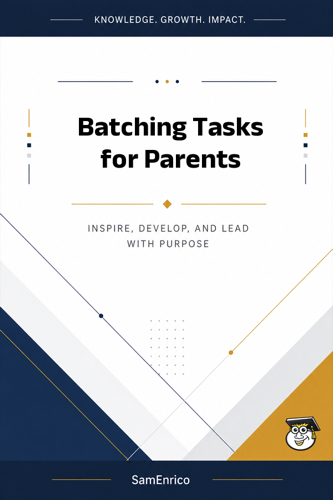
Batching Tasks for Parents
Groups similar chores to save time.
Groups similar chores to save time.
Formats
About this book
Free sample
Chapter 1: The Switching Tax--–- The phone buzzes. You swipe it open. A school email about picture day forms—due yesterday. You set the phone down, but the pasta water is boiling over. You grab a towel, wipe the stove, and hear your five-year-old crying because they can’t find the blue sock.
Not the matching one. The blue one. You tell them to check under the bed. Mid-sentence, your partner texts: Can you grab milk? You reply with one thumb while stirring with the other.
The pasta sticks. The child wails. The email remains unanswered. The milk is forgotten. And it is only 8:47 AM.This scene is not an exaggeration.
It is the average Tuesday morning for millions of parents. And if you felt a tightness in your chest reading it, you already know the truth: something is wrong with how we parent. But here is what most productivity books get wrong. They assume the problem is you. They assume you need better discipline, better tools, better willpower.
They tell you to wake up earlier, make more lists, and try harder.You have tried harder. You are exhausted. And it is not working.The problem is not your effort. The problem is a hidden force that drains your energy without your permission. It is called context switching, and it is silently stealing your time, your patience, and your presence.
This chapter will prove that multitasking is a lie, explain why you feel scattered even when you are busy, and introduce the only solution that actually works for parents: batching.The Myth of the Multitasking Parent Multitasking has been sold to parents as a superpower. We wear it like a badge of honor. I can fold laundry while helping with spelling words while meal planning while yelling at the dog. The cultural message is clear: the more you can do at once, the better you are parenting.This is wrong. Not just slightly inaccurate—scientifically, neurologically, demonstrably wrong.Multitasking does not mean doing two things at once.
It means switching rapidly between two things, and each switch costs you. In 2001, the American Psychological Association published a…
This is the end of the free sample. Get the eBook to keep going. Buy now
Contents
- Chapter 1
- Chapter 2
- Chapter 3
- Chapter 4
- Chapter 5
- Chapter 6
- Chapter 7
- Chapter 8
- Chapter 9
- Chapter 10
- Chapter 11
- Chapter 12
Details
- Author
- Hebert Bernardo
- Publisher
- SamEnrico
- Language
- English
- Genre
- Non-Fiction, Self-Help, Batching
- Released
- 2026-06-06
- Pages (approx.)
- 136
- Available as
- eBook, Audiobook

Read better in the ZLOADR app
Your eBooks on your phone or tablet. Sign in with your SamEnrico account and start reading.
More by Hebert Bernardo
 Purpose After Job LossHebert Bernardo$11.99
 Teresas Concept of DetachmentHebert Bernardo$11.99
 IBS Mixed Type Management CourseHebert Bernardo$11.99
 Collaborative Playlist GuideHebert Bernardo$11.99
 Diabetes Weight Loss GuideHebert Bernardo$11.99
 Morning Ritual Replacement GuideHebert Bernardo$11.99
 Military Shift Sleep GuideHebert Bernardo$11.99
 The Waratah War: How a Rural Rivalry Became Australia's Greatest Football FeudHebert Bernardo$11.99
 The Demon of Kolomea: Galicia's Forgotten Serial KillerHebert Bernardo$11.99
 Service Providers Guide to HepatologyHebert Bernardo$11.99
 How to Produce Toy PlaysetsHebert Bernardo$11.99
 How to Become a Ship RunnerHebert Bernardo$11.99