
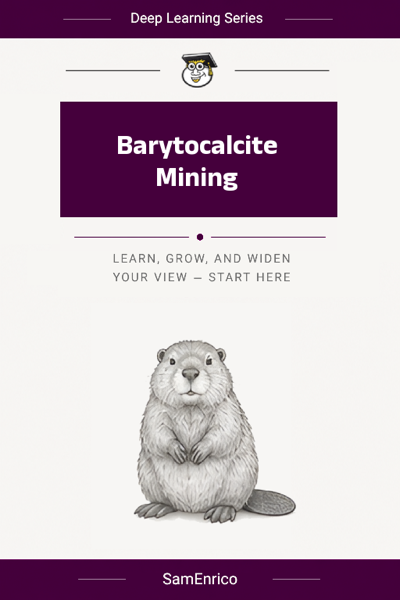
Non-FictionInformativeEducational
Barytocalcite Mining eBook
A Coursebook on Barytocalcite Mining
A Coursebook on Barytocalcite Mining
Formats
Free sample
Chapter 1: The Crystal That Coughed--–- The first death came on a Tuesday. Not from a cave-in, not from black damp, not from the thousand other ways a 19th-century mine could kill a man. John Brougham, a 34-year-old lead miner from Nenthead, Cumbria, had been working a narrow vein of what his foreman called "white stuff" – a heavy, glassy mineral that glittered strangely under the candlelight. Three days after breathing its dust, Brougham developed a dry cough that worsened into hemoptysis. On the fifth day, his kidneys failed.
The local physician, baffled, recorded the cause as "miner's phthisis," a catch-all term for lungs destroyed by rock dust. But Brougham had never worked in coal. He had never cut slate. He had only chipped away at a vein of barytocalcite, and in doing so, became the first recorded casualty of a mineral that would spend the next 150 years quietly killing, confusing, and enriching those who crossed its path.This is not a textbook. It is a detective story about a crystal that lies somewhere between treasure and poison.
Barytocalcite – Ba Ca(CO₃)₂ to the chemist, a monoclinic puzzle to the crystallographer, and a forgotten fortune to the miner – is one of the rarest commercially significant minerals on Earth. Yet almost no one has heard of it. It has no Wikipedia page in most languages. It appears in exactly two mining textbooks, both out of print. And for nearly a century, the only place it was ever mined as a primary target was a single, collapsing hole in the hills of northern England called Blagill Mine.This chapter is the foundation upon which every subsequent chapter rests.
It will not merely list physical properties, though those matter. It will tell you how to recognize barytocalcite in the dark, how to distinguish it from its treacherous cousins barite and witherite, and why a mineral that fizzes in acid like a soda water could be worth more per tonne than lead. More importantly, it will explain the central paradox that runs through this entire book: barytocalcite is both a scientific treasure and an industrial orphan – beautiful enough for museum display, deadly enough to require hazmat suits, and rare enough that most geologists will never see it in the field.The Four Faces of Barium Before we can understand barytocalcite, we must understand its element: barium (Ba), atomic number 56, an alkaline earth metal that sits directly below calcium on the periodic table. Barium is a chameleon. In its pure metallic form, it is a soft, silvery-white metal that oxidizes explosively in air.
But in nature, barium is almost always found combined with other elements, forming minerals that range from the industrially mundane to the scientifically bizarre.Three barium minerals dominate the earth's crust. The first is barite (Ba SO₄), barium sulfate – a dense, chemically inert mineral that comprises more than 80 percent of the world's barium production. Barite is so stable that it laughs at acid. Drop a piece in hydrochloric acid, and nothing happens. No bubbles.
No fizz. Just a heavy thunk at the bottom of the beaker. This inertness makes barite invaluable as a weighting agent in drilling fluids for oil and gas wells. The global market consumes roughly 8 million tonnes of it every year.The second is witherite (Ba CO₃), barium carbonate. Unlike barite, witherite is soluble in acid and highly toxic.
Victorian rat poison manufacturers loved it. So did ceramic glazers, who used it to create brilliant lusters. But witherite is rare. The only significant deposits in the world are in Northumberland, England, and Shaanxi, China. Miners learned quickly that inhaling witherite dust caused "witherite tremors" – a neurological syndrome involving muscle spasms, cardiac arrhythmias, and death.
By 1920, most British witherite mines had closed.The third is barytocalcite (Ba Ca(CO₃)₂), a double carbonate containing both barium and calcium in a 1:1 ratio. It is the bastard child of barite and calcite – sharing properties with both but identical to neither. Barytocalcite fizzes in cold hydrochloric acid (like calcite) but is toxic (like witherite). It is denser than calcite but lighter than barite. And crucially, it decomposes at a lower temperature than witherite, which makes it useful for producing high-purity barium chemicals without the energy costs associated with processing barite.But here is where things get strange.
Barytocalcite is not a single mineral. It is a trimorph – one chemical formula, three crystal structures. The other two are alstonite and paralstonite. All three have the exact same composition: Ba Ca(CO₃)₂. But alstonite crystallizes in the orthorhombic system, paralstonite in the trigonal, and barytocalcite in the monoclinic.
To the naked eye, they look nearly identical. To an X-ray diffractometer, they are as different as ice, water, and steam.This polymorphism matters deeply to the miner and processor. Different crystal structures mean different cleavage planes, different hardness, and different behavior during crushing and flotation. A processing plant designed for barytocalcite may fail miserably when fed alstonite, even though the chemical composition is identical. More than one mining operation has gone bankrupt because it mistook one trimorph for another.The Physical Signature: How to Identify Barytocalcite in the Field Let us dispense with the poetry and get practical.
You are standing at an abandoned mine dump in the North Pennines. The ground underfoot is littered with gray-white rocks, some stained orange by rusting pyrite, others gleaming with the dull luster of weathered calcite. Somewhere in this rubble, there may be barytocalcite worth hundreds of dollars per kilogram to a mineral collector. How do you find it?Color and Luster. Fresh barytocalcite is colorless to white, sometimes with a faint yellow or gray tint.
It has a vitreous (glass-like) to resinous luster on fresh surfaces. Weathering dulls this to a chalky appearance. If you see a mineral that looks like calcite but feels unusually heavy – pick it up.Hardness. On the Mohs scale of mineral hardness (1 = talc, 10 = diamond), barytocalcite scores a 4. This means it can be scratched by a steel knife blade (hardness 5.5) but not by a copper penny (hardness 3).
It will scratch calcite (hardness 3) but not fluorite (hardness 4). Carry a pocket knife and a piece of calcite. If the unknown mineral scratches calcite but is scratched by the knife, you are in the right range.Density. Here is where barytocalcite betrays itself. Its specific gravity ranges from 3.65 to 3.71.
Calcite, by comparison, is 2.71. Barite is much heavier at 4.5. So barytocalcite sits in the middle: heavier than most carbonates, lighter than most sulfates. In the hand, a barytocalcite crystal feels "substantial" – not as dense as lead ore, but noticeably heavier than the limestone that surrounds it. If you have a graduated cylinder and a scale, you can measure density precisely.
In the field, you learn to trust your wrist.Cleavage. Barytocalcite has perfect cleavage in two directions, producing smooth, flat surfaces that reflect light like a mirror. The cleavage planes intersect at angles of approximately 60° and 120°, a distinctive signature of the monoclinic system. When you break a piece of barytocalcite, it tends to form sharp-edged fragments with stepped surfaces. Calcite, by contrast, cleaves into rhombohedra.
Barite cleaves into right-angled blocks.The Acid Test. This is the single most useful field test, and it costs nothing. Carry a small dropper bottle of…
This is the end of the free sample. Get the eBook to keep going. Buy now
About this book
Details
- Author
- Royer Alejandra
- Publisher
- SamEnrico
- Language
- English
- Genre
- Non-Fiction, Informative, Educational
- Released
- 2026-06-02
- Pages (approx.)
- 150
- Available as
- eBook, Audiobook

Read better in the ZLOADR app
Your eBooks on your phone or tablet. Sign in with your SamEnrico account and start reading.
More by Royer Alejandra
 Papua New Guinea TrekRoyer Alejandra$11.99
 The Sleep Apnea Brain ConnectionRoyer Alejandra$11.99
 Remote Commute ReplacementRoyer Alejandra$11.99
 Lonely Musician On TourRoyer Alejandra$11.99
 The High Cortisol Management GuideRoyer Alejandra$11.99
 Blood on the Andes: Pizarro's Betrayal at Cajamarca (1532)Royer Alejandra$11.99
 Learn to Play the Bass ClarinetRoyer Alejandra$11.99
 How to Start a Firewood (retail) Business (Beginners Guide)Royer Alejandra$11.99
 Startup World Cup GuideRoyer Alejandra$12.99
 EE for RA TA ExperienceRoyer Alejandra$12.99
You may also like
 Hong Kong Handover 1997Dunn Johnnie$11.99
 Zumba For Postnatal Recovery CourseNeal Christian$11.99
 Zumba for BeginnersLadner Nikia$11.99
 YouTube Comment Mining GuideHumes Pandora$12.99
 Worry Box MeditationCarlin Rudy$11.99
 Workplace Stress MeditationNguyen Lynn$11.99
 Workplace Stress and Sleep RepairHawley Ivory$11.99
 Workplace Perfectionism CureDelaney Jeffry$11.99
 Workplace Injustice Anger GuideWallen Isabelle$11.99
 Work Addiction and Burnout LinkGreenwood Ester$11.99
 Women in Yoga and WellnessBeattie Galina$11.99
 Women in Stand Up ComedyChun Evangeline$11.99