
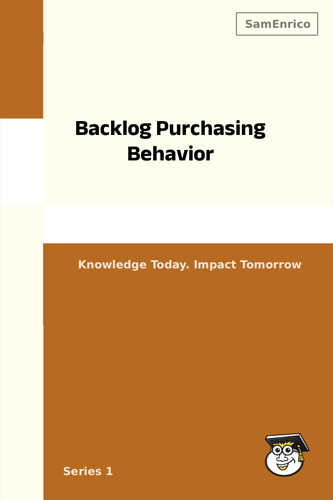
Backlog Purchasing Behavior eBook
Analyze sale driven purchases of unplayed games.
by Bolt China
Analyze sale driven purchases of unplayed games.
Formats
Free sample
Chapter 1: The 33% Confession--–- I own 2,147 video games. I have finished 89 of them. Last year, I spent $640 during Steam sales and played exactly eleven hours of new games. I have a problem. And statistically, so do you.Let me say that again, slower, so the shame has time to settle: two thousand, one hundred and forty-seven games.
At an average retail price of thirty dollars, that is over sixty-four thousand dollars worth of software. In my defense, I paid far less—mostly during sales, mostly in bundles, mostly at three in the morning when my judgment was soft and my credit card was saved. But the number of dollars I saved is not the point. The point is that I own more games than I could play in three lifetimes, and yet, last Tuesday, I spent twenty minutes scrolling my library, sighed, and played another round of Rocket League.This is not a confession of unique depravity. This is the new normal.The analyst Chris Zukowski, who studies game purchasing behavior for developers, published a staggering statistic a few years ago that has haunted me ever since.
He looked at a sample of core gamers and found that out of 558 games owned, the average player had launched only 187 of them. Roughly one-third. The other two-thirds—371 games per person—sat in digital libraries, unplayed, accumulating nothing but guilt. Zukowski called this the "33% Rule," and he noted that developers have quietly built their businesses around it. "Most people who buy your game will not play it," he told an audience of indie developers.
"And that is actually good for you."Good for them. Bad for us.This book is about that gap. The gap between buying and playing. The gap between the person you are and the person you keep spending money to become. The gap between the sixty-four thousand dollars worth of games in my library and the eighty-nine I have actually bothered to finish.The Birth of the Digital Pile of Shame There is a German word that does not translate cleanly into English: Spielschuld.
It means "game guilt"—the specific, low-grade anxiety you feel when you look at your library and see all the games you have not played. The English-speaking internet has coined its own term, less elegant but more honest: the "Pile of Shame." It appears in Reddit threads, You Tube comments, and late-night Discord conversations. "How big is your Pile of Shame?" "I finally reduced my Pile of Shame by two games this month." "I am never going to finish my Pile of Shame and I have accepted that."The phrase is telling. We do not call it a "backlog" because that word implies a professional queue, a manageable list, a series of tasks waiting for attention. We call it a Pile of Shame because that is what it feels like.
Each unplayed game is not a possibility. It is a reproach.I have interviewed dozens of gamers for this book, and the same confession emerges again and again. A thirty-four-year-old software engineer in Seattle owns 1,200 Steam games. He has played 400 of them for more than an hour. He has finished twelve.
"Every time I open my library," he told me, "I feel like I'm looking at a to-do list I will never finish. It's not fun anymore. It's just... weight." A twenty-eight-year-old graphic designer in London has three hundred games across Steam, Epic, GOG, and her Nintendo Switch. She has played maybe sixty.
"I buy games the way other people buy candles," she said. "They look nice on the shelf. They make me feel like a person who has their life together. And then I never light them."These are not outliers. These are the average users.The Three Tribes of the Unplayed Not all backlog builders are the same.
After analyzing hundreds of forum posts, Reddit threads, and personal interviews, I have identified three distinct archetypes. You will recognize yourself in one of them. Perhaps in all three.The Drunken Sailor The Drunken Sailor buys games the way a sailor on shore leave buys drinks: impulsively, enthusiastically, and with no regard for the morning after. The trigger is almost always a sale. Steam sends a notification: "Your wishlist item is 75% off!" The Drunken Sailor clicks.
The price is five dollars. Five dollars is nothing. Five dollars is a fancy coffee. Five dollars is less than the shipping on a physical game. The Drunken Sailor buys it without asking the only question that matters: Will I actually play this?The Drunken Sailor does not ask that question because the question is painful.
The answer is almost always no. But the purchase happens so fast—three clicks, a fingerprint scan, a confirmation chime—that there is no time for the question to form. The Drunken Sailor is not buying a game. The Drunken Sailor is buying the feeling of having bought a game. The dopamine hit comes at the moment of purchase, not at the moment of play.
And like any dopamine loop, it requires ever-larger doses. One five-dollar game becomes ten. Ten becomes fifty. The library grows. The shame grows faster.The Bargain Hunter The Bargain Hunter is the Drunken Sailor's more disciplined, more self-deceiving cousin.
The Bargain Hunter does not buy games impulsively. The Bargain Hunter waits. Sometimes for years. They add games to their wishlist, track price histories on sites like Isthereanydeal.com, and strike only when the discount reaches optimal levels—typically 75% off or more. The Bargain Hunter prides themselves on restraint.
"I never pay full price," they will tell you. "I got the entire Civilization franchise for forty dollars. It would have cost three hundred at launch."The problem, of course, is that the Bargain Hunter still does not play the games. They simply acquire them more efficiently. The discipline of waiting for the perfect price becomes a substitute for the discipline of actually playing.
The Bargain Hunter has optimized the wrong variable. They have minimized dollars spent per game while maximizing games purchased per hour of playtime. The ratio is inverted. They are not saving money. They are spending money on things they do not use, which is not saving at all.
It is just spending with extra steps.The Collector The Collector has given up the pretense of play entirely. The Collector buys games to own them—to see them in the library, to sort them by genre, to display the cover art, to feel the quiet satisfaction of a complete set. The Collector is not delusional. They know they will never play most of these games. They do not care.
The library is the game.I spoke to a Collector in Chicago who owns every mainline Final Fantasy game across every platform. He has physical copies for Play Station, digital copies for Steam, remastered versions for Switch, and mobile ports for his phone. He has finished exactly two of them. "I like knowing they are there," he told me. "It's like a museum.
You don't have to touch every painting. You just need to know the collection is complete."The Collector is often wealthy, or at least comfortable. They have disposable income and they spend it on what brings…
This is the end of the free sample. Get the eBook to keep going. Buy now
About this book
Details
- Author
- Bolt China
- Publisher
- SamEnrico
- Language
- English
- Genre
- Non-Fiction, Consumer Mind Report, Backlog Psychology
- Released
- 2026-06-11
- Pages (approx.)
- 133
- Available as
- eBook, Audiobook

Read better in the ZLOADR app
Your eBooks on your phone or tablet. Sign in with your SamEnrico account and start reading.
More by Bolt China
 Observing Your EnvironmentBolt China$11.99
 Artificial Turf Chemical GuideBolt China$11.99
 Video Game Addiction RecoveryBolt China$11.99
 The Meeting Meltdown PreventionBolt China$11.99
 El Sonido de la Revolución: The Man Behind Latin America's Greatest HitsBolt China$11.99
 How to Start a Hobby in WakeboardingBolt China$11.99
 Citizenship After Express EntryBolt China$12.99
 Video Marketing One Page PlanBolt China$12.99
 Understanding Pulmonary Hypertension, SecondaryBolt China$17.99
 Financial Controller In TrainingBolt China$11.99