
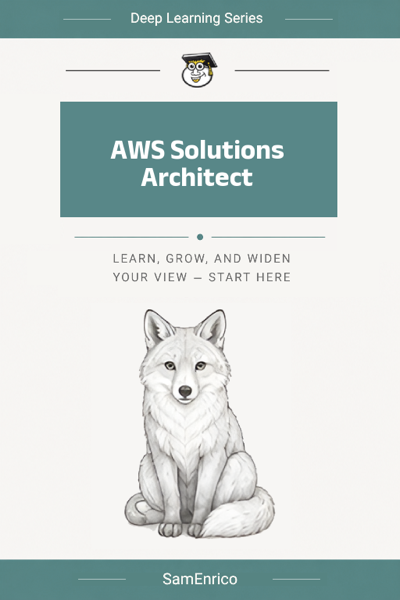
Non-FictionInformativeEducational
AWS Solutions Architect eBook
A Coursebook on AWS Solutions Architect
A Coursebook on AWS Solutions Architect
Formats
Free sample
Chapter 1: The Invisible Architect--–- The first thing you need to understand about cloud architecture is that the best architectures are invisible. When a system works perfectly, no user celebrates the load balancer, no one thanks the auto-scaling group, and absolutely nobody names their pet after the NAT gateway. The invisible architect succeeds by making complexity disappear—by turning potential failure into resilience, manual decisions into automation, and chaotic growth into elegant structure.This is not a book about memorizing AWS service names. You can get those from a cheat sheet. This is a book about thinking like a solutions architect: making trade-offs under uncertainty, designing for failure, and knowing that every decision—from the instance type you choose to the region you deploy in—has cascading consequences.
Whether you are preparing for the AWS Certified Solutions Architect certification or building real systems that thousands of people depend on, the mindset comes first. The services come second.The Architect’s Identity: More Than Operations, More Than Code Before you write a single line of infrastructure as code, you need to understand how this role differs from the two adjacent roles that people often confuse it with.A Sys Admin (System Administrator) focuses on individual servers. They patch operating systems, rotate logs, monitor disk space, and restart failed services. Their world is concrete: this specific EC2 instance, that specific EBS volume. When a server breaks, they fix it.
When a deployment fails, they roll it back. The Sys Admin’s time horizon is minutes to days.A Developer writes application code. They implement business logic, handle edge cases, fix bugs, and add features. Their unit of work is the function, the class, the microservice. They care about maintainability, testability, and speed of iteration.
The developer’s time horizon is hours to weeks.A Solutions Architect sits above both. You do not manage servers directly—you design systems that make servers manageable. You do not write business logic—you create the environment where business logic runs safely and scalably. You answer questions like: Should this workload run on EC2, Lambda, or Fargate? How many Availability Zones provide enough redundancy without wasting money?
If this database fails at 3:00 AM, does the system recover automatically or wake up a human?Most critically, the architect balances competing constraints that have no single correct answer:Cost vs. Performance: Provision more capacity → faster responses → higher bills Speed vs. Reliability: Deploy weekly → fast features → more outages Simplicity vs. Flexibility: Use one database → easy to operate → hard to scale specialized workloads The best architects make these trade-offs explicit, document the rationale, and revisit decisions as conditions change. You are not looking for the perfect architecture because it does not exist.
You are looking for the architecture that best fits your specific business constraints, risk tolerance, and operational maturity.The Shared Responsibility Model: Your Half of the Contract Many cloud beginners assume that “moving to the cloud” means outsourcing all infrastructure worry. That is dangerously wrong. AWS publishes a clear dividing line in the Shared Responsibility Model, and every architect must internalize it.AWS is responsible FOR the cloud:Physical data center security (guards, fences, biometrics)Hardware lifecycle (servers, networking gear, power distribution)Hypervisor and virtualization layer Global network backbone Software-defined services (S3, Lambda, Dynamo DB) at the control plane level You are responsible IN the cloud:Customer data (encryption at rest and in transit)Operating system patches and configuration (on EC2)Network firewall rules (security groups, NACLs)Identity and Access Management (IAM users, roles, policies)Account management and multi-account governance Application-level security (code vulnerabilities, dependency management)The biggest mistake new architects make is assuming that “AWS-managed” means “no responsibility.” For example, AWS RDS manages the database server, applies patches, and handles backups. But you are still responsible for:Who can connect to the database (security groups, IAM authentication)Which tables and columns are encrypted How long backups are retained (AWS default is 7 days; compliance may require 35)Whether read replicas are placed in different Availability Zones This model creates the architect’s central tension: you gain massive leverage from AWS managed services, but you lose visibility and control compared to running your own servers. The best architects push work up the stack whenever possible—using Lambda instead of EC2, Dynamo DB instead of self-managed Cassandra—but only after verifying that the managed service’s constraints fit the workload.The Well-Architected Framework: Your Six Pillars of Judgment AWS distills decades of operational experience into the Well-Architected Framework.
You will see it referenced in every serious architecture discussion, every certification exam, and every AWS review. Memorize the six pillars not as abstract ideals but as practical lenses for decision-making.Operational Excellence: Run Systems Effectively This pillar answers: When something goes wrong, do you know? Can you fix it? Can you prevent it from recurring?Operational excellence means infrastructure that is observable, automatable, and continuously improving. It shows up in:Deployability: Can you roll out a change to 10% of traffic, monitor for errors, and auto-rollback if metrics degrade?
(This requires ALB weighted routing, covered in Chapter 4.)Runbooks: When an alarm fires, is there documented, tested remediation? Better yet, is remediation automated via Lambda and Systems Manager?Post-incident analysis: Do you have a blameless culture that fixes processes, not people?Key practice: Deploy small, deploy often, and always have a rollback path.Security: Protect Data and Assets This pillar answers: Who can access what, and how is it monitored?Security is not a checklist you complete once. It is continuous verification. In AWS, security shows up as:Least privilege IAM: No user or role has permissions beyond what they need right now. Temporary credentials via IAM roles replace long-term access keys.Encryption everywhere: Data at rest (EBS, S3, RDS encryption) and data in transit (TLS for all API calls, VPC traffic encryption).Auditability: AWS Cloud Trail logs every API call.
AWS Config tracks resource configuration changes. Both feed into security information and event management (SIEM) systems.Key practice: Assume breach. Design every component as if an attacker already has a foothold. Use network segmentation, service controls, and zero-trust principles.Reliability: Recover from Failure This pillar answers: When components fail—and they will—does the system continue working?Reliability is not about preventing failure (impossible). It is about containing failure.
In AWS, reliability means:Multi-AZ deployment: Spread resources across at least two Availability Zones. One entire data center can disappear without the system noticing.Automatic recovery: Auto Scaling Groups replace failed instances. RDS Multi-AZ fails over to a standby replica. Load balancers route around unhealthy targets.Graceful degradation: When a dependency fails (a cache, a downstream API), the system returns a stale but reasonable response or defers processing to a queue instead of crashing.Key practice: Test failure modes regularly. Chaos engineering moves recovery theory into practiced reality.Performance Efficiency: Use Resources Optimally This pillar answers: Are you wasting compute, memory, or network capacity?Performance efficiency means right-sizing resources to workload demands, not over-provisioning “just in case.” In AWS, this includes:Elasticity: Auto Scaling groups add and remove instances based on demand.
Dynamo DB on-demand capacity scales without provisioning.Modern hardware: Graviton processors (ARM-based) often deliver 40% better price-performance than x86 for web servers and containers.Caching…
This is the end of the free sample. Get the eBook to keep going. Buy now
About this book
Details
- Author
- Jaynes Alphonso
- Publisher
- SamEnrico
- Language
- English
- Genre
- Non-Fiction, Informative, Educational
- Released
- 2026-05-11
- Pages (approx.)
- 142
- Available as
- eBook, Audiobook

Read better in the ZLOADR app
Your eBooks on your phone or tablet. Sign in with your SamEnrico account and start reading.
More by Jaynes Alphonso
 Brokerage Trade Settlement GuideJaynes Alphonso$11.99Brokerage Trade Settlement GuideJaynes Alphonso$11.99
 The Remote Security GuideJaynes Alphonso$11.99
 Scalp Micropigmentation GuideJaynes Alphonso$11.99
 Toddler CPR ModificationJaynes Alphonso$11.99
 The Shadow of the Lion: The Copycat Murders Inspired by Chaka ZuluJaynes Alphonso$11.99
 How to Produce Blood Glucose Meter AccessoriesJaynes Alphonso$11.99
 SA Business Credit BuilderJaynes Alphonso$12.99
 10 Ways to Use Glucose-fructose (Recipe Book)Jaynes Alphonso$11.99
You may also like
 Hong Kong Handover 1997Dunn Johnnie$11.99
 Zumba For Postnatal Recovery CourseNeal Christian$11.99
 Zumba for BeginnersLadner Nikia$11.99
 YouTube Comment Mining GuideHumes Pandora$12.99
 Worry Box MeditationCarlin Rudy$11.99
 Workplace Stress MeditationNguyen Lynn$11.99
 Workplace Stress and Sleep RepairHawley Ivory$11.99
 Workplace Perfectionism CureDelaney Jeffry$11.99
 Workplace Injustice Anger GuideWallen Isabelle$11.99
 Work Addiction and Burnout LinkGreenwood Ester$11.99
 Women in Yoga and WellnessBeattie Galina$11.99
 Women in Stand Up ComedyChun Evangeline$11.99