
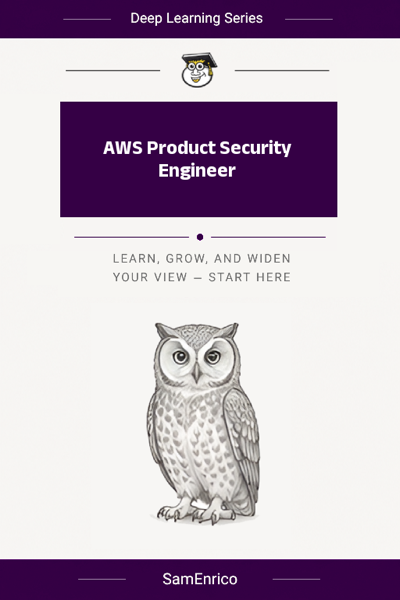
Non-FictionInformativeEducational
AWS Product Security Engineer eBook
A Coursebook on AWS Product Security Engineer
A Coursebook on AWS Product Security Engineer
Formats
Free sample
Chapter 1: The $400M Mistake...--–- The notification arrived at 2:47 AM on a Sunday. Sarah, a senior product security engineer at a fast-growing fintech unicorn, was already awake nursing a cup of cold coffee when her phone buzzed with the first of what would become hundreds of alerts. The Pager Duty notification simply said: "Guard Duty Finding: Privilege Escalation:IAMUser/Administrative Access. Severity: HIGH."She clicked the link and saw it: a new IAM role had been created in the production account ten minutes ago. That role had a policy attached allowing "Action": "*" on "Resource": "*".
Within seconds of the role's creation, someone – or something – had assumed it and launched a dozen GPU instances in a region the company never used: eu-north-1 (Stockholm).Sarah's stomach dropped. She remembered that role. She had approved it six months ago during a frantic "innovation week" when a product team needed temporary access to test a new machine learning pipeline. The role was supposed to be temporary. The team had promised to delete it after the demo.
They hadn't. And because no one had applied a Service Control Policy (SCP) to prevent wildcard actions, that forgotten role had just become the most expensive mistake of her career.By 4:00 AM, the attacker's crypto mining operation was in full swing. By 8:00 AM, the AWS bill had accrued 47,000.Bythetimethepost−mortemmeetingconvenedon Tuesdaymorning,thetotalcost–includingincidentresponsehours,lostcustomerconfidence,andtheremediationsprintthatdelayedaproductlaunch–wouldexceed47,000. By the time the post-mortem meeting convened on Tuesday morning, the total cost – including incident response hours, lost customer confidence, and the remediation sprint that delayed a product launch – would exceed 47,000.Bythetimethepost−mortemmeetingconvenedon Tuesdaymorning,thetotalcost–includingincidentresponsehours,lostcustomerconfidence,andtheremediationsprintthatdelayedaproductlaunch–wouldexceed400,000.The root cause wasn't an exotic zero-day exploit. It wasn't a sophisticated nation-state actor.
The root cause was a single overprivileged IAM role, a missing SCP, and a product security culture that treated "temporary" permissions as harmless.This book exists to ensure that story never happens to you.The Product Security Engineer: A Role Redefined The question most people ask when they hear "AWS Product Security Engineer" is: Isn't that just a cloud security architect with a different title?The answer is a definitive no – and understanding the difference is the foundation of everything that follows.A cloud security architect focuses on infrastructure: VPC configurations, network access control lists (NACLs), security group rules, and the overall security posture of the AWS environment. They worry about whether an S3 bucket is public, whether an EC2 security group allows port 22 from the internet, and whether Cloud Trail is enabled across all regions. These are important concerns, but they are infrastructure concerns – the cloud equivalent of making sure the walls have fire alarms and the doors have locks.An AWS Product Security Engineer, by contrast, focuses on what runs inside that infrastructure: the application code, the CI/CD pipeline, the service-to-service authentication logic, the data model, and the business logic that attackers will try to subvert. You don't just ask "Is the S3 bucket private?" You ask "Does the application need to write to that bucket at all? Can the Lambda function that writes to it do so with the principle of least privilege?
Is the bucket key policy scoped to the specific prefix the application actually uses?"In short: The cloud security architect builds and secures the stadium. The product security engineer secures the game being played inside it.This distinction isn't academic. It directly impacts how you spend your time, which tools you master, and how you measure success. According to AWS's own internal role definitions and the latest SCS-C03 exam guide, a product security engineer spends approximately 60% of their time on proactive activities: design reviews, threat modeling, code audits, and pipeline automation. Only 20% goes to reactive work like incident response.
The remaining 20% covers governance, compliance, and team enablement.Contrast this with a traditional infrastructure security role, which might invert those percentages – spending 60% of time responding to alerts and patching systems, and only 20% on proactive design.The difference is not just philosophical. It's a matter of leverage. Every hour you spend fixing a vulnerability in your IAM policy automation prevents that vulnerability from appearing in a hundred future deployments. Every hour you spend on a design review catches a flaw before it costs $400,000. That's the economic argument for the product security engineer – and it's the thesis of this entire book.The Shared Responsibility Model: Your Playing Field Before you can secure anything in AWS, you need to understand the boundary between AWS's job and your job.
That boundary is defined by the Shared Responsibility Model – and misinterpreting it is one of the top causes of security breaches in the cloud.Here is the model, stripped down to its essentials:AWS is responsible for the security of the cloud. This includes:Physical hardware (data centers, servers, network cables)Global infrastructure (Regions, Availability Zones, edge locations)Managed service infrastructure (the hypervisor that runs EC2 instances, the control plane for S3, the underlying database engine for RDS)You are responsible for security in the cloud. This includes:Customer data (encryption, retention, deletion)Application code and business logic Identity and access management for your users and services Operating system patches on EC2 (unless you use a fully managed service)Network security configurations (security groups, NACLs – although AWS provides the tools, you configure them)Data encryption at rest and in transit Where confusion often arises is with managed services. If you use Amazon RDS for Postgre SQL, AWS manages the database engine, applies security patches, and ensures the underlying infrastructure is secure. But you are responsible for:The database user accounts and passwords Which IAM roles can access the database Whether the database is encrypted at rest (and which KMS key is used)Whether the database is in a private subnet or exposed to the internet Similarly, with Amazon EKS (Kubernetes), AWS secures the control plane.
But you are responsible for:The security context of your pods Kubernetes RBAC (Role-Based Access Control)Network policies that isolate services The container images you run (including their base images and dependencies)The Shared Responsibility Model is not static. It shifts as you adopt different services. When you use AWS Lambda (serverless), AWS takes on responsibility for the underlying operating system, runtime, and execution environment. You focus on function code and its IAM execution role. That's why serverless architectures can reduce your security burden – but only if you understand where the boundary sits.Throughout this book, every chapter will reference the Shared Responsibility Model.
Chapter 2 covers your responsibilities for IAM. Chapter 5 covers data protection. Chapter 7 covers service-to-service networking. But the model itself is the lens through which all security decisions should be viewed.Shift Left: Why Product Security Engineers Live in Design Docs The phrase "Shift Left" originated in software testing, where teams realized that finding and fixing bugs earlier in the development lifecycle – moving that work "left" on the timeline diagram – was dramatically cheaper than finding them in production. The same principle applies to security, with an even stronger economic case.Consider the cost of fixing a security vulnerability:Design stage (before any code is written): A two-hour threat modeling session and design review.
Cost: negligible.Development stage (code written, not yet deployed): A code change, re-review, and re-running tests. Cost: hours to days.Staging environment…
This is the end of the free sample. Get the eBook to keep going. Buy now
About this book
Details
- Author
- Pauley Norberto
- Publisher
- SamEnrico
- Language
- English
- Genre
- Non-Fiction, Informative, Educational
- Released
- 2026-05-09
- Pages (approx.)
- 136
- Available as
- eBook, Audiobook

Read better in the ZLOADR app
Your eBooks on your phone or tablet. Sign in with your SamEnrico account and start reading.
More by Pauley Norberto
 Prioritization Against Interruptions CoursePauley Norberto$11.99
 Jamaican Hurricane Preparation PlanPauley Norberto$11.99
 Film Studies Essay PromptsPauley Norberto$11.99
 The Hannah Arendt Political ThoughtPauley Norberto$11.99
 Divorce Paralegal GuidePauley Norberto$11.99
 The Last Enlightenment: How Reason Defied the DarkPauley Norberto$11.99
 Understanding PleuritisPauley Norberto$17.99
 QuickBooks Apps EcosystemPauley Norberto$12.99
 Hotel Portfolio M&APauley Norberto$12.99
 How to Start a Optical Glass Business (Beginners Guide)Pauley Norberto$11.99
You may also like
 Hong Kong Handover 1997Dunn Johnnie$11.99
 Zumba For Postnatal Recovery CourseNeal Christian$11.99
 Zumba for BeginnersLadner Nikia$11.99
 YouTube Comment Mining GuideHumes Pandora$12.99
 Worry Box MeditationCarlin Rudy$11.99
 Workplace Stress MeditationNguyen Lynn$11.99
 Workplace Stress and Sleep RepairHawley Ivory$11.99
 Workplace Perfectionism CureDelaney Jeffry$11.99
 Workplace Injustice Anger GuideWallen Isabelle$11.99
 Work Addiction and Burnout LinkGreenwood Ester$11.99
 Women in Yoga and WellnessBeattie Galina$11.99
 Women in Stand Up ComedyChun Evangeline$11.99