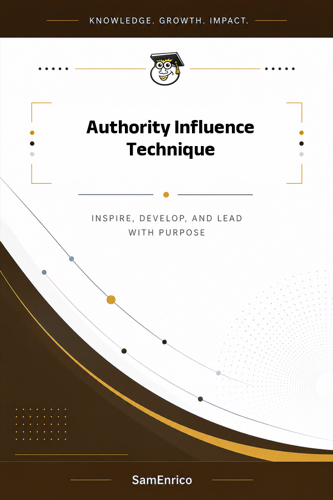
Authority Influence Technique
Establish credibility to make others more likely t
Establish credibility to make others more likely to agree.
Formats
About this book
Free sample
Chapter 1: The Trust Lie--–- In 2019, a forty-two-year-old cardiologist named Dr. Chen stood before a packed auditorium of medical peers and delivered a presentation on a new protocol for treating hypertension. He had three board certifications, twenty years of clinical experience, and a research fellowship from a top-tier university. His slides were immaculate. His data was peer-reviewed.
His delivery was confident. When he finished, the first question from the audience was not about his methodology or his conclusions. It was: “Did this study receive any funding from pharmaceutical companies?”Dr. Chen was stunned. Not because the question was unfair—it was entirely reasonable—but because ten years earlier, no one would have asked it.
Ten years earlier, the audience would have assumed that a cardiologist of his stature was trustworthy. They would have listened, nodded, and updated their practices accordingly. But in 2019, the default setting had changed. Trust was no longer granted. It was interrogated.This chapter is about that interrogation.
It is about why the old assumption of expertise has collapsed, why your degrees and titles no longer protect you, and why the very word “authority” has become suspect in the minds of the people you most need to persuade. If you want to make others agree with you—not because you have power over them, but because they genuinely believe you—you must first understand why they have stopped believing in everyone else.The Collapse of the Automatic Yes There was a time, not so long ago, when authority was a shortcut. People did not have the time, energy, or access to verify every claim made by every expert. So they developed a mental heuristic: if someone had the right title, the right degree, or the right position, they were probably worth listening to. This heuristic was not perfect, but it worked well enough to become the default setting for human interaction.That default setting has now been reversed.
The automatic yes has become an automatic maybe, and often an automatic no.The data on this shift is overwhelming. In 1972, the Stanford Prison Experiment—deeply flawed though it was—still…
This is the end of the free sample. Get the eBook to keep going. Buy now
Contents
- Chapter 1
- Chapter 2
- Chapter 3
- Chapter 4
- Chapter 5
- Chapter 6
- Chapter 7
- Chapter 8
- Chapter 9
- Chapter 10
- Chapter 11
- Chapter 12
Details
- Author
- Barrios Cassie
- Publisher
- SamEnrico
- Language
- English
- Genre
- Non-Fiction, Self-Help, Credibility
- Released
- 2026-06-07
- Pages (approx.)
- 138
- Available as
- eBook, Audiobook

Read better in the ZLOADR app
Your eBooks on your phone or tablet. Sign in with your SamEnrico account and start reading.
More by Barrios Cassie
 Caregiving For Parent With Macular DegenerationBarrios Cassie$11.99
 Golden Milk Turmeric GuideBarrios Cassie$11.99
 Cash Only Recovery PlanBarrios Cassie$11.99
 Stress and Cortisol Driven Binge EatingBarrios Cassie$11.99
 Cholesterol Exercise GuideBarrios Cassie$11.99
 Avalanche Survivor TacticsBarrios Cassie$11.99
 Nocturnal Panic AttacksBarrios Cassie$11.99
 The Hammer of Hastings: Harold Godwinson's Last StandBarrios Cassie$11.99
 The Forge of Hephaestus: The Lame God Who Shaped OlympusBarrios Cassie$11.99
 How to Produce Home Automation KitsBarrios Cassie$11.99
 How to Become a Railroad-maintenance ClerkBarrios Cassie$11.99
 International Franchise Dispute ResolutionBarrios Cassie$12.99