
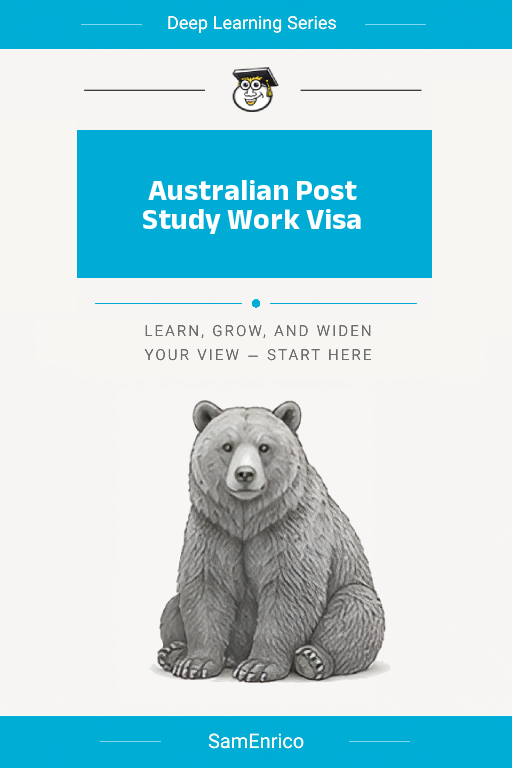
Australian Post Study Work Visa eBook
Access Temporary Graduate visa for 2-6 years after
Access Temporary Graduate visa for 2-6 years after Australian degree completion.
Formats
Free sample
Chapter 1: The Gold List--–- Every year, over 100,000 international students graduate from Australian universities. They walk across stages in Sydney, Melbourne, and Brisbane, holding degrees they were told would open doors to permanent residency. Their families back home celebrate. Their friends post congratulations on social media. And then, within six months, nearly one-third of them discover a devastating truth: their degree will not get them the visa length they assumed.Not because they failed their courses.
Not because they broke visa conditions. But because they chose the wrong degree.This chapter demolishes the single most dangerous myth in Australian migration: that any accredited degree qualifies you for the maximum post-study work visa. The truth is brutal and precise. Your visa duration is not determined by whether you hold a Bachelor’s degree versus a Master’s degree. It is not determined by the prestige of your university.
It is determined by a little-known legislative instrument called the Specified Qualifications List, or SQL, which ties your visa length to your specific CRICOS code and your specific field of study.If you are reading this book before you have enrolled in an Australian course, consider yourself fortunate. You have time to make the right choice. If you are already midway through a degree, do not despair. This chapter will also show you how to pivot, how to extend, and how to salvage your migration pathway. But the message is unambiguous: from this moment forward, you must think like a migration strategist, not like a student.The Old World vs.
The New World Before 2024, the Temporary Graduate visa (subclass 485) operated on a relatively simple principle. If you completed a Bachelor’s degree, you received two years. If you completed a Master’s degree, you received three years. If you completed a Ph D, you received four years. The field of study did not matter.
An English literature graduate received the same duration as a software engineering graduate. A marketing graduate received the same as a civil engineer.That world is gone.In July 2024, the Australian Department of Home Affairs implemented the most significant restructuring of the post-study work visa in a decade. The new framework introduced the Post-Higher Education Work stream and the Post-Vocational Education Work stream, but more importantly, it introduced the Specified Qualifications List. This list, updated every six months, identifies specific fields of study that qualify for extended visa durations. Everything else defaults to the minimum.The logic is explicit: Australia wants to keep graduates who fill critical skills shortages.
It does not want to keep everyone else. The days of studying “anything” and staying for “anytime” are over.Why This Chapter Will Save You Two to Four Years Let me be direct about the stakes. If you choose a degree that appears on the SQL, you can secure a 485 visa for up to four years for a Bachelor’s degree with Honours, three to four years for a Master’s degree, and four to six years for a Ph D. If you choose a degree that does not appear on the SQL, you receive the baseline duration: two years for a Bachelor’s or Coursework Master’s, three years for a Research Master’s, and four years for a Ph D.The difference between appearing on the SQL and not appearing is often a single specialisation. One university offers a Bachelor of Information Technology.
Another offers a Bachelor of Information Technology with a specialisation in Artificial Intelligence. The first gets two years. The second, because AI appears on the SQL, gets three to four years. That is an extra one to two years of work rights, an extra one to two years to accrue points for permanent residency, and an extra one to two years of Australian income.I have personally advised students who discovered this difference only after graduation. They sat in my office, holding their testamurs, asking why their friend from the same university received a longer visa.
The answer was always the same: your friend read the SQL before enrolling. You did not.What Is the Specified Qualifications List (SQL)?The Specified Qualifications List is a legislative instrument published by the Australian Department of Home Affairs, updated in March and September of each year. It is not a secret document. It is publicly available on the Federal Register of Legislation. But very few international students have ever heard of it, and even fewer know how to read it.The SQL contains approximately 265 specific occupations as of the 2025-2026 migration year.
Each occupation is tied to one or more CRICOS codes, which are the unique identifiers for every course offered by an Australian education provider. When you enrol in a course, that course has a CRICOS code. That CRICOS code either appears on the SQL or it does not. There is no grey area. There is no discretion.
There is no appeal.The occupations on the SQL are not random. They reflect Australia’s identified skills shortages. At the time of writing, the SQL heavily favours healthcare, engineering, information technology, teaching, and social work. It also includes select trades, construction roles, and scientific research positions. If your occupation is not on this list, Australia is effectively telling you that your skills are not in immediate shortage.Let me pause here to address a common objection.
Many students believe that if they study a degree that is not on the SQL, they can still secure permanent residency through other pathways like employer sponsorship or state nomination. This is true in theory, but the data tells a different story. Over ninety percent of international students who transition to permanent residency do so through occupations that appear on the SQL or the longer Skilled Occupation List. The reason is simple: state governments and employers prefer to sponsor candidates whose occupations are already designated as critical. You are fighting an uphill battle if your degree does not appear on these lists.Reverse-Engineering Your Course Selection The most powerful strategy in this book is also the simplest: start with the SQL, then choose your degree, not the other way around.Most international students do the opposite.
They choose a university based on rankings. They choose a city based on lifestyle. They choose a degree based on vague interests. Only after enrolling do they ask, “Can I stay after graduation?” This is backwards. It is the equivalent of buying a plane ticket before deciding on a destination.The reverse-engineering methodology has four steps:First, open the current SQL document from the Federal Register of Legislation.
You can find it by searching “Specified Qualifications List 485” on any search engine. Look for the most recent version, which will be labelled with a year and a month.Second, scan the list of occupations and identify which ones match your skills, interests, and prior education. If you have no prior education in a technical field, be realistic. You will not become a civil engineer in two years if you have never studied mathematics. But you might become a social worker, a nurse, or a teacher.Third, for each occupation that interests you, note the corresponding CRICOS codes.
These codes are listed alongside the occupation. The SQL document tells you exactly which courses qualify for extended duration.Fourth, search…
This is the end of the free sample. Get the eBook to keep going. Buy now
About this book
Details
- Author
- Stock Mathilda
- Publisher
- SamEnrico
- Language
- English
- Genre
- Non-Fiction, Student's Shortcut
- Released
- 2026-05-30
- Pages (approx.)
- 140
- Available as
- eBook, Audiobook

Read better in the ZLOADR app
Your eBooks on your phone or tablet. Sign in with your SamEnrico account and start reading.
More by Stock Mathilda
 In Law Relationship Self EsteemStock Mathilda$11.99
 Metta and Vagal ToneStock Mathilda$11.99
 Assertiveness Role Play CardsStock Mathilda$11.99
 Escherichia Coli ProbioticsStock Mathilda$11.99
 The Only Books Were TextbooksStock Mathilda$11.99
 Pets Terminal Illness GriefStock Mathilda$11.99
 Black Friday Sobriety GuideStock Mathilda$11.99
 Nightmare and BipolarStock Mathilda$11.99
 Counter Reformation New Orders HandbookStock Mathilda$11.99
 The Phantom of the Iron Bridge: Brunel’s Forgotten LegacyStock Mathilda$11.99
 The Bridge and the Ballad: A Love Story in Stone and SteelStock Mathilda$11.99
 The Ballad of the Phantom Vote: How a Single Ballot Changed an ElectionStock Mathilda$11.99
You may also like
 Hong Kong Handover 1997Dunn Johnnie$11.99
 Zumba For Postnatal Recovery CourseNeal Christian$11.99
 Zumba for BeginnersLadner Nikia$11.99
 YouTube Comment Mining GuideHumes Pandora$12.99
 Worry Box MeditationCarlin Rudy$11.99
 Workplace Stress MeditationNguyen Lynn$11.99
 Workplace Stress and Sleep RepairHawley Ivory$11.99
 Workplace Perfectionism CureDelaney Jeffry$11.99
 Workplace Injustice Anger GuideWallen Isabelle$11.99
 Work Addiction and Burnout LinkGreenwood Ester$11.99
 Women in Yoga and WellnessBeattie Galina$11.99
 Women in Stand Up ComedyChun Evangeline$11.99