
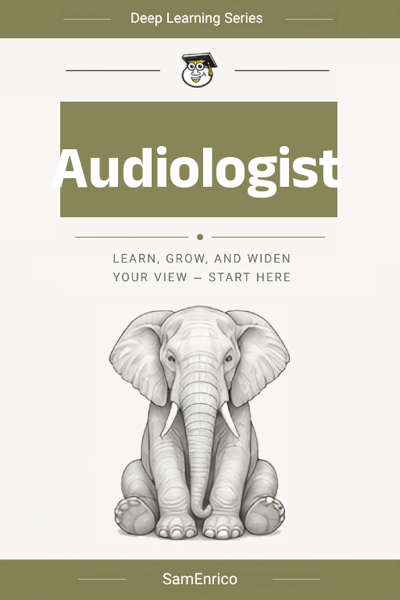
Non-FictionInformativeEducational
Audiologist eBook
A Coursebook on Audiologist
A Coursebook on Audiologist
Formats
Free sample
Chapter 1: The Unheard Majority...--Half a century ago, a firefighter named Frank returned from the battlefields of World War II not with shrapnel wounds or bullet holes, but with an invisible injury that would change the course of medical history. Frank could still hear the roar of artillery—that sound was seared into his memory—but he could no longer hear the crackle of his daughter's voice on the telephone. His wife accused him of ignoring her. His captain thought he was being insubordinate. Frank himself believed he was losing his mind.
He went to an otologist—an ear surgeon—who peered into his ears with a bright light, declared his eardrums pristine, and sent him home with a sympathetic shrug and two words: "Nervous exhaustion."Frank was not exhausted. Frank was not crazy. Frank was part of an unprecedented wave of service members returning from global conflict with a condition that had no name, no diagnostic test, and no treatment. The military called it "acoustic trauma." The veterans called it the "silent wound." And the medical establishment, for the most part, called it untreatable.That changed because of a handful of unlikely heroes—not physicians, but physicists and speech scientists who had been pressed into service during the war to help pilots communicate in deafening cockpits and sonar operators detect enemy submarines through layers of ocean noise. When the war ended, these men and women looked at Frank and the hundreds of thousands like him and asked a question no one else was asking: what if we couldn't cure the damage, but we could measure it, understand it, and teach people how to live with it?Out of that question, a profession was born.
They called it "audiology," from the Latin audire—to hear. And the people who practiced it were called audiologists.The Birth of a Profession: From Battlefield to Clinic The origin story of audiology is not found in ancient texts or European universities. Unlike medicine, which traces its roots to Hippocrates, or surgery, which grew from battlefield amputations, audiology is a thoroughly modern profession, born in the aftermath of World War II and shaped by the specific technological and social conditions of mid-20th-century America. Understanding this history is not merely an academic exercise; it is essential to understanding what an audiologist is, what an audiologist does, and why the profession has evolved so dramatically in the past seventy years.Before World War II, hearing loss was largely viewed through two limited lenses. The first was medical: if you had a problem with your ears, you saw an otologist—a physician specializing in ear surgery.
Otologists were brilliant at treating infections like mastoiditis, removing foreign bodies, and draining middle ear effusions. But they had almost nothing to offer patients with sensorineural hearing loss—damage to the inner ear or auditory nerve. The prevailing medical wisdom held that once the delicate hair cells of the cochlea were destroyed, hearing loss was permanent, untreatable, and essentially a matter for the patient to accept.The second lens was educational: children with significant hearing loss were sent to special schools for the "deaf and dumb"—a deeply offensive term that reflected the era's conflation of hearing loss with intellectual disability. These children were taught manual communication or oral speech, but there was no systematic effort to assess the degree or type of hearing loss, no standardized testing across schools, and no profession dedicated to the non-medical, non-educational aspects of hearing impairment.The war changed everything. Millions of young men were exposed to sustained noise levels that would be illegal in any modern workplace.
Naval gunners fired cannons in enclosed turrets. Aircraft mechanics worked inches from roaring engines. Infantrymen endured artillery barrages that could permanently shift the threshold of hearing in a single afternoon. By 1945, the United States Veterans Administration estimated that more than 150,000 returning service members had significant hearing loss directly attributable to military service—and that was likely a vast undercount.These young men did not have syphilis of the ear. They did not have cholesteatomas.
They had noise-induced cochlear damage, a condition the otologists of the era could diagnose only by saying "there's nothing wrong with your eardrums, so I don't know what to tell you." The veterans were frustrated. The VA was overwhelmed. And a small group of researchers at military hospitals—men like Raymond Carhart, Norton Canfield, and James Jerger—realized that a new kind of professional was needed.Carhart, in particular, is often called the father of audiology. A physicist by training, he had worked on auditory displays for fighter pilots during the war. He understood sound measurement, hearing thresholds, and the psychophysics of loudness and pitch in ways that most physicians did not.
After the war, he established the first audiology program at Northwestern University, training a generation of clinicians in the systematic measurement of hearing using an instrument called the audiometer—a device that had existed since the 1920s but had never been standardized or used systematically in clinical practice.The early audiologists were not doctors. They were not surgeons. They were, in the terminology of the time, "hearing clinicians" or "audiometric technicians." But they brought something crucial to the table: the ability to quantify what the patient and the physician could not see. With a calibrated audiometer, an audiologist could produce a map of the patient's hearing—an audiogram—that showed, frequency by frequency, exactly where the loss was and how severe it was. For the first time, "he's not listening" became "he has a 40 d B sensorineural loss at 4000 Hz."From Technician to Doctor: The Evolution of the Au DFor the first several decades of the profession, audiology existed in a kind of professional limbo.
Most audiologists worked in hospitals, often under the supervision of an otologist. Certification was available through the American Speech-Language-Hearing Association (ASHA), and a master's degree was considered the terminal degree for clinical practice. Audiologists could test hearing, fit hearing aids, and provide aural rehabilitation—but they could not practice independently in most states. They were, in the eyes of the law and insurance companies, "allied health professionals," not independent practitioners.This began to change in the 1970s and 1980s, driven by three converging forces. First, the technology of hearing aids improved dramatically.
The transition from bulky vacuum-tube body aids to behind-the-ear transistor devices meant that hearing aids were no longer simply amplifiers; they could be programmed, adjusted, and fine-tuned to match the specific configuration of a patient's hearing loss. This required clinical judgment that went far beyond simple fitting protocols.Second, the scope of practice expanded. Audiologists began performing electrophysiological tests like auditory brainstem response (ABR) and otoacoustic emissions (OAEs), which required an understanding of neural physiology and signal averaging that was outside the typical otologist's training. Balance disorders—dizziness, vertigo, imbalance—also fell under the audiologist's purview, as the inner ear's vestibular system is physically and functionally connected to the cochlea. An audiologist could now diagnose not just hearing loss but also vestibular pathology, often before a patient had seen any physician.Third, veteran audiologists looked at their counterparts in optometry, psychology, and physical therapy—professions that had successfully transitioned to independent, doctoral-level practice—and asked why audiology could not do…
This is the end of the free sample. Get the eBook to keep going. Buy now
About this book
Details
- Author
- Larkin Stormy
- Publisher
- SamEnrico
- Language
- English
- Genre
- Non-Fiction, Informative, Educational
- Released
- 2026-05-11
- Pages (approx.)
- 157
- Available as
- eBook, Audiobook

Read better in the ZLOADR app
Your eBooks on your phone or tablet. Sign in with your SamEnrico account and start reading.
More by Larkin Stormy
 Phone Notification Management WorkbookLarkin Stormy$11.99
 Indian Agent Retention PlaybookLarkin Stormy$11.99
 Nursing School Essay GuideLarkin Stormy$11.99
 International Divorce RecoveryLarkin Stormy$11.99
 The Names and Faces Sleep TrickLarkin Stormy$11.99
 The Phantom of Puzhal: India’s Most Audacious Prison BreaksLarkin Stormy$11.99
 Understanding Plague, SepticemicLarkin Stormy$17.99
 QuickBooks Bill Pay GuideLarkin Stormy$12.99
 Aerospace Supplier M&ALarkin Stormy$12.99
 How to Start a Temporary Help Service BusinessLarkin Stormy$11.99
You may also like
 Hong Kong Handover 1997Dunn Johnnie$11.99
 Zumba For Postnatal Recovery CourseNeal Christian$11.99
 Zumba for BeginnersLadner Nikia$11.99
 YouTube Comment Mining GuideHumes Pandora$12.99
 Worry Box MeditationCarlin Rudy$11.99
 Workplace Stress MeditationNguyen Lynn$11.99
 Workplace Stress and Sleep RepairHawley Ivory$11.99
 Workplace Perfectionism CureDelaney Jeffry$11.99
 Workplace Injustice Anger GuideWallen Isabelle$11.99
 Work Addiction and Burnout LinkGreenwood Ester$11.99
 Women in Yoga and WellnessBeattie Galina$11.99
 Women in Stand Up ComedyChun Evangeline$11.99