
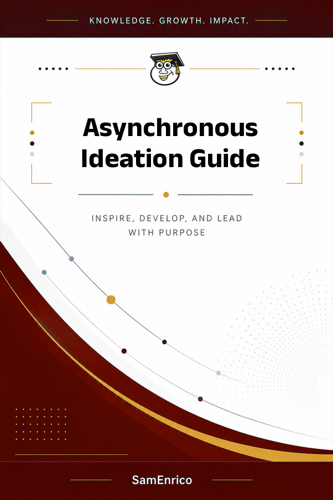
Asynchronous Ideation Guide eBook
Generate ideas across time zones without real time
by Pak Belia
Generate ideas across time zones without real time meetings using shared documents.
Formats
Free sample
Chapter 1: The Meeting Trap...–- Imagine you have just emerged from a three-hour video call that spanned six time zones. The recording is already posted in your team’s Slack channel, but no one will watch it. The shared notes document contains fourteen bullet points, three of which are contradictory. Two people dominated the conversation. One person never spoke.
And despite the marathon session, you have exactly one actionable idea—which you could have generated alone in fifteen minutes while drinking your morning coffee.This scene is not an outlier. It is the default experience of creative work in distributed teams. And it is quietly destroying your team’s capacity to generate breakthrough ideas.The problem is not your team. The problem is not your tools. The problem is not even remote work itself.
The problem is the default assumption that real-time meetings are the appropriate container for creative thinking. That assumption is wrong. And the longer you hold it, the more ideas you lose, the more energy you waste, and the more your most thoughtful team members learn to stay silent.This chapter makes a simple but radical case: asynchronous ideation—generating ideas across time zones using shared documents rather than real-time meetings—produces more original ideas, more equitable participation, and less team fatigue than any synchronous alternative. The evidence is clear. The logic is sound.
And the time to adopt it has never been more urgent.The Hidden Arithmetic of Meeting-Based Creativity Let us begin with a simple calculation. A one-hour meeting with eight people consumes eight person-hours of organizational attention. In that hour, what does the team typically produce? Research on traditional brainstorming suggests a surprisingly consistent answer: fewer than twenty distinct ideas, most of which are generated in the first fifteen minutes. The remaining forty-five minutes are consumed by repetition, tangents, status updates, and the quiet exhaustion of waiting for one’s turn to speak.Now compare this to an asynchronous process.
The same eight people are given forty-eight hours to contribute to a shared document. Each person spends thirty minutes thinking and writing. Total person-hour investment: four hours—half the cost of the meeting. Yet the output often exceeds one hundred distinct ideas, many of which would never have surfaced in a live conversation because they require time to develop.This arithmetic is not merely quantitative. It is qualitative.
The meeting’s fifteen-minute burst of ideas tends to capture what is most obvious, most rehearsed, or most confidently stated. The asynchronous document captures what is original, half-formed, or quietly brilliant—because it gives ideas time to breathe.Consider a product team at a global software company that made this shift. After years of weekly two-hour brainstorming calls that produced an average of twelve ideas per session (most of which were variations on existing features), they moved to a forty-eight-hour async document process. The first session generated ninety-three ideas. Among them was a feature that became their highest-rated release of the year—an idea that had never surfaced in any meeting because the person who conceived it needed three days to articulate it.That person was not shy.
That person was not inexperienced. That person simply thought in a different rhythm than a video call allows.The Three Fatal Flaws of Synchronous Brainstorms To understand why meetings fail at ideation, we must understand the cognitive psychology of group creativity. The literature is remarkably consistent: traditional brainstorming—people in a room (or on a call) generating ideas aloud—is undermined by three structural flaws that are not fixed by better facilitation or more inclusive norms. These flaws are baked into the format itself.Flaw One: Production Blocking Only one person can speak at a time. This seems trivial until you consider its consequences.
While one person talks, everyone else must listen, wait, and remember their own ideas. But human working memory is fragile. Studies show that by the time a speaker finishes a thirty-second contribution, listeners have forgotten an average of forty percent of the ideas they were holding. The longer the meeting, the more ideas are lost before they are ever spoken.Production blocking also creates a perverse incentive structure. Because you cannot speak while others speak, you learn to interrupt or to truncate your ideas.
You stop developing full thoughts and start delivering soundbites. Creativity suffers not because people are uncreative but because the format forces them to be brief.In asynchronous documents, production blocking vanishes. Everyone can contribute simultaneously. No one waits for a turn. No one forgets an idea while listening to someone else.
The document accepts all contributions in parallel, then sorts them out later.Flaw Two: Evaluation Apprehension The fear of judgment is not a character flaw; it is a biological fact. When humans anticipate evaluation—especially public evaluation by peers or authority figures—the brain’s threat response activates. Creative thinking, which requires risk-taking and novelty, is suppressed. The result is self-censorship: people offer safe ideas, incremental improvements, or nothing at all.In meetings, evaluation apprehension is omnipresent. Every idea is spoken aloud in front of everyone.
Body language, tone of voice, and facial expressions provide immediate feedback—often negative—before the idea is even complete. The consequence is that unusual ideas rarely survive.Asynchronous documents do not eliminate evaluation apprehension, but they reduce it significantly. Contributions are written, not spoken. They can be anonymous when needed. They are received without nonverbal cues.
And they are evaluated on content, not delivery. Many teams using async methods report that their most surprising ideas come from participants who rarely speak in meetings.Flaw Three: Social Loafing In group settings, individuals exert less effort than they would alone. This is not laziness; it is a rational response to diffusion of responsibility. If ten people are generating ideas, why work hard? Someone else will pick up the slack.But when everyone assumes someone else will do the work, no one does.
The result is that group brainstorming often produces fewer total ideas than the same number of individuals working alone and combining their results—a finding that has been replicated for decades.Asynchronous documents make social loafing visible and therefore less likely. Contribution tracking shows who has participated and who has not. Time stamps reveal when contributions were made. This transparency, when paired with psychological safety (discussed in Chapter 2), encourages accountability without shame.The Async Advantage: Evidence from the Research The claim that asynchronous methods outperform synchronous ones is not opinion. It is a finding replicated across multiple studies and contexts.In one controlled experiment, researchers compared face-to-face brainstorming groups with asynchronous electronic brainstorming groups.
The asynchronous groups generated forty-two percent more original ideas—not just more ideas, but more ideas rated as novel and useful by independent judges. The effect held across group sizes, time limits, and problem types.Why? The researchers identified three mechanisms. First, asynchronous groups experienced no production blocking; everyone contributed simultaneously. Second, asynchronous groups had more time to reflect and build on others’ ideas.
Third, asynchronous groups were less influenced by status and personality; ideas were evaluated on merit, not on who spoke them.Another study examined global teams across twelve time zones. Teams that used asynchronous ideation methods reported…
This is the end of the free sample. Get the eBook to keep going. Buy now
About this book
Details
- Author
- Pak Belia
- Publisher
- SamEnrico
- Language
- English
- Genre
- Non-Fiction, Self-Help, Async Work
- Released
- 2026-06-08
- Pages (approx.)
- 148
- Available as
- eBook, Audiobook

Read better in the ZLOADR app
Your eBooks on your phone or tablet. Sign in with your SamEnrico account and start reading.
More by Pak Belia
 Growth Mindset In MusicPak Belia$11.99
 The OKR for Sales TeamsPak Belia$11.99
 Road Rage for ParentsPak Belia$11.99
 Amazon River Source QuestPak Belia$11.99
 EMDR for UnforgivenessPak Belia$11.99
 Outsourcing for PodcastersPak Belia$11.99
 Mindfulness for Seniors BeginnersPak Belia$11.99
 The Sapphire Serpent Heist: A Thief’s MasterpiecePak Belia$11.99
 The Harmonic Crown: Black Composers Who Shaped Classical MusicPak Belia$11.99
 The Essential Guide to Christmas: PopPak Belia$11.99
 How to Produce Quick-dryPak Belia$11.99
 How to Produce Emergency Food KitsPak Belia$11.99
You may also like
 Asynchronous Work CommunicationPryor Alaina$11.99
 Asynchronous Creative CollaborationKelsey Twanda$11.99
 Asynchronous Communication MasteryRash Caron$11.99
 Asynchronous Collaboration GuideGarner Owen$11.99
 Asynchronous Work Time ManagementLegg Dorothea$11.99
 Asynchronous BrainstormingKimbrell Cherry$11.99
 Async Communication Best PracticesFair Leonie$11.99