
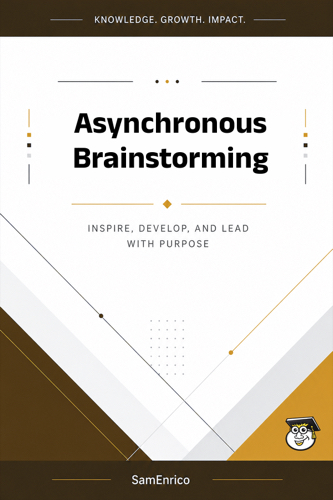
Asynchronous Brainstorming eBook
Use shared documents for idea generation across ti
Use shared documents for idea generation across time zones.
Formats
Free sample
Chapter 1: The 2 AM Zoom--–- The call started at 1:58 AM Singapore time. Maya had been awake for nineteen hours. Her baby had cried at 11 PM, her laptop had crashed at midnight, and now she was staring at nine faces on a Zoom grid—eight of them in perfectly lit home offices during their afternoon, and her own exhausted, coffee-stained reflection. The agenda said "Quick Brainstorm: Q3 Feature Roadmap." Ninety minutes later, they had generated forty-seven sticky notes, zero decisions, and one passive-aggressive comment from the London lead: "Maybe Maya can take the action items since she's the one who's awake."She closed her laptop at 3:30 AM. Not a single idea from that session ever made it into production.This scene is not an outlier.
It is the rule. And if you have ever been Maya—or the London lead secretly resenting the 4 PM slot that runs until 5:30, or the New York associate who stayed late for the "quick sync" that ate her evening—you already know that real-time brainstorming is not just inefficient. It is actively damaging your team's best ideas, your employees' wellbeing, and your organization's ability to innovate across time zones.This book offers a radical alternative: Asynchronous Brainstorming. It is a structured, non-real-time process using shared digital documents where ideas are written, left to mature, and refined over hours or days rather than seconds. It replaces the tyranny of the loudest voice with the democracy of the written word.
It transforms time zones from a liability into a strategic asset. And it will fundamentally change how you think about collaboration.But before we build that future, we must first bury the myth that the real-time brainstorm is sacred. This chapter is the autopsy.The Sacred Cow of Live Brainstorming The live brainstorming session enjoys an almost religious status in modern business culture. We treat it as the default setting for creativity. When a problem arises, we say, "Let's get everyone in a room"—or, since 2020, "Let's hop on a Zoom." We assume that more voices, faster responses, and real-time interaction will produce better ideas.
This assumption is wrong.The belief in live brainstorming rests on three pillars, each of which crumbles under scrutiny.Pillar One: Speed Produces Quality The logic seems intuitive: if we generate ideas quickly, we can iterate quickly. The faster we talk, the faster we solve. But cognitive science tells a different story. The human brain does not produce its best work under time pressure. When you force someone to respond within seconds, you trigger what psychologists call the "fight or flight" response.
Cortisol rises. The prefrontal cortex—the part of your brain responsible for complex reasoning and novel connections—partially shuts down. You do not get creative breakthroughs. You get the first thing that came to mind, which is almost never the best thing.Pillar Two: Real-Time Interaction Sparks Synergy The argument here is that ideas build on ideas. Someone says something half-formed, someone else finishes it, and suddenly you have a breakthrough that no individual could have reached alone.
This does happen. But it happens far less often than we believe. Research on meeting dynamics shows that the average brainstorming session produces only one truly novel idea for every ninety minutes of meeting time. The rest is repetition, social performance, or the same three people talking to each other.Pillar Three: Everyone Contributes This is the most dangerous myth. In a live meeting, contribution is gated by speed, confidence, and social status.
The extrovert speaks first. The senior person's half-baked thought carries more weight than the junior person's polished insight. Non-native speakers hesitate. Introverts are interrupted. And the person who needs thirty seconds to process a question before answering is labeled "slow" or "unprepared."The result is not collective intelligence.
It is a performance stage for the already confident.The Data That Should Terrify You Let us move from anecdotes to evidence. The science of meeting effectiveness has matured significantly over the past decade, and the findings are damning.A comprehensive study of decision-making in corporate meetings found that 36% of decisions made in live meetings are either forgotten or never acted upon within one week. Not because they were bad decisions, but because no one wrote them down in a place that anyone could find. In the chaos of real-time conversation, the output is vapor.The same study found that 25% of meeting time is spent on circular discussions—the same point being made, rephrased, argued, and re-argued without progress. This is not collaboration.
This is a verbal treadmill.Other research has quantified the cost of context switching. Every time a notification pings or a meeting begins, it takes an average of 23 minutes to fully regain deep focus. If you have five meetings in a day, you have lost nearly two hours of productive work—not counting the meetings themselves.And then there is the human cost. A survey of knowledge workers across twelve countries found that 71% report feeling "meeting fatigue" that affects their personal lives. Forty-three percent have considered leaving a job because of excessive or poorly run meetings.
The 2 AM Zoom for Singapore is not just inefficient. It is a retention disaster.But perhaps the most damning evidence comes from a simple experiment conducted by a team of organizational psychologists. They took two groups of engineers and gave them the same complex problem. Group A brainstormed in a live, one-hour meeting. Group B brainstormed asynchronously over forty-eight hours using a shared document, with no live interaction at all.
The results: Group B generated 38% more ideas, and independent evaluators rated their top three ideas as 42% more innovative than Group A's. The asynchronous group also reported significantly higher satisfaction with the process.Speed, it turns out, is not a shortcut to quality. It is an obstacle.The Velocity Bias: Why We Mistake Fast for Smart If live brainstorming is so ineffective, why do we keep doing it? The answer lies in a cognitive distortion I call the Velocity Bias.Velocity Bias is the unconscious assumption that faster responses indicate greater intelligence, competence, or creativity. It is the reason the person who talks the most in a meeting is often assumed to have contributed the most.
It is the reason "quick thinker" is a compliment while "thoughtful responder" is not. It is the reason we schedule thirty-minute meetings for problems that require three days of reflection.Velocity Bias is hardwired into human social cognition. In prehistoric environments, fast decision-making was literally a matter of life and death. The person who spotted the predator first and screamed "Run!" was more valuable than the person who thought carefully about escape routes. Speed was a survival trait.But brainstorming is not predator detection.
Creative problem-solving is not a sprint. It is a form of exploration that requires incubation, connection, and the kind of slow thinking that Daniel Kahneman called "System 2." When you force System 2 problems through a System 1 process (fast, reactive, social), you get garbage.Velocity Bias also creates a perverse incentive structure. In a live meeting, you are rewarded for speaking quickly, even if what you say is shallow. You are penalized for silence, even if that silence is you thinking deeply. Over time…
This is the end of the free sample. Get the eBook to keep going. Buy now
About this book
Details
- Author
- Kimbrell Cherry
- Publisher
- SamEnrico
- Language
- English
- Genre
- Non-Fiction, Self-Help, Async Work
- Released
- 2026-06-07
- Pages (approx.)
- 155
- Available as
- eBook, Audiobook

Read better in the ZLOADR app
Your eBooks on your phone or tablet. Sign in with your SamEnrico account and start reading.
More by Kimbrell Cherry
 Yoga Nidra for Deep RestKimbrell Cherry$11.99
 Nicotine Withdrawal ManagementKimbrell Cherry$11.99
 Empathy for Partners GuideKimbrell Cherry$11.99
 Define Problem Statements GuideKimbrell Cherry$11.99
 Storming of the Bastille GuideKimbrell Cherry$11.99
 Blue Zone Home Design GuideKimbrell Cherry$11.99
 Deep Work for Remote EmployeesKimbrell Cherry$11.99
 Charlemagne's Golden Dawn: The Carolingian RenaissanceKimbrell Cherry$11.99
 Nefertiti’s Curse: The Pharaoh’s Forbidden LoveKimbrell Cherry$11.99
 How to Become a Power-transformer RepairerKimbrell Cherry$11.99
 How to Produce ICE BinsKimbrell Cherry$11.99
 Versioning for Cost IncreasesKimbrell Cherry$12.99
You may also like
 Asynchronous Work CommunicationPryor Alaina$11.99
 Asynchronous Creative CollaborationKelsey Twanda$11.99
 Asynchronous Communication MasteryRash Caron$11.99
 Asynchronous Collaboration GuideGarner Owen$11.99
 Asynchronous Work Time ManagementLegg Dorothea$11.99
 Asynchronous Ideation GuidePak Belia$11.99
 Async Communication Best PracticesFair Leonie$11.99