
Non-FictionBusiness BriefInfrastructureDevOps
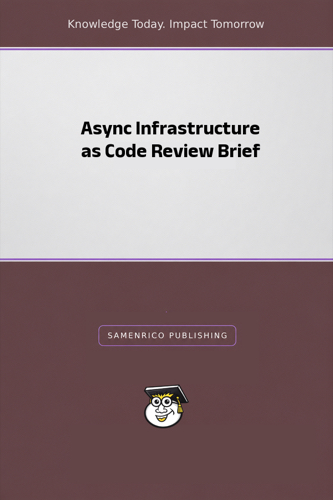
Async Infrastructure as Code Review Brief eBook
Review Terraform, CloudFormation, and Ansible chan
Review Terraform, CloudFormation, and Ansible changes asynchronously using pull request workflows.
Formats
Free sample
Chapter 1: The 3 AM Confession--It was 3:14 AM on a Saturday when the senior platform engineer finally admitted what everyone already suspected: “I have no idea how to undo what I just did.”The confession came over a crackling conference bridge, fifteen minutes after a routine database migration had turned into a full-blown outage. The change had been simple—or so everyone thought. A single checkbox in the AWS Console, clicked by a well-intentioned developer who needed to “just quickly fix something” before the weekend. No ticket. No pull request.
No second pair of eyes. Just a click, a confirmation dialog, and then silence as the production database began rejecting connections at an alarming rate.By the time the incident was resolved—four hours later, after twelve engineers had been woken up, three rollback attempts had failed, and the company had lost an estimated $240,000 in revenue—the post-mortem asked one devastating question: “Who approved this change?”The answer, of course, was no one.The Infrastructure Confession If you have worked with cloud infrastructure for more than six months, you have either lived this story or you have a version of it that is uniquely yours. Perhaps it was a Terraform apply that deleted a security group because someone forgot to add the -target flag. Perhaps it was an Ansible playbook that restarted 200 production servers simultaneously because a handler fired in the wrong order. Perhaps it was a Cloud Formation stack update that hung for forty-five minutes, forcing a desperate engineer to hit the delete button, only to discover that the stack had exports that three other critical stacks depended upon.The specifics change.
The pattern does not.Infrastructure changes are treated differently than application code, and this difference is killing our ability to operate reliably at scale. We would never allow a developer to push application code directly to production without a code review, without automated tests, without a pull request. Yet for infrastructure—the very foundation upon which our applications run—we routinely accept practices that would be considered malpractice in software development.This book exists because that contradiction is no longer acceptable.The Automation Fear That Paralyzes Teams Let us name the elephant in the room. The reason most teams do not fully automate infrastructure changes is not technical. It is emotional.
It is fear.Automation Fear is the deep-seated reluctance to let machines touch production infrastructure without extensive human oversight. It manifests in predictable ways: the engineer who always runs terraform plan and then copy-pastes the output into Slack instead of trusting the CI pipeline. The manager who insists on a “change advisory board” meeting before any infrastructure modification, even for a tag update. The senior architect who keeps the production AWS access keys in a password manager and types them into the terminal manually because “automation is too risky.”On the surface, this fear appears rational. Infrastructure is critical.
An outage costs money, reputation, and sleep. But the fear is actually a trap. The more you rely on manual processes to prevent failures, the more fragile your systems become. Each manual step introduces a new opportunity for human error. Each undocumented console click creates configuration drift.
Each hero who “just knows how to fix it” becomes a single point of failure.The paradox of Automation Fear is that it creates the very fragility it seeks to avoid.A team that manually approves every infrastructure change is a team that moves slowly, documents poorly, and learns almost nothing from its mistakes. When something breaks—and it will break—the post-mortem becomes a forensic investigation of who clicked what, rather than a process improvement of how the automation failed.Antifragile Infrastructure: Beyond Resilience The Greek philosopher Nassim Nicholas Taleb introduced a concept that is essential for understanding what we are trying to build. In his book “Antifragile,” Taleb describes three categories of systems when exposed to volatility, error, and stress.Fragile systems break when stressed. A glass vase on a high shelf is fragile. A single misstep, and it shatters.
Most manual infrastructure processes are fragile. They work perfectly under ideal conditions and fail catastrophically when anything unexpected occurs.Robust systems resist stress. A steel beam is robust. It can withstand significant force without changing. Many automated infrastructure pipelines aim for robustness—they handle expected failure modes but do not improve from exposure to error.Antifragile systems gain strength from stress.
A human immune system is antifragile. Exposure to pathogens makes it stronger. This is what we want for our infrastructure review processes.When we force all infrastructure changes through pull request workflows, we are not merely building robust systems. We are building antifragile ones. Each review, each comment, each automated test that catches a mistake makes the system stronger.
The knowledge gained from a failed plan diff is preserved in the PR history. The security policy that rejected a misconfigured S3 bucket becomes a reusable OPA rule. The integration test that caught a race condition becomes a permanent regression guard.The PR is not just a gate. It is a learning mechanism.The Iron Age vs. The Cloud Age To understand why pull request workflows are essential for infrastructure, we must first understand how we arrived at our current predicament.The Iron Age: Pets and SSHIn the early days of cloud computing—and for many organizations, this is still the present—infrastructure was managed like a collection of pets.
Each server had a name, a personality, and an engineer who was emotionally attached to it. Changes were made via Secure Shell (SSH). An engineer would log into a server, run a series of commands, and hope for the best. If the server became sick, the engineer would nurse it back to health with more manual commands. If it died, there was grieving.This model had several catastrophic flaws.First, SSH-driven changes were invisible.
There was no record of who ran what command on which server at what time, unless the engineer remembered to log their session. Second, changes were non-repeatable. The same set of commands might work on one server and fail on another because of subtle differences in configuration drift. Third, disaster recovery was a fantasy. Rebuilding a “pet” server required not just a backup of its data, but also the tacit knowledge stored in the head of the engineer who cared for it.The Cloud Age: Cattle and Declarative APIs The cloud age introduced a fundamentally different model.
Servers became cattle, not pets. Infrastructure became declarative. Instead of running commands to achieve a desired state, engineers wrote configuration files that described the desired state, and tools like Terraform, Cloud Formation, and Ansible reconciled reality with that description.This shift was revolutionary. Infrastructure could be versioned in Git. Teams could review changes before they were applied.
Environments could be recreated from scratch using nothing but code.But here is the problem that most organizations have not yet solved: they adopted declarative tools but kept imperative processes.They write Terraform but still run terraform apply from their laptops. They store Cloud Formation templates in Git but still click “update stack” in the AWS Console. They version Ansible playbooks but still use ansible-playbook with --ask-become-pass rather than trusting a CI pipeline.The tool…
This is the end of the free sample. Get the eBook to keep going. Buy now
About this book
Details
- Author
- Tremblay Doria
- Publisher
- SamEnrico
- Language
- English
- Genre
- Non-Fiction, Business Brief, Infrastructure, DevOps
- Released
- 2026-06-11
- Pages (approx.)
- 131
- Available as
- eBook, Audiobook

Read better in the ZLOADR app
Your eBooks on your phone or tablet. Sign in with your SamEnrico account and start reading.
More by Tremblay Doria
 Affirmations That Actually WorkTremblay Doria$11.99
 TM Student SuccessTremblay Doria$11.99
 Opioid Use and HIV GuideTremblay Doria$11.99
 Emotional Intelligence in NegotiationTremblay Doria$11.99
 The Lost Fleet of the Aral Sea: Unlocking a Forgotten EmpireTremblay Doria$11.99
 The Art of the Spin: How a Press Secretary Saved a PresidencyTremblay Doria$11.99
 How to Become a Scoreboard OperatorTremblay Doria$11.99
 Insurance Requirement UpdateTremblay Doria$12.99
 Countdown Timer Free AppTremblay Doria$12.99
 Field CoordinatorTremblay Doria$11.99
You may also like
 Hong Kong Handover 1997Dunn Johnnie$11.99
 Zumba For Postnatal Recovery CourseNeal Christian$11.99
 Zumba for BeginnersLadner Nikia$11.99
 YouTube Comment Mining GuideHumes Pandora$12.99
 Worry Box MeditationCarlin Rudy$11.99
 Workplace Stress MeditationNguyen Lynn$11.99
 Workplace Stress and Sleep RepairHawley Ivory$11.99
 Workplace Perfectionism CureDelaney Jeffry$11.99
 Workplace Injustice Anger GuideWallen Isabelle$11.99
 Work Addiction and Burnout LinkGreenwood Ester$11.99
 Women in Yoga and WellnessBeattie Galina$11.99
 Women in Stand Up ComedyChun Evangeline$11.99