
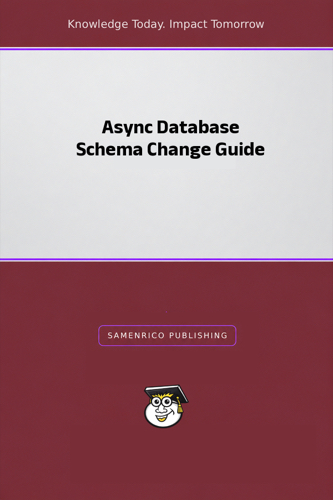
Async Database Schema Change Guide
Document schema changes, migration plans, and roll
by Vidal Mika
Document schema changes, migration plans, and rollback procedures asynchronously for team review.
Formats
About this book
Free sample
Chapter 1: The Friday Freeze--–- It was 3:47 PM on a Friday when Maya’s phone buzzed with the message every on-call engineer dreads: “Orders table is locked. Customers can’t checkout. Revenue dropping.” She had done everything right — or so she thought. The ALTER TABLE orders ADD COLUMN priority_flag TINYINT(1) had passed peer review, been tested in staging, and looked completely harmless. But the orders table had 847 million rows, and My SQL decided to copy the entire table to disk before adding the column.
Forty-three minutes later, the lock was still holding. The company lost an estimated $94,000 in abandoned carts. Maya spent her weekend writing an incident report and wondering if she should update her resume.The Hidden Tax Nobody Talks About This story is not unique. In fact, variations of it play out every single week in companies of all sizes — from five-person startups to Fortune 500 enterprises. The details change — the database might be Postgre SQL instead of My SQL, the table might be called transactions instead of orders, the engineer might be named Alex instead of Maya — but the underlying pattern remains disturbingly consistent: a routine schema change triggers an unexpected production incident, and everyone asks the same question afterward: “How did we not see this coming?”The answer, uncomfortable as it may be, is that most engineering organizations have built their database change processes around an assumption that stopped being true years ago: the assumption that schema changes are rare, simple, and can be coordinated in real time.The Pre-Cloud Era and Its Scars To understand why this assumption persists, we need to briefly visit the not-so-distant past.
Ten or fifteen years ago, database schema changes looked fundamentally different than they do today. Application deployments happened monthly, or even quarterly. Teams were smaller. The “DBA” — Database Administrator — was a distinct role, often gatekeeping access to production. A schema change request meant filling out a Jira ticket, scheduling a meeting with the DBA review board, and getting a time slot — usually on a Thursday night — to run your ALTER statements while the application…
This is the end of the free sample. Get the eBook to keep going. Buy now
Contents
- Chapter 1
- Chapter 2
- Chapter 3
- Chapter 4
- Chapter 5
- Chapter 6
- Chapter 7
- Chapter 8
- Chapter 9
- Chapter 10
- Chapter 11
- Chapter 12
Details
- Author
- Vidal Mika
- Publisher
- SamEnrico
- Language
- English
- Genre
- Non-Fiction, Business Brief, Database, DevOps
- Released
- 2026-06-10
- Pages (approx.)
- 141
- Available as
- eBook, Audiobook

Read better in the ZLOADR app
Your eBooks on your phone or tablet. Sign in with your SamEnrico account and start reading.
More by Vidal Mika
 EQ for CoachesVidal Mika$11.99
 TM Athlete PerformanceVidal Mika$11.99
 Opioid Use and Hepatitis CVidal Mika$11.99
 Imposter Syndrome in Medical ProfessionalsVidal Mika$11.99
 Pill Poppers & Power: The Fall of Insys TherapeuticsVidal Mika$11.99
 The Phantom Fleet of the Great Lakes: The Lost Ships of 1913Vidal Mika$11.99
 How to Start a Presbyterian Church of Wales Business (Beginners Guide)Vidal Mika$11.99
 Referral Program Free GuideVidal Mika$12.99
 HVAC Maintenance Lease UpdateVidal Mika$12.99
 Fabrication Machine OperatorVidal Mika$11.99
 Understanding Cranioacrofacial SyndromeVidal Mika$17.99