
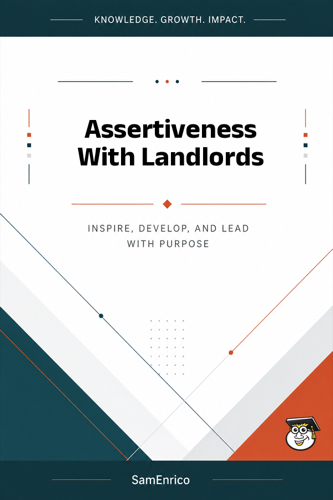
Assertiveness With Landlords eBook
Request repairs and enforce your rights without fe
by Coker Bret
Request repairs and enforce your rights without fear.
Formats
Free sample
Chapter 1: The Gratitude Trap--–- Maria hadn’t complained about the heat in three years. Not because it worked—it didn’t. Every winter, her Brooklyn apartment hovered at fifty-five degrees. She slept in a winter coat, wore gloves to make coffee, and watched her breath fog in the bathroom. But when friends asked why she didn’t call the landlord, she said the same thing every time: “At least I have a roof over my head.”Maria was not weak.
She was a nurse, twelve-hour shifts, saving lives. But inside her own home, she had become a ghost. She paid $1,900 a month for a radiator that clicked but never warmed, for windows that whistled with January wind, for a ceiling that leaked so consistently she had named the drip “Henry.” She never called the landlord because she was terrified of one word: eviction. In her mind, complaining was a dare. And she was not brave enough to dare the man who controlled whether she slept indoors.Maria’s story opens this book for a reason.
She represents millions of renters across the United States—forty-four million households, to be precise—who live in substandard conditions not because they have to, but because they have been conditioned to believe that asking for basic habitability is a personal failing. They have fallen into what this chapter calls the Gratitude Trap.The Gratitude Trap is a psychological snare. It tells you that housing is a privilege, not a contract. It whispers that you should be grateful for what you have, even when what you have is a moldy ceiling, a broken lock, or a pest infestation. It transforms a paying customer into a supplicant.
And it is the single greatest barrier between tenants and their legal rights.This chapter dismantles the Gratitude Trap. It will not give you laws or forms—those come in later chapters. Instead, it will rewire the way you see yourself as a renter. By the end of this chapter, you will understand why you have been silent, why that silence serves only your landlord, and how to replace fear with a calm, documented, legally grounded assertiveness. You will take a self-assessment to identify your “tenant fear profile.” And you will make a commitment—not to be aggressive, not to be angry, but to be effective.Let us begin by understanding how you got here.The Making of a “Good Tenant”Most renters are not born afraid.
They learn it.Think back to your first apartment. Perhaps you were eighteen, fresh out of your parents’ house, signing a lease that you did not fully read. The landlord or property manager smiled, shook your hand, and said something like, “We’re a family here,” or “Take care of the place, and we’ll take care of you.” You felt relief. You had secured housing. You were an adult.Now consider what you were not told.
You were not told that the heat was last serviced during the Clinton administration. You were not told that the previous tenant moved out because of bed bugs. You were not told that the landlord’s “family” metaphor would dissolve the moment you asked for a new smoke detector.Instead, you were handed a lease filled with clauses designed to protect the landlord, and you were expected to nod and sign. That is not an accident. The residential lease—unlike almost any other consumer contract—is drafted entirely by one party.
You do not negotiate it. You do not hire a lawyer to review it. You sign it because you need a place to live by the first of the month.From that moment forward, a silent curriculum begins. You learn that calling the landlord feels like an imposition. You learn that maintenance requests go into a portal and disappear.
You learn that asking for a repair is often met with silence, defensiveness, or a veiled threat about how “other tenants” are happy here. You learn to live with the drip, the draft, the dark.This is not your fault. It is the result of a power imbalance baked into the American housing system. Landlords have lawyers, property managers, and eviction courts. Tenants have… hope.
And hope is not a legal strategy.The Difference Between Being Grateful and Being Exploited Gratitude is a virtue. Exploitation is not. The Gratitude Trap confuses the two.Let us draw a clear line. It is reasonable to be grateful for housing in a market where rents are high and vacancies are low. It is not reasonable to be grateful for housing that fails to meet basic health and safety standards.
When you pay rent, you are not making a charitable donation. You are purchasing a product: a habitable home.Imagine going to a restaurant. You order a steak, medium rare. The waiter brings you a burned hockey puck of meat. Do you say, “Thank you so much for this meal—at least I’m not starving”?
No. You send it back. You ask for what you paid for. You do this without fear because you understand the transaction: money in exchange for a specific standard of goods.Now apply that same logic to your apartment. You pay rent.
In exchange, the law—not the landlord’s goodwill, not the lease, but the law—guarantees you certain minimum conditions. Heat in the winter. Running water. A roof that does not leak. Walls without mold.
Floors without pests. These are not upgrades or luxuries. They are the legal baseline of habitability.When you request a repair, you are not being difficult. You are not being ungrateful. You are asking the landlord to deliver the product you already paid for.
The fact that this feels uncomfortable is a measure of how thoroughly the Gratitude Trap has conditioned you.Aggression vs. Assertiveness: The Critical Distinction Many tenants swing between two unhelpful poles. On one end, they say nothing—passive silence. On the other end, they explode—aggressive demands, emotional outbursts, threats shouted into a voicemail. Neither works.Passive silence gets you ignored.
Aggressive outbursts get you labeled a “problem tenant” and, in some cases, accelerate retaliation. Between these two poles lies assertiveness: calm, documented, fact-based communication that relies on legal rights rather than emotional leverage.Here is the difference in practice:Passive: “I’m sorry to bother you, but if you have time, maybe you could look at the leak whenever it’s convenient… no rush…” (The landlord never responds.)Aggressive: “You’re a slumlord! I’m going to sue you and post about you on every website! Fix this now or else!” (The landlord stops responding and calls his lawyer.)Assertive: “Dear Landlord, this is formal notice that the heat in Unit 4B has been non-functional for 72 hours, violating the implied warranty of habitability under [state code]. Please repair within 24 hours as required by law.
Attached are time-stamped photos and a log of outdoor temperatures. If I do not receive confirmation of repair by tomorrow at 5 PM, I will exercise my legal remedies under [state code section].” (The landlord calls back within two hours.)Assertiveness works because it does two things simultaneously. First, it establishes that you know your rights—which immediately…
This is the end of the free sample. Get the eBook to keep going. Buy now
About this book
Details
- Author
- Coker Bret
- Publisher
- SamEnrico
- Language
- English
- Genre
- Non-Fiction, Self-Help, Housing
- Released
- 2026-06-06
- Pages (approx.)
- 158
- Available as
- eBook, Audiobook

Read better in the ZLOADR app
Your eBooks on your phone or tablet. Sign in with your SamEnrico account and start reading.
More by Coker Bret
 Wrestling Skin Infection PreventionCoker Bret$11.99
 The MBSR for Insomnia WorkbookCoker Bret$11.99
 Active Listening For AnxietyCoker Bret$11.99
 Wholesaling Team Building GuideCoker Bret$11.99
 Creative Block for AnxietyCoker Bret$11.99
 Nostril vs Belly Breathing FocusCoker Bret$11.99
 Third Party Contract PenaltiesCoker Bret$11.99
 The Broken TelevisionCoker Bret$11.99
 The Blood of Austerlitz: Napoleon's Perfect StormCoker Bret$11.99
 Echoes of the Vanished: The CIA’s Secret War Against the Soviet Space ProgramCoker Bret$11.99
 The Silk Road Sting: How a FBI Sting Exposed a $1 Billion Bribery WebCoker Bret$11.99
 Strategic Decision Making for LeadersCoker Bret$11.99
You may also like
 Hong Kong Handover 1997Dunn Johnnie$11.99
 Zumba For Postnatal Recovery CourseNeal Christian$11.99
 Zumba for BeginnersLadner Nikia$11.99
 YouTube Comment Mining GuideHumes Pandora$12.99
 Worry Box MeditationCarlin Rudy$11.99
 Workplace Stress MeditationNguyen Lynn$11.99
 Workplace Stress and Sleep RepairHawley Ivory$11.99
 Workplace Perfectionism CureDelaney Jeffry$11.99
 Workplace Injustice Anger GuideWallen Isabelle$11.99
 Work Addiction and Burnout LinkGreenwood Ester$11.99
 Women in Yoga and WellnessBeattie Galina$11.99
 Women in Stand Up ComedyChun Evangeline$11.99