
Non-FictionSelf-HelpFriendship Skills
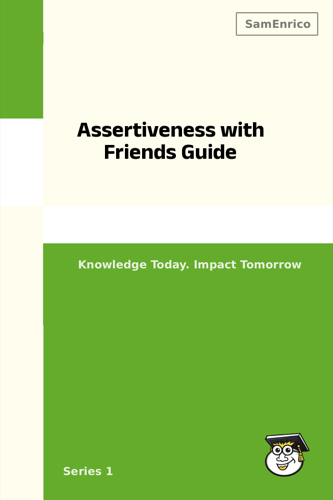
Assertiveness with Friends Guide eBook
Ask for space and say no to favors without losing
by Jay Ninfa
Ask for space and say no to favors without losing friendships using this guide.
Formats
Free sample
Chapter 1: The Debt Collector...--–- The phone buzzed on your nightstand at 10:47 PM. You saw the name. Your stomach dropped. Not because you don’t love this person—you do. But because you are already running on fumes.
You have nothing left to give. And yet, when you answer, you hear yourself say, “Of course. No problem. I’ll handle it.”You hang up. You lie in the dark.
And the resentment begins.This book is not about how to be rude. It is not about how to burn bridges or become the kind of person who keeps score. This book is about one specific, agonizing problem that most assertiveness guides dance around but never solve: how to ask for space and say no to a friend’s favor without losing the friendship.If you picked up this book, you have likely said “yes” hundreds of times when you meant “no.” You have nodded along to a friend’s venting session while your own battery drained to zero. You have agreed to pet-sit, move furniture, lend money, or “just listen for a few minutes” that turned into three hours. And then, after the friend left or hung up, you sat alone and felt something you would never say out loud: Why do they ask so much of me?
Why don’t they see that I’m drowning?Here is the brutal truth that no one tells you: Constant “yes” people are not good friends. They are liars who trade honesty for temporary approval. That sounds harsh. Let me explain.When you say yes but mean no, you are not protecting the friendship. You are planting a time bomb.
Every silent yes is a loan you make to your friend at an invisible interest rate—interest you will collect later as resentment, withdrawal, passive-aggressive comments, or an eventual explosion. Your friend never asked for that loan. They never signed that contract. But you are angry at them anyway. That is the Debt Collector Effect, and it is the single greatest destroyer of friendships in existence.The Friendship Fallacy: Why “Nice” People Often Make the Worst Friends We have been raised on a dangerous lie: that good friends are always available, always agreeable, and always say yes.
This is the Friendship Fallacy. It confuses being “easygoing” with being “good.” It equates constant presence with loyalty. And it has created an entire generation of people who are exhausted, resentful, and secretly furious at the very people they claim to love.Think about the friends you truly admire. Are they the ones who say yes to everything? Or are they the ones who have a clear sense of who they are, what they need, and when they need to step back?
Most people, when asked, will say they respect the friend who can say “I need a night to myself” more than the friend who always shows up but seems distracted, tired, or vaguely annoyed.That is the paradox of the People-Pleaser. You say yes to be liked. But the more you say yes when you mean no, the less likeable you become—because resentment leaks. It always leaks. Your friend may not know why you seem distant, but they feel it.
The friendship becomes a minefield of unspoken debts, and neither of you knows why.This chapter is going to show you exactly how the People-Pleaser’s Trap works, why your nervous system fights you every time you try to say no, and how to begin dismantling the automatic “yes” response that has been running your friendships for years.The Physiology of “Yes”: Why Your Body Betrays You Let us start with the most important fact in this entire book: The anxiety you feel when saying “no” is not a character flaw. It is a survival mechanism.Your nervous system has one job: keep you alive. Tens of thousands of years ago, being rejected by your tribe meant death. No shelter, no food sharing, no protection from predators. So your brain evolved a powerful alarm system: social disapproval equals danger.When you are about to say “no” to a friend, your amygdala (the brain’s fear center) activates before you even open your mouth.
Your heart rate increases. Cortisol floods your system. Your muscles tense. You may feel a hot flush in your chest or a hollow pit in your stomach. This is not anxiety disorder.
This is your ancient brain screaming, “Do not say no! You will be cast out! You will die alone!”Of course, you will not die alone. Your friend will not exile you to the wilderness. But your nervous system does not know the difference between a saber-toothed tiger and a text message that says, “Hey, can you watch my dog this weekend?” To your amygdala, they are the same threat.This is why people-pleasing is so hard to stop.
It is not a bad habit like nail-biting. It is a deeply ingrained survival strategy. And you cannot think your way out of it with logic alone. You have to retrain your nervous system.The good news: Neuroplasticity is real. You can rewire your response.
But the first step is simply recognizing that the panic you feel is not a sign that you are making a mistake. It is a sign that your ancient brain is misfiring. The panic is the problem, not the evidence.The Debt Collector Effect: How Silent Yeses Destroy Friendships Let me tell you about Sarah. (All names and identifying details changed, but the story is real.)Sarah had a childhood friend named Jen. They had known each other for fifteen years.
Jen was going through a difficult divorce and leaned heavily on Sarah. Sarah wanted to be supportive. So she said yes to everything: late-night phone calls, last-minute babysitting, emergency grocery runs, listening to the same stories about the ex-husband’s lawyer for the thirtieth time.Sarah never said no. She never said, “I can’t tonight.” She never said, “I need a break.” She told herself she was being a good friend.Eight months into Jen’s divorce, Sarah exploded. Jen asked if Sarah could help her move a piece of furniture on a Tuesday afternoon.
Sarah had a deadline at work, but instead of saying no, she said yes. Then she showed up late, rushed, and irritable. Jen asked, “Is everything okay?” And Sarah snapped: “I am so tired of you needing things from me. I have my own life. I can’t be your therapist forever.”Jen was blindsided.
She had no idea Sarah was keeping score. She thought their friendship was fine. Sarah had never said a single word about being overwhelmed.That fight ended a fifteen-year friendship. Not because Jen was a bad friend. Because Sarah was a silent banker who had been issuing invisible loans for months and then demanded repayment without warning.This is the Debt Collector Effect.
Every time you say yes when you mean no, you are writing an IOU in your own mental ledger. Your friend does not know the IOU exists. They did not ask for it. They cannot repay it. But you will demand payment anyway—in the form of resentment…
This is the end of the free sample. Get the eBook to keep going. Buy now
About this book
Details
- Author
- Jay Ninfa
- Publisher
- SamEnrico
- Language
- English
- Genre
- Non-Fiction, Self-Help, Friendship Skills
- Released
- 2026-06-07
- Pages (approx.)
- 141
- Available as
- eBook, Audiobook

Read better in the ZLOADR app
Your eBooks on your phone or tablet. Sign in with your SamEnrico account and start reading.
More by Jay Ninfa
 HIIT During Pregnancy GuideJay Ninfa$11.99
 Sleep Meditation GroupJay Ninfa$11.99
 Concertmaster Leadership LessonsJay Ninfa$11.99
 The OCD Symmetry and Ordering GuideJay Ninfa$11.99
 The Hollow PactJay Ninfa$11.99
 Grass SeederJay Ninfa$11.99
 Win Back Campaigns GuideJay Ninfa$12.99
 Dating App Free to PaidJay Ninfa$12.99
 How to Become a Germination WorkerJay Ninfa$11.99
 The Breeder's Guide to Harlequin RabbitsJay Ninfa$11.99
You may also like
 Hong Kong Handover 1997Dunn Johnnie$11.99
 Zumba For Postnatal Recovery CourseNeal Christian$11.99
 Zumba for BeginnersLadner Nikia$11.99
 YouTube Comment Mining GuideHumes Pandora$12.99
 Worry Box MeditationCarlin Rudy$11.99
 Workplace Stress MeditationNguyen Lynn$11.99
 Workplace Stress and Sleep RepairHawley Ivory$11.99
 Workplace Perfectionism CureDelaney Jeffry$11.99
 Workplace Injustice Anger GuideWallen Isabelle$11.99
 Work Addiction and Burnout LinkGreenwood Ester$11.99
 Women in Yoga and WellnessBeattie Galina$11.99
 Women in Stand Up ComedyChun Evangeline$11.99