
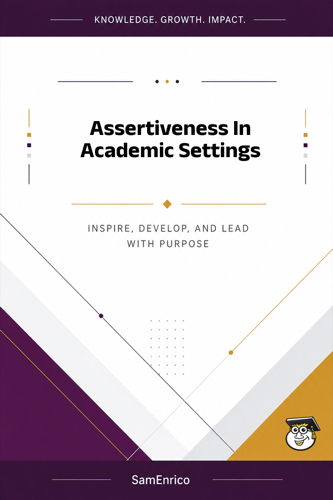
Non-FictionSelf-HelpAcademicStudents
Assertiveness In Academic Settings eBook
Advocate for grades, extensions, and research need
by Muncy Dayna
Advocate for grades, extensions, and research needs with professors respectfully.
Formats
Free sample
Chapter 1: The Silence Tax--–- Every semester, thousands of students sit in office hours, in lecture halls, and at their desks, staring at a grade they believe is wrong, a deadline they cannot meet, or a research opportunity they desperately need. And every semester, the vast majority of them say nothing. They swallow the unfair grade, submit the rushed paper, and watch a less qualified peer accept the lab position they were too afraid to ask for. This is not a failure of courage. It is a failure of understanding—a fundamental miscalculation about how power works in academic settings and what professors actually expect from the students they respect.If you have ever walked away from a conversation you wished you had handled differently, or stayed silent when you knew you deserved better, you have paid the Silence Tax.
The cost is not merely emotional. It is concrete: lower grades than you earned, slower progress toward your degree, fewer letters of recommendation, and a growing sense that academia is a game you are playing by rules you do not fully understand.This chapter diagnoses why otherwise capable, intelligent, hardworking students consistently fail to advocate for themselves. The answer is not that you lack assertiveness as a personality trait. The answer is that you have been trained—by years of schooling, by cultural messages about respect, and by the very structure of higher education—to mistake compliance for virtue. Breaking that pattern requires understanding the hidden architecture of student silence.
Only then can you begin to dismantle it.The Power Differential: More Than Just a Grade Let us begin with an uncomfortable truth that most books on student success dance around but rarely state plainly: your professor holds power over you that is fundamentally asymmetrical. This is not a matter of opinion or individual personality. It is a structural feature of higher education.Your professor controls your grades, which affect your GPA, which affects your scholarships, your graduate school applications, and your first job prospects. Your professor writes your letters of recommendation, which can open or close doors to opportunities you cannot even see yet. Your professor decides whether to fund your research, invite you into their lab, introduce you to collaborators, or offer you the kind of mentorship that transforms a student into a scholar.
This is not an equal relationship. It is not supposed to be.The problem is not the existence of this power differential. The problem is that most students do not understand how it actually operates. They assume, often correctly, that the professor could punish them for speaking up—by grading more harshly, by refusing future opportunities, by labeling them as "difficult" in whispered conversations with colleagues. But they also assume, often incorrectly, that professors actively want students to remain silent.
They do not.Here is what the research on academic power dynamics reveals: professors report feeling frustrated by student silence. They want students to ask questions, to seek clarification, to request extensions when genuinely needed, to challenge grades when evidence supports it. The vast majority of professors see these behaviors as signs of engagement, not disrespect. The fear of retaliation is overwhelmingly disproportionate to the actual risk. But knowing this intellectually does not erase the fear, because the fear is not rational.
It is structural and conditioned.The Psychological Contract: What You Think Professors Expect Every relationship operates under an implicit psychological contract—an unspoken set of expectations about what each party owes the other. In the student-professor relationship, students typically believe the contract looks something like this: I owe you compliance, deference, and silence. You owe me a fair grade, provided I follow the rules perfectly.This contract is a fiction, but it is a powerful one. It is reinforced by years of K-12 education where asking for exceptions was often punished or dismissed. It is reinforced by syllabi that list penalties for late work in bold red font but say nothing about how to request an extension.
It is reinforced by horror stories shared in dorm rooms and group chats: "My friend asked for a regrade and the professor lowered her score." (What the story leaves out is that the friend submitted no evidence and argued emotionally rather than factually.)The psychological contract of compliance leads students to make three catastrophic errors in judgment. First, they assume that any request for change is inherently disrespectful. Second, they assume that professors will interpret silence as respect when in fact professors often interpret silence as disengagement. Third, they assume that the cost of speaking up is higher than the cost of staying silent. In many cases, the opposite is true.A student who never asks for help, never challenges a grade, and never requests an extension may appear "easy" or "low-maintenance." But they also appear invisible.
Professors remember students who advocate for themselves thoughtfully. They write stronger letters for students who have shown the ability to negotiate professionally. They offer research positions to students who have demonstrated they can articulate their needs and collaborate on solutions. The compliant student gets a good grade. The advocating student gets a career.The Compliance Trap: Why High Achievers Suffer Most Perhaps the most counterintuitive finding in the literature on student assertiveness is this: high-achieving students are more likely to stay silent than their lower-achieving peers.
This is the compliance trap, and it operates like a psychological vise.High-achieving students have built their academic identities on rule-following. They arrived on time, submitted work early, studied the rubric, and received the rewards: A's, praise, scholarships, acceptance letters. Deference has worked for them. Why would they abandon a winning strategy?The answer is that what works in high school and introductory courses does not work in advanced seminars, research labs, and professional settings. In those environments, the rules are ambiguous, the rubrics are subjective, and the professor is looking for evidence of independent thinking—not blind obedience.
But high-achieving students have internalized deference so deeply that they experience any request for accommodation as a moral failure. They believe that a "good student" would have managed their time better, understood the material perfectly, or simply accepted the grade without complaint.This internalized perfectionism is reinforced by what psychologists call upward social comparison. Students look around and see peers who appear to be handling everything effortlessly. They do not see the extension requests those peers submitted, the office hours they attended, or the grade challenges they won. They see only the polished surface and conclude that their own struggles are uniquely shameful.The compliance trap has a second, more insidious dimension: high-achieving students often believe that speaking up will reveal them as impostors.
If they ask for help, they fear, the professor will discover that they do not actually belong. This impostor phenomenon is rampant in competitive academic environments, and it directly suppresses assertive behavior. The student who fears being exposed as a fraud would rather accept a lower grade than risk asking a question that might confirm their worst fears about themselves.Entitlement vs. Advocacy: The Critical Distinction Before we go any further, we must draw a line that will run through every chapter of this book. There is a profound difference…
This is the end of the free sample. Get the eBook to keep going. Buy now
About this book
Details
- Author
- Muncy Dayna
- Publisher
- SamEnrico
- Language
- English
- Genre
- Non-Fiction, Self-Help, Academic, Students
- Released
- 2026-06-10
- Pages (approx.)
- 137
- Available as
- eBook, Audiobook

Read better in the ZLOADR app
Your eBooks on your phone or tablet. Sign in with your SamEnrico account and start reading.
More by Muncy Dayna
 Recovery After Corporate BurnoutMuncy Dayna$11.99
 Flatmate Anger Resolution GuideMuncy Dayna$11.99
 Pre Talk Humor InoculationMuncy Dayna$11.99
 The Geo Arbitrage Home Base SelectionMuncy Dayna$11.99
 The Siege of Leiden: A City's Defiance That Sparked a RevolutionMuncy Dayna$11.99
 LatAm Waste Recycling GuideMuncy Dayna$12.99
 Executive Summary Peer Review GuideMuncy Dayna$12.99
 Understanding Lymphedema Hereditary Type 1Muncy Dayna$17.99
 HousemanMuncy Dayna$11.99
 How to Become a Nuclear-fuels Reclamation EngineerMuncy Dayna$11.99
You may also like
 Hong Kong Handover 1997Dunn Johnnie$11.99
 Zumba For Postnatal Recovery CourseNeal Christian$11.99
 Zumba for BeginnersLadner Nikia$11.99
 YouTube Comment Mining GuideHumes Pandora$12.99
 Worry Box MeditationCarlin Rudy$11.99
 Workplace Stress MeditationNguyen Lynn$11.99
 Workplace Stress and Sleep RepairHawley Ivory$11.99
 Workplace Perfectionism CureDelaney Jeffry$11.99
 Workplace Injustice Anger GuideWallen Isabelle$11.99
 Work Addiction and Burnout LinkGreenwood Ester$11.99
 Women in Yoga and WellnessBeattie Galina$11.99
 Women in Stand Up ComedyChun Evangeline$11.99