
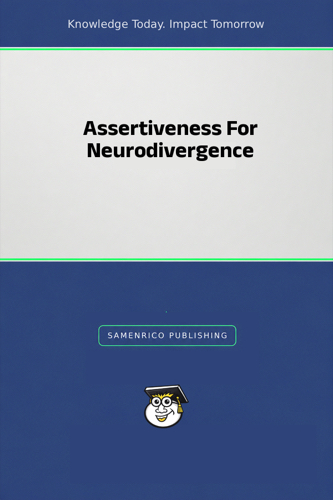
Non-FictionSelf-HelpNeurodiversity
Assertiveness For Neurodivergence eBook
Advocate for accommodations and communicate needs
by Clapp Piedad
Advocate for accommodations and communicate needs directly.
Formats
Free sample
Chapter 1: The Invisible Operating System--–- Most assertiveness advice is written for a brain you do not have. That is not an insult; it is a structural fact. When you pick up a typical book on standing up for yourself, communicating with confidence, or setting boundaries, you are reading instructions designed for someone whose social hardware processes hierarchy as intuitive, eye contact as automatic, and indirect hints as perfectly clear. If your brain is wired differently—if you are autistic, have ADHD, live with dyslexia, or fall anywhere on the neurodivergent spectrum—those instructions do not just fail to help. They actively harm.
They teach you to mask harder, to perform confidence you do not feel, and to blame yourself when the performance inevitably cracks.This book begins with a different premise: self-advocacy is not a personality trait. It is a skill. And every skill requires a toolkit matched to the user. You would not teach someone with limited hand mobility to play the piano using the same finger exercises as a concert pianist. You would adapt the instrument, the technique, or the expectation.
The same logic applies here. Neurodivergent assertiveness requires a toolkit that rejects the neurotypical standard as the default, replaces improvisation with pre-scripting, and treats sensory needs as operational requirements rather than personal preferences.This chapter diagnoses the core problem: the operating system mismatch between how most institutions expect communication to happen and how your brain actually processes information. Understanding this mismatch is not an excuse to avoid advocating for yourself. It is the foundation that makes effective advocacy possible. You cannot build a house on a map of the wrong continent.The Myth of the Universal Social Script Every human culture has unwritten rules about how people should talk to one another.
These rules govern turn-taking, volume, eye contact, personal space, and the acceptable ratio of directness to politeness. Most people learn these rules implicitly, the way they learn their native language—by immersion, not by instruction. They do not remember being taught that looking away during a conversation signals dishonesty or that a pause before answering means you are thinking carefully. They simply absorbed these patterns and now experience them as natural, obvious, and universal.But they are not universal. They are cultural and neurological.
What feels like a natural social rhythm to a neurotypical person raised in a Western corporate environment is a specific configuration of expectations, not a law of nature. When a manager says, "Just be direct with me," they often mean, "Be direct within the narrow bandwidth of directness that I already find comfortable." They do not mean, "Tell me exactly what you think without any social lubricant, including the parts where you point out that my request is inefficient or my deadline is arbitrary."The neurodivergent person who takes that invitation literally—who says, "Your deadline is arbitrary and I will need twice as long"—is then labeled aggressive, difficult, or lacking social skills. The person who says nothing, masks their frustration, and misses the deadline is labeled unreliable. The person who carefully scripts a middle-ground response is exhausted before lunch. There is no winning move within the standard playbook because the standard playbook was not written for you.This chapter uses the term neurotypical operating system to describe the default social software that most institutions, schools, and workplaces assume everyone is running.
That operating system has specific features. It prioritizes performative communication over informational communication. It reads indirect hints as polite and direct statements as rude. It equates eye contact with honesty, a steady tone with calm, and visible emotional expression with sincerity. And it penalizes deviations not with explicit rules but with vague feedback like "you need to work on your communication style."The problem is not that the neurotypical operating system is malicious.
The problem is that it is invisible to the people who run it. They do not see it as an operating system. They see it as reality.Performative vs. Informational Communication To understand why standard assertiveness advice fails, you need to distinguish between two fundamentally different communication modes.Performative communication prioritizes social harmony, saving face, and maintaining relationships over the literal accuracy of the exchange. In this mode, what matters is not whether every statement is factually correct but whether the conversation preserves the participants' sense of dignity and belonging.
A performative speaker will use softening language ("I might be wrong, but…"), indirect requests ("It would be great if someone could…"), and vague commitments ("Let's touch base offline"). A performative listener is expected to decode the real meaning from tone, context, and shared history. This mode is efficient for people who share a deep contextual background. It is a nightmare for anyone who processes language literally.Informational communication prioritizes accuracy, efficiency, and truth-telling over social lubrication. In this mode, what matters is whether the information exchanged is correct, complete, and actionable.
An informational speaker will state facts directly ("This deadline is not feasible"), ask clarifying questions ("What do you mean by 'ASAP'?"), and expect commitments to be explicit ("Will you send that by Tuesday at 3 PM?"). An informational listener assumes that words mean what they say and that if something is not stated, it is not agreed upon. This mode is efficient for technical work, crisis response, and any setting where misunderstanding has real costs. It is perceived as rude, aggressive, or overly literal by people running the performative operating system.Most neurodivergent people default to informational communication. This is not a deficiency; it is a different priority system.
When you are autistic, your brain processes language for meaning first and social valence second—if at all. When you have ADHD, your working memory cannot hold both the factual content of a conversation and the elaborate dance of indirect hints, so you drop the hints. When you are dyslexic, you have learned that precision prevents the catastrophic misunderstandings that have derailed you before. Informational communication is not a bug. It is a feature that evolved for survival in a world that punishes mistakes.But in a performative culture, informational communication reads as aggression.
The performative person hears a direct statement and feels attacked because, in their operating system, directness is reserved for conflict. They then respond with defensive politeness, which the informational person hears as a non-answer, which triggers more direct questioning, which escalates the perceived hostility. Neither person is wrong. Both are trapped by incompatible software.This book does not ask you to abandon your informational mode. It teaches you to translate it strategically—not to fake performative communication, but to build a bridge that lets your informational clarity be heard as competence rather than combat.The 40% Rule: Why You Are Exhausted There is a concept that circulates in neurodivergent communities, supported by emerging research and overwhelming lived experience, known informally as the 40% rule.
It states that neurodivergent people expend roughly 40 percent more cognitive and emotional energy than their neurotypical peers to achieve the same visible outcome in a standard environment. This figure is not a precise clinical measurement but a useful approximation of a very real phenomenon. Where does that 40 percent go? Into three invisible labor categories.Translation labor is the…
This is the end of the free sample. Get the eBook to keep going. Buy now
About this book
Details
- Author
- Clapp Piedad
- Publisher
- SamEnrico
- Language
- English
- Genre
- Non-Fiction, Self-Help, Neurodiversity
- Released
- 2026-06-08
- Pages (approx.)
- 153
- Available as
- eBook, Audiobook

Read better in the ZLOADR app
Your eBooks on your phone or tablet. Sign in with your SamEnrico account and start reading.
More by Clapp Piedad
 Couples Anger ResolutionClapp Piedad$11.99
 DBT For Anger RegulationClapp Piedad$11.99
 Chase Elliott Young GunClapp Piedad$11.99
 The Stress Resilient PartnershipClapp Piedad$11.99
 Herbert Hoover GuideClapp Piedad$11.99
 Community Therapy Worker HandbookClapp Piedad$11.99
 Cialdini Research UpdateClapp Piedad$11.99
 The Forgotten Battle of the Chindits: Jungle War in Burma (1944)Clapp Piedad$11.99
 The Shanghai Opium Heist: The Case That Sank a Cruise Liner (1927)Clapp Piedad$11.99
 Understanding Central Pontine MyelinolysisClapp Piedad$11.99
 How to Produce Shoes and AccessoriesClapp Piedad$11.99
 A Collector's Handbook to the Borgward Isabella TsClapp Piedad$11.99
You may also like
 Hong Kong Handover 1997Dunn Johnnie$11.99
 Zumba For Postnatal Recovery CourseNeal Christian$11.99
 Zumba for BeginnersLadner Nikia$11.99
 YouTube Comment Mining GuideHumes Pandora$12.99
 Worry Box MeditationCarlin Rudy$11.99
 Workplace Stress MeditationNguyen Lynn$11.99
 Workplace Stress and Sleep RepairHawley Ivory$11.99
 Workplace Perfectionism CureDelaney Jeffry$11.99
 Workplace Injustice Anger GuideWallen Isabelle$11.99
 Work Addiction and Burnout LinkGreenwood Ester$11.99
 Women in Yoga and WellnessBeattie Galina$11.99
 Women in Stand Up ComedyChun Evangeline$11.99