
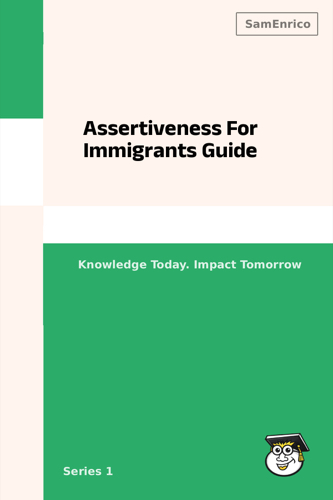
Non-FictionSelf-HelpImmigrantCultural
Assertiveness For Immigrants Guide eBook
Navigate language barriers and cultural norms whil
Navigate language barriers and cultural norms while advocating for needs.
Formats
Free sample
Chapter 1: The Betrayal of Silence--–- The first time I truly understood the cost of silence, I was sitting in a windowless conference room on the thirty-seventh floor of a Manhattan skyscraper, watching a promotion I had earned with eighteen-hour days and seven years of loyal service slide off the table and into the hands of a man who had been with the company for eleven months.He spoke faster than me. He interrupted without apology. He laughed at jokes I did not understand. And when the manager asked for volunteers to lead the international account—the very account I had been quietly managing for two years because no one else wanted to learn the time zone math—my colleague raised his hand and said, "I'll take it," before I could form the words in English.I said nothing.I nodded. I smiled.
I told myself that hard work speaks for itself. I told myself that good things come to those who wait. I told myself that speaking up would make me seem aggressive, ungrateful, difficult—the very things I had spent seven years trying not to be.That night, I stood in my kitchen and wept into a bowl of rice and beans that tasted like home and failure in equal measure. And in that moment, I made a promise to myself that I am now making to you: I would learn to speak. Not louder.
Not meaner. But sooner. Clearer. Without apology for the accent that carries the weight of two continents.This book is the record of that learning. And Chapter One is where we begin by naming the enemy that has kept you silent for far too long.The Two Worlds Inside Your Chest Every immigrant lives with a paradox that no one prepares you for.
You left your country of origin because something was missing—opportunity, safety, dignity, love, or simply the chance to breathe without running out of air. You arrived in a new place with hope and terror braided together like rope. And somewhere along the way, you absorbed a message that was never spoken aloud but felt everywhere, in every interaction, like humidity before a storm.The message is this: You are a guest here. Be grateful. Do not complain.
Do not ask for too much. Do not take up too much space.This is what I call the Gratitude Trap, and it is the single greatest obstacle to assertiveness for immigrants across every nationality, every profession, and every stage of settlement. The trap works like this: because you were allowed in—because someone granted you a visa, a green card, a work permit, or simply the mercy of not being deported—you owe a permanent debt of silence. Every request becomes a risk. Every boundary becomes a betrayal.
Every "no" feels like ingratitude.The trap is reinforced by two different cultural programming systems that live inside your chest like rival siblings fighting for control.On one side sits your heritage culture—the norms, values, and unwritten rules of the country where you were born and raised. For most immigrants, this culture is collectivist (the group's needs come before the individual's), hierarchical (age and authority command respect and deference), and indirect (meaning is carried by silence, implication, and relationship, not by explicit words). In a collectivist, hierarchical, indirect culture, assertiveness is not a virtue. It is a threat. It destabilizes the social order.
It signals that you do not know your place.On the other side sits your host culture—the norms of the country where you now live. For most immigrants in English-speaking Western countries, this culture is individualist (your needs matter as much as anyone else's), egalitarian (authority can and should be questioned), and direct (clear, explicit communication is a sign of honesty and respect). In this culture, assertiveness is not just acceptable. It is expected. Silence is not politeness.
Silence is complicity. Silence is invisibility.You are trapped in the middle. Your heritage culture says: Be quiet. Be polite. Defer to authority.
Your host culture says: Speak up. Advocate for yourself. No one will hand you anything. And because you carry both sets of rules inside you at all times, every interaction becomes a negotiation between two incompatible maps of the same territory.No wonder you feel paralyzed.The Four Life Positions: Where Do You Stand?To understand why assertiveness feels so dangerous, we need to look at the foundational beliefs you hold about yourself and about other people. Psychologists call these beliefs life positions, and they operate below the level of conscious thought, shaping every interaction you have.There are four possible life positions.
Only one leads to healthy assertiveness.Position One: "I'm OK, You're OK" – This is the healthiest position. You believe that you have inherent worth and that other people have inherent worth too. You do not need to shrink to make others comfortable, and you do not need to puff yourself up to prove your value. From this position, assertiveness flows naturally: you state your needs clearly because your needs matter, and you listen to others' needs because their needs matter too. There is no contradiction between self-respect and respect for others.Position Two: "I'm Not OK, You're OK" – This is the position of chronic self-doubt and deference.
You believe that you are fundamentally flawed, less capable, less intelligent, less deserving than other people. You look at locals and see competence, confidence, and belonging. You look at yourself and see an accent, a foreign name, a different face, a permanent sense of being out of place. From this position, assertiveness feels impossible because you have nothing to stand on. Every request sounds like begging.
Every boundary sounds like rudeness. Every "no" sounds like a confession of inadequacy.Position Three: "I'm OK, You're Not OK" – This is the position of superiority and contempt. You believe that you have it figured out and everyone else is wrong, lazy, or stupid. This position sometimes appears as a defense mechanism among immigrants who have been hurt too many times—if you dismiss everyone else as incompetent, you never have to risk being hurt by them again. But assertiveness from this position is not assertiveness at all.
It is aggression disguised as confidence. It pushes people away and guarantees that you will be heard but never loved.Position Four: "I'm Not OK, You're Not OK" – This is the position of despair. You believe that you are worthless and that the world is worthless too. Nothing matters. Nothing will change.
If you find yourself in this position—if hope has drained away and you cannot imagine a different future—please put this book down and seek professional support. A therapist, a trusted community leader, or a crisis helpline can help you find solid ground again. This book will be waiting for you when you return.The research is clear: most immigrants, especially in the first five to ten years after arrival, default to Position Two: "I'm Not OK, You're OK." You have internalized the message that your culture, your accent, your manners, your very way of being in the world is inferior to the host culture's. You have learned to apologize for existing. And…
This is the end of the free sample. Get the eBook to keep going. Buy now
About this book
Details
- Author
- Faust Kaylene
- Publisher
- SamEnrico
- Language
- English
- Genre
- Non-Fiction, Self-Help, Immigrant, Cultural
- Released
- 2026-06-07
- Pages (approx.)
- 150
- Available as
- eBook, Audiobook

Read better in the ZLOADR app
Your eBooks on your phone or tablet. Sign in with your SamEnrico account and start reading.
More by Faust Kaylene
 Decidophobia Decision Making CBTFaust Kaylene$11.99
 1031 Exchange Timeline ExtensionsFaust Kaylene$11.99
 Hearing Aid Self Esteem GuideFaust Kaylene$11.99
 The Stress Heart Disease Connection GuideFaust Kaylene$11.99
 The Lioness of Meroë: Amanishakheto and the Kushite Golden AgeFaust Kaylene$11.99
 Understanding Marchiafava–micheli DiseaseFaust Kaylene$17.99
 Mercury MiningFaust Kaylene$11.99
 Bulgaria Renewable Energy GuideFaust Kaylene$12.99
 Strategy Meeting Quick Reference CardFaust Kaylene$12.99
 How to Become a Land-leasing ExaminerFaust Kaylene$11.99
You may also like
 Hong Kong Handover 1997Dunn Johnnie$11.99
 Zumba For Postnatal Recovery CourseNeal Christian$11.99
 Zumba for BeginnersLadner Nikia$11.99
 YouTube Comment Mining GuideHumes Pandora$12.99
 Worry Box MeditationCarlin Rudy$11.99
 Workplace Stress MeditationNguyen Lynn$11.99
 Workplace Stress and Sleep RepairHawley Ivory$11.99
 Workplace Perfectionism CureDelaney Jeffry$11.99
 Workplace Injustice Anger GuideWallen Isabelle$11.99
 Work Addiction and Burnout LinkGreenwood Ester$11.99
 Women in Yoga and WellnessBeattie Galina$11.99
 Women in Stand Up ComedyChun Evangeline$11.99