
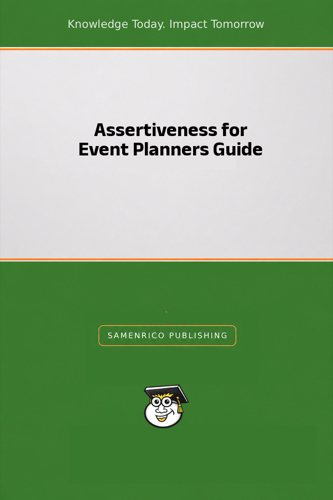
Non-FictionSelf-HelpEvent Management
Assertiveness for Event Planners Guide eBook
Manages demanding clients and pushy vendors.
Manages demanding clients and pushy vendors.
Formats
Free sample
Chapter 1: The Permission Problem--When Kaitlyn, a 15-year veteran of corporate event planning, took the call from her biggest client ten days before a 2,000-person product launch, she did what she had always done. She said yes.The client wanted a last-minute addition: a custom-built, two-story "brand immersion center" that would require structural engineering, special permitting, and an extra $47,000 in labor. The timeline was impossible. The budget had already been exhausted. And yet, when the client said, "Kaitlyn, I know this is a lot, but we really need you to make this happen," she heard herself reply, "Of course.
I'll figure it out."She did figure it out. She pulled her team off their weekends. She paid overtime rates to three vendors. She ate the $47,000 because she had never discussed change orders with this client. The event was spectacular.
The client was thrilled. And Kaitlyn lost $12,000 on the job after accounting for all the un-billed labor.Six months later, that same client asked for an even larger last-minute addition on the next event. Kaitlyn was terrified, exhausted, and secretly furious. But she said yes again.This is not a story about a bad planner. This is a story about a good planner who never learned that "yes" is the most dangerous word in event planning.The Hidden Cost of Yes Let us be clear about something that most event planning training gets exactly backwards: saying yes to every request does not build trust.
It erodes it.When you say yes to a client's unreasonable last-minute demand, you are not being helpful. You are not being a team player. You are not building goodwill. You are training that client to make even bigger demands, and you are teaching them, whether they realize it or not, that your expertise is not worth respecting.This is not speculation. It is psychology.The Rescuer Complex: Why Planners Cannot Stop Saying Yes Event planners are disproportionately likely to suffer from what I call the Rescuer Complex.
This is not a clinical diagnosis but rather a pattern of behavior that emerges from the intersection of three forces: personality, industry culture, and financial fear.First, the personality piece. People who are drawn to event planning tend to be high in agreeableness and conscientiousness. You like making people happy. You take pride in solving problems. You derive genuine satisfaction from pulling off the impossible.
These are not flaws. They are strengths. But every strength, when unmanaged, becomes a vulnerability.Second, the industry culture. Event planning has historically been positioned as a "service profession" rather than a strategic discipline. Clients hire you to "handle things." Vendors expect you to "be flexible." The unspoken rule is that the planner who complains is the planner who does not get rehired.
This culture rewards silence and punishes boundaries.Third, the financial fear. Most planners, especially independent ones, live in constant low-grade anxiety about where the next client is coming from. This scarcity mindset makes every "no" feel like a gamble. What if they fire me? What if they leave a bad review?
What if they tell their colleagues that I was difficult?The Rescuer Complex is the perfect storm of these three forces. You want to help. The culture expects you to sacrifice. And fear tells you that you cannot afford to say no.The result is not heroism. The result is servility disguised as service.The Intimidation Cycle: How Your Fear Gives Them Power To understand why saying yes is so dangerous, you need to understand a mechanism I call the Intimidation Cycle, adapted from the work of negotiation theorist Robert Ringer.The cycle works like this:Stage One: Fear.
The planner feels a threat. The client might leave. The vendor might walk off the job. The review might be bad. The planner experiences this fear viscerally.Stage Two: Surrender.
The planner says yes to an unreasonable request to make the fear go away. The immediate relief is powerful. The crisis is averted. The planner feels, for a moment, safe.Stage Three: Contempt. Here is where the psychology gets dark.
The client or vendor does not walk away feeling grateful. They walk away feeling, often subconsciously, that the planner's expertise is not valuable. After all, if the planner could say yes to an unreasonable request without any pushback, the original price must have been inflated. The planner must not have known what they were doing. The planner cannot be trusted to protect the event's integrity.Stage Four: Escalation.
Because the client or vendor now has less respect for the planner, they feel entitled to make an even larger demand. And because the planner has already shown that fear works, the new demand comes with even more pressure.Stage Five: Increased Fear. The planner now faces a larger demand, a more aggressive tone, and less time to respond. Their fear spikes higher than before. And the cycle begins again.This is not a theory.
This is what happened to Kaitlyn. She said yes to the first unreasonable demand. The client felt momentarily grateful, then subconsciously lost respect. The second demand was larger. Kaitlyn's fear was greater.
And the cycle escalated until she was losing money on a client who should have been her most profitable.The cycle breaks only when the planner breaks it. And the only way to break it is to stop saying yes unconditionally.The Difference Between Unconditional and Conditional Yes Here is the distinction that separates struggling planners from successful ones.An unconditional yes is what Kaitlyn gave. It sounds like: "Of course. I'll figure it out." It contains no conditions, no trade-offs, no conversation about resources. It is a pure gift of the planner's time, money, and sanity.
And it is poison.A conditional yes sounds like: "That is a great idea. We can absolutely do that. Let me prepare a change order with the additional cost and timeline, and once we have that signed, we will make it happen."Notice what the conditional yes does not do. It does not say no. It does not shut down the client's idea.
It does not create conflict. What it does is introduce reality. It says: yes, and here is what yes costs. Yes, and here is what yes requires. Yes, and here is how we do this without destroying the event or the planner.The conditional yes is the fundamental building block of assertive event planning.
Every technique in this book is a variation on this single principle: you can say yes to almost anything, as long as you attach a condition that protects the event's success and your own viability.But here is what most planners get wrong. They think the conditional yes is about money. It is not. It is about respect.When you attach a condition to a yes, you are telling the client or vendor that your time, your expertise, and your resources have value. You are telling them that you are paying attention.
You are telling them that you will not be taken advantage of. And you are telling them, without saying a word, that you are a professional who deserves to be treated like one.The most surprising finding from my research with hundreds…
This is the end of the free sample. Get the eBook to keep going. Buy now
About this book
Details
- Author
- Farrington Cherie
- Publisher
- SamEnrico
- Language
- English
- Genre
- Non-Fiction, Self-Help, Event Management
- Released
- 2026-06-06
- Pages (approx.)
- 148
- Available as
- eBook, Audiobook

Read better in the ZLOADR app
Your eBooks on your phone or tablet. Sign in with your SamEnrico account and start reading.
More by Farrington Cherie
 Self Talk For MindfulnessFarrington Cherie$11.99
 Titanic Forensic InvestigationFarrington Cherie$11.99
 Cooperative Turnaround StrategyFarrington Cherie$11.99
 Walking Meditation for ArtistsFarrington Cherie$11.99
 The Siege of Saigon: When Diplomacy Failed (1968)Farrington Cherie$11.99
 Understanding Opioid-induced HyperalgesiaFarrington Cherie$17.99
 IT Service Desk TechnicianFarrington Cherie$11.99
 Coding Bootcamp Accreditation MythsFarrington Cherie$12.99
 Construction and Contractor PricingFarrington Cherie$12.99
 How to Become a ShacklerFarrington Cherie$11.99
You may also like
 Hong Kong Handover 1997Dunn Johnnie$11.99
 Zumba For Postnatal Recovery CourseNeal Christian$11.99
 Zumba for BeginnersLadner Nikia$11.99
 YouTube Comment Mining GuideHumes Pandora$12.99
 Worry Box MeditationCarlin Rudy$11.99
 Workplace Stress MeditationNguyen Lynn$11.99
 Workplace Stress and Sleep RepairHawley Ivory$11.99
 Workplace Perfectionism CureDelaney Jeffry$11.99
 Workplace Injustice Anger GuideWallen Isabelle$11.99
 Work Addiction and Burnout LinkGreenwood Ester$11.99
 Women in Yoga and WellnessBeattie Galina$11.99
 Women in Stand Up ComedyChun Evangeline$11.99