
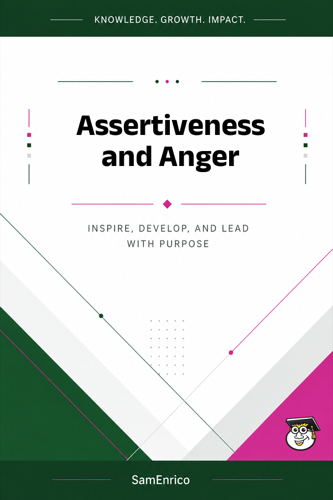
Assertiveness and Anger eBook
Expresses anger constructively rather than passive
Expresses anger constructively rather than passively or explosively.
Formats
Free sample
Chapter 1: The Five Monsters Inside--You have been lied to about your anger.Not by accident. Not through well-meaning but incorrect advice. Systematically, culturally, and repeatedly, you have been taught that anger is a problem to be solved, a weakness to be hidden, or a fire to be extinguished before it burns down everything you love. You have been told to "calm down," "let it go," "pick your battles," and "don't be so sensitive." You have been sold meditation apps, breathing techniques, and the false promise that if you just think positive thoughts, the rage will dissolve like morning fog.It will not.And it should not.Here is the truth that every best-selling book on anger management eventually arrives at but rarely states plainly enough: Anger is not your enemy. It is your internal smoke alarm.
When a smoke alarm shrieks in your kitchen, you do not smash it with a hammer and declare the problem solved. You ask: Where is the fire? When you feel anger rising in your chest, you have been trained to do the equivalent of smashing the alarm—through explosion (yelling, slamming, breaking) or suppression (silence, smiling, swallowing). Both are forms of destruction. Both leave the fire burning.This book will teach you a third way.
But before you can learn to express anger constructively, you must first understand how you currently express it destructively. You must look into the mirror and name the monster that lives there.Because here is the second truth: everyone has one. Everyone has a default pattern—a signature move they make when the heat rises. Some people have two or three. But every single person who struggles with anger falls into one of five dysfunctional patterns.
In clinical literature, these are called maladaptive anger styles. In this book, we will call them what they are: The Five Monsters.You are about to meet them.The Architecture of Dysfunction: Why You Need This Diagnosis Before a doctor prescribes treatment, she makes a diagnosis. She does not hand out antibiotics for a broken bone or chemotherapy for a sprained ankle. Yet most anger management advice is dispensed like a shotgun blast: "Breathe deeply." "Count to ten." "Communicate better." These are not bad suggestions, but they are useless if they do not match your specific monster.The Exploder needs a different intervention than the Avoider. The Passive-Aggressor needs a different script than the Ruminator.
And the Self-Abuser? The Self-Abuser needs something entirely different from all of them—compassion before technique.This chapter will help you diagnose yourself. It will describe each of the Five Monsters in vivid, uncomfortable detail. You will recognize yourself in at least one of them—probably two. That recognition will sting.
Good. That sting is the beginning of change.At the end of this chapter, you will find a self-assessment quiz (expanded in Appendix A) and a decision tree that directs you to the specific chapters in this book that will help your particular monster. You will not need to read every chapter in order, though you are welcome to. You can, if you wish, jump straight to your intervention.But first, you must meet the monsters.Monster #1: The Exploder Signature move: Intensity. Volume.
Speed.The Exploder does not feel anger gradually. They do not notice a 3 or a 4 on the anger scale. They go from zero to eight in the time it takes a normal person to form a sentence. Their anger arrives like a flash flood—sudden, overwhelming, and destructive. They yell.
They slam doors. They throw objects (sometimes at people, sometimes at walls). They say things they regret within seconds but cannot seem to stop the words from leaving their mouth.What the Exploder looks like in real life:Maria, a 34-year-old project manager, has been promoted three times in seven years. She is brilliant, efficient, and respected. She is also terrified of herself.
Last Tuesday, her teenage daughter left a wet towel on the bathroom floor for the fourth time that week. Maria asked her daughter to pick it up. Her daughter rolled her eyes and said, "It's just a towel, Mom." Maria felt something snap. She screamed—actually screamed—"I am so sick of your disrespect!" She grabbed the towel and threw it down the hallway. Her daughter ran to her room crying.
Maria stood in the hallway, heart pounding, and thought: Who am I?Two hours later, she apologized. Her daughter accepted. But Maria knows it will happen again. It always happens again.The Exploder's internal experience:Exploders do not enjoy exploding. This is a common myth—that Exploders are simply "letting off steam" or "being authentic." In truth, most Exploders feel shame immediately after an outburst.
They feel out of control. They feel like a monster. They often make elaborate apologies, buy gifts, or over-function in relationships to compensate for their explosions. But shame does not prevent the next explosion. In fact, shame often fuels it—because the Exploder is also angry at themselves for being angry, creating a vicious cycle of trigger → explosion → shame → trigger.What the Exploder fears most: Vulnerability.
The Exploder learned, usually early in life, that anger is the only emotion that gets results. Sadness was ignored. Fear was punished. Hurt was mocked. But anger?
Anger made people pay attention. So the Exploder became expert at converting every vulnerable feeling into rage. A husband who feels hurt that his wife forgot their anniversary? He explodes about her "always being selfish." A father who feels terrified that his son is failing school? He explodes about the boy being "lazy and unmotivated." The explosion is not the problem—it is a symptom of an emotional system that has no other gear.The Exploder's impact on others: People around Exploders walk on eggshells.
They learn to predict the explosion and avoid the trigger. This creates a false calm—not genuine peace, but the tense quiet of a household that is always waiting for the next storm. Children of Exploders often become hyper-vigilant, anxious, or (ironically) Exploders themselves. Partners of Exploders either become Avoiders (silently withdrawing) or develop their own explosive counter-attacks.If you are an Exploder, your core intervention is: Learning to catch anger at a 3 or 4 (Chapter 3), using the STOP method to create a gap between trigger and response (Chapter 4), and replacing demands with preferences (Chapter 5). You do not need to feel less anger.
You need to slow down the time between the feeling and the action.Monster #2: The Avoider Signature move: Disappearance. Silence. Physical symptoms.The Avoider fears conflict more than anything. Not just loud conflict—any conflict. A disagreement about where to eat dinner.
A gentle request to do the dishes. A partner saying, "I feel hurt when you come home late." To the Avoider, all of these feel like landmines. So they do the only thing that feels safe: they leave. Not always physically. Sometimes they leave emotionally—going silent, changing the subject, or suddenly needing to check their phone.
Sometimes they leave physically—walking out of the room, staying late at work, developing a mysterious headache exactly when a difficult conversation is about to begin.What the Avoider looks like in real life:David, 42, has been married…
This is the end of the free sample. Get the eBook to keep going. Buy now
About this book
Details
- Author
- Pinson Cristobal
- Publisher
- SamEnrico
- Language
- English
- Genre
- Non-Fiction, Self-Help / Anger
- Released
- 2026-06-11
- Pages (approx.)
- 147
- Available as
- eBook, Audiobook

Read better in the ZLOADR app
Your eBooks on your phone or tablet. Sign in with your SamEnrico account and start reading.
More by Pinson Cristobal
 PGT After Loss GuidePinson Cristobal$11.99
 Crooked Teeth Childhood ShamePinson Cristobal$11.99
 Cocaine Baby SyndromePinson Cristobal$11.99
 Study Sleep Memory ConnectionPinson Cristobal$11.99
 Franchising Your Local Brand Across Borders Cultural TrainingPinson Cristobal$11.99
 Small Talk for College StudentsPinson Cristobal$11.99
 Antioxidant ProtocolPinson Cristobal$11.99
 The Library of Alexandria: Beacon of the Ancient WestPinson Cristobal$11.99
 The Battle of Mohi: The Mongols Crush the Last European Kingdom (1241)Pinson Cristobal$11.99
 How to Start a offshore Support Vessel Business (Beginners Guide)Pinson Cristobal$11.99
 How to Produce SpreadersPinson Cristobal$11.99
 Mastering The Art of Bare-knuckle Boxing (London Prize Ring Rules)Pinson Cristobal$11.99
You may also like
 Anticipatory Grief and AngerMassey Cynthia$11.99
 Spouse Death and AngerFredericks Sunni$11.99
 Validating Anger GuideSauer Carlotta$11.99
 Body Scan for Anger ManagementMcmillian Merle$11.99
 Pet Loss and AngerIvory Jackelyn$11.99
 Healing Divorce AngerRosenberg Misti$11.99
 Child Loss and AngerBeatty Lynetta$11.99