
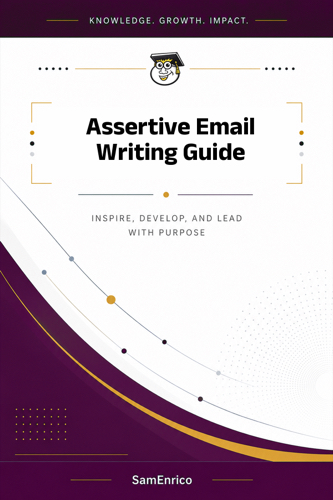
Assertive Email Writing Guide Audiobook
Craft direct professional messages that don't apol
by May Joanna
Craft direct professional messages that don't apologize or overexplain.
Formats
Free sample
Chapter 1: The Apology Audit--–- The email arrives at 10:47 AM. You have already said “sorry” three times before your finger touches the keyboard. You open your sent folder, scroll back seven days, and begin counting. By the time you reach Tuesday afternoon, you have lost track. Every few messages, there it is: “Sorry to bother you.” “Sorry for the delay.” “Sorry, just following up.” “Sorry if this is a dumb question.” “Sorry to pile on.” “Sorry for the double email.” “Sorry, I know you are busy.” The word has become punctuation.
It is the period at the end of sentences that should have ended with confidence. It is the breath you take before asking for something you have every right to request. And it is costing you far more than you realize.This chapter is not about grammar. It is not about politeness versus rudeness. It is about the slow, invisible erosion of your professional authority, one soft word at a time.
Before we can rewrite your email habits, we must first see them clearly. That requires an audit—a forensic examination of the language you currently use without thinking. Most professionals who believe they write assertively are shocked by what they find when they actually look. The “sorry reflex” has become so automatic that it no longer registers as an apology. It feels like warmth.
It feels like teamwork. It feels like being considerate. But feeling and function are not the same thing.The Seven Soft Phrases That Are Sabotaging You Let us name the enemy. After analyzing thousands of workplace emails across industries and seniority levels, seven weak phrases appear with remarkable consistency. They are the telltale signs of the apologetic writer.
Some of these will look familiar. Some may surprise you. All of them can be eliminated without changing the substantive meaning of your message.The first is “I just wanted to check in.” The word “just” minimizes the importance of your communication. It says, “What I am about to say is not very important, and I am aware that I am probably bothering you.” Remove “just” and the sentence becomes “I wanted to check in”—still soft, but better. Replace the entire construction with “What is the status of Project X?” and you have transformed an apology for existing into a legitimate business question.The second is “Sorry to bother you.” This is the classic deferential apology for existing.…
This is the end of the free sample. Get the Audiobook to keep going. Buy now
About this book
Details
- Author
- May Joanna
- Publisher
- SamEnrico
- Language
- English
- Genre
- Non-Fiction, Self-Help, Business Writing
- Released
- 2026-06-11
- Pages (approx.)
- 139
- Available as
- eBook, Audiobook

Listen in the VoxFlicks app
Audiobooks and audio dramas wherever you go. Sign in with your SamEnrico account and press play.
More by May Joanna
 Smoking Relapse FirewallMay Joanna$11.99
 Lewis Hamilton Diversity PathMay Joanna$11.99
 Emotional Numbness RecoveryMay Joanna$11.99
 Unheard VoicesMay Joanna$11.99
 Cold Email PersuasionMay Joanna$11.99
 Music Streaming Cancellation FactorsMay Joanna$11.99
 Mendeleev Populist PoliticsMay Joanna$11.99
 The Lost Tournament: The Secret of the Medici’s Football DynastyMay Joanna$11.99
 The Spy Who Vanished: The Disappearance of Gustavus Vasa FoxMay Joanna$11.99
 Understanding Ataxia-telangiectasiaMay Joanna$11.99
 How to Start a Hobby in Composing MusicMay Joanna$11.99
 How to Produce Food Storage BagsMay Joanna$11.99
You may also like
 Assertive Email WritingHinkle Angella$11.99
 The Assertive Email Writing GuideWord Zenia$11.99
 Self Doubt Email Communication GuideCalabrese Taren$11.99
 Assertive Email Writing HandbookHimes Velva$11.99
 Email Writing for Remote WorkRoyster Mana$11.99
 The Angry Email De escalation GuideMcreynolds Adena$11.99
 Persuasive Email and Message GuideEllsworth Maryjane$11.99
 The Email Clarity for Remote TeamsBeaty Hien$11.99